Introduction: Where the Cart Stopped and God Chose to Stay
In the arid Aravalli foothills of southern Rajasthan, roughly 48 kilometres north-east of Udaipur, lies the small temple town of Nāthdvāra — literally “The Gateway of the Lord.” Unlike most ancient tīrthas whose sanctity reaches back into Vedic antiquity, Nāthdvāra’s story begins in a single dramatic year: 1672 CE, when a bullock cart carrying the most sacred image in Vaiṣṇava Hinduism sank axle-deep into the mud of a place then called Sīhāḍ (or Singhāḍ) and refused to move further. The accompanying priests of the Puṣṭi Mārga recognised the event as divine will: Shrīnāthji — the child Kṛṣṇa who once lifted Mount Govardhana on his little finger — had chosen this spot as his eternal home.
Today, the Shrīnāthji Temple (known as the “Haveli” rather than a “mandir,” following the distinctive Puṣṭi Mārga tradition of treating the deity’s abode as a royal household) is the most important pilgrimage centre for followers of the Vallabha Sampradāya. It attracts millions of devotees annually, predominantly from Gujarat and Rajasthan, and sustains one of the richest living traditions of devotional art, music, and seva (ritual service) in all of Hinduism.
The Deity: Shrīnāthji and the Govardhana Līlā
The Divine Image
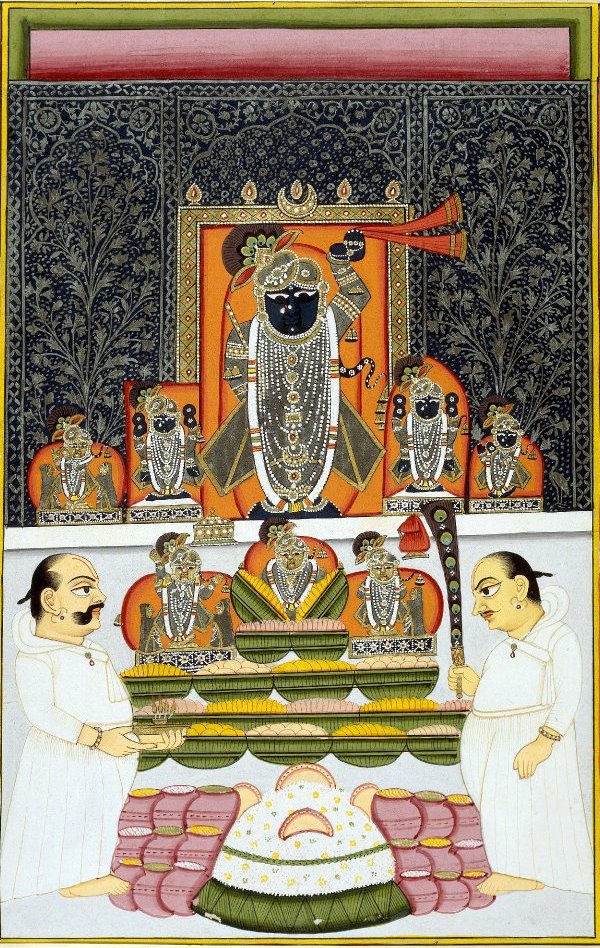
The sacred image of Shrīnāthji is carved in bas-relief from a monolithic slab of black marble (some traditions say black touchstone). It depicts Kṛṣṇa as a seven-year-old child, his left arm raised high to hold aloft Mount Govardhana, while his right hand rests on his hip in a gesture of effortless grace. The icon measures approximately four feet in height. Engraved around the central figure are two cows, one lion, one serpent, two peacocks, and one parrot, with three sages positioned nearby — each element symbolising aspects of Kṛṣṇa’s pastoral life in Vraja (Bhāgavata Purāṇa 10.24-25).
The theological significance of this particular form is profound. The Govardhana Līlā (Bhāgavata Purāṇa 10.24-25) narrates how the young Kṛṣṇa convinced the cowherds of Vraja to worship Mount Govardhana rather than Indra, the king of the gods. Enraged, Indra unleashed a devastating storm. Kṛṣṇa lifted the entire mountain on his little finger, sheltering all the villagers and their cattle beneath it for seven days. This act demonstrated that the Supreme Lord’s protection surpasses all cosmic forces — the foundational teaching of the Puṣṭi Mārga’s theology of divine grace (puṣṭi).
Discovery on Govardhana Hill
According to tradition, the image of Shrīnāthji was not carved by human hands but self-manifested (svayambhū). It is said that in 1409 CE, a cow standing on Govardhana Hill near Mathurā began spontaneously releasing milk onto a particular spot on the hillside. When the local cowherd investigated, the raised left arm of a divine image was found protruding from the earth. The face appeared in 1479 CE, and the full image was gradually revealed over decades.
Shrī Vallabhāchārya (1479-1531), the great Tailaṅga Brahmin philosopher who founded the Puṣṭi Mārga (Path of Grace) based on his philosophy of Śuddha Advaita (Pure Non-Dualism), first encountered the image during his pilgrimages to the Vraja region. He named the deity “Gopāla” and established worship at the site, which he called Gopālpura. His son and successor, Shrī Viṭṭhalnāthji (1515-1586), later gave the deity the name “Shrīnāthji” and formalised the elaborate system of worship that continues to this day.
The Great Migration of 1672: From Mathurā to Nāthdvāra
Aurangzeb’s Threat and the Decision to Flee
By the mid-17th century, the Mughal Emperor Aurangzeb (r. 1658-1707) had embarked on a systematic campaign of temple destruction across northern India. The Shrīnāthji image, then enshrined at a temple on Govardhana Hill near Mathurā, faced imminent danger. In 1669, Aurangzeb issued a general order for the demolition of Hindu temples and the destruction of idols. The Keśavadeva Temple in Mathurā was razed that same year.
The Gosvāmī priests of the Puṣṭi Mārga decided to move the sacred image to safety. In 1672 CE, the icon was carefully placed on a bullock cart and the perilous journey southward began. The caravan travelled along the Yamunā and was held at Agra for nearly six months while the priests waited for a safe route. Eventually, they moved further south through the territories of the Mewar kingdom, whose Rājpūt rulers were sympathetic to Hindu causes.
The Miracle at Sīhāḍ
When the cart bearing Shrīnāthji reached the small village of Sīhāḍ in the Aravalli hills, the wheels sank deep into the mud and no effort could move them. The accompanying priests interpreted this as a divine sign: the Lord himself had chosen this location as his new abode. The Mahārāṇā Rāj Singh I of Mewar (r. 1652-1680), a devoted Hindu ruler who had already given refuge to several displaced deities, immediately offered his patronage and protection. A new temple was constructed at the site under the direction of Gosvāmī Dāmodardāsji, and the village was renamed Nāthdvāra — “Gateway of the Lord.”
The relocation was not merely a physical displacement but a theological event. Puṣṭi Mārga tradition holds that just as Kṛṣṇa once chose to leave Vraja for Dvārakā, so Shrīnāthji chose to leave Govardhana for Nāthdvāra. The deity’s will (icchā) is paramount — the cart did not break; the Lord simply decided to stop.
Vallabhāchārya and the Puṣṭi Mārga
Philosophical Foundations
Shrī Vallabhāchārya’s philosophy of Śuddha Advaita (Pure Non-Dualism) differs from Śaṅkara’s Advaita Vedānta in a crucial respect: while Śaṅkara teaches that the world is māyā (illusory), Vallabhāchārya holds that the world is real because it is Brahman’s own self-expression. The Supreme Being (Puruṣottama) is identified with Kṛṣṇa, and the entire creation is his līlā (divine play). Liberation comes not through jñāna (knowledge) or karma (action) alone, but through God’s grace (puṣṭi) — hence the name Puṣṭi Mārga, the “Path of Grace.”
This theological framework shapes every aspect of worship at Nāthdvāra. The deity is not an idol to be propitiated but a living child-god to be served with love (sevā), adorned with beauty (śṛṅgāra), fed with exquisite meals (bhoga), and entertained with music and art. The relationship between devotee and deity is modelled on the love of the gopīs (cowherd women) of Vraja for Kṛṣṇa — intimate, unconditional, and joyous.
The Vallabha Lineage
After Vallabhāchārya, the tradition was institutionalised by his son Viṭṭhalnāthji, who established the system of Aṣṭachāpa (eight seals) — the eight poet-saints whose compositions form the liturgical core of Puṣṭi Mārga worship. These include the great Sūrdāsa, Kumbhandāsa, Paramānandadāsa, Kṛṣṇadāsa, and others. The lineage of Gosvāmī priests who administer the Nāthdvāra temple today are direct descendants of Vallabhāchārya, maintaining an unbroken family succession of over five hundred years.
The Eight Daily Darśans (Jhāṅkīs)
The most distinctive feature of worship at the Shrīnāthji Temple is the system of eight daily darśans (viewings), called jhāṅkīs (literally “glimpses”). The inner sanctum opens and closes eight times each day, each darśan corresponding to an episode in the daily life of the child Kṛṣṇa. Between darśans, the doors are closed and elaborate preparations are made for the next viewing. The eight jhāṅkīs are:
1. Maṅgalā (Early Morning, ~5:30 AM)
The first and most auspicious darśan of the day. Shrīnāthji is awakened from sleep, and devotees receive the blessing of seeing the Lord at the very start of the day. The word maṅgala underscores the auspiciousness of beginning the day with a vision of God. The deity is dressed simply, often in white.
2. Śṛṅgāra (Morning Adornment, ~7:00-7:30 AM)
About an hour after Maṅgalā, Shrīnāthji is elaborately dressed from head to toe, adorned with jewellery, and garlanded with fresh flowers. This darśan emphasises the aesthetic dimension of Puṣṭi Mārga worship: the Lord is beautified so that devotees may experience divine beauty (saundarya) as a form of grace.
3. Gvāla (Cowherds’ Darśan, ~9:00-9:15 AM)
This darśan takes place at the hour when the young Kṛṣṇa would traditionally take his cows to pasture. The mukhiyā (chief) of the temple’s cowshed (gauśālā) visits Shrīnāthji at this time to inform him that all his cows are well and healthy — a touching re-enactment of the pastoral Vraja life.
4. Rājabhoga (Royal Meal, ~11:30 AM-12:15 PM)
The main meal of the day is offered to Shrīnāthji. In this darśan, the deity is seen in all his regal splendour, surrounded by an elaborate spread of food offerings. This is often considered the most magnificent jhāṅkī of the day. After Rājabhoga, the Lord “retires” for an afternoon rest of approximately three hours.
5. Utthāpana (Afternoon Awakening, ~3:15-3:45 PM)
Shrīnāthji is awakened from his afternoon rest. The deity is presented with light refreshments, and devotees receive the darśan of the freshly-risen Lord.
6. Bhoga (Evening Snack, ~4:15-4:45 PM)
An evening offering of food is made. This is typically a lighter meal, and the darśan is shorter than Rājabhoga.
7. Sandhyā Āratī (Evening Worship, ~5:15-5:45 PM)
The evening āratī (lamp worship) is performed as twilight approaches. This is a deeply atmospheric darśan, with the glow of oil lamps illuminating the sanctum. The singing of devotional compositions by the Aṣṭachāpa poets accompanies the ritual.
8. Śayana (Bedtime, ~6:15-7:15 PM)
The final darśan of the day. Shrīnāthji is prepared for sleep — dressed in night clothes, offered pāna (betel leaf), and put to bed. Devotees bid the Lord goodnight. This intimate closing ritual reinforces the Puṣṭi Mārga understanding of the deity as a beloved child in the household.
The timings and the elaborate dress, jewellery, and floral decorations change according to the season, festival calendar, and lunar day — making every single day’s darśan unique across the entire year.
Pichwai: The Sacred Painting Tradition
Origins and Purpose
Pichwai (from Sanskrit pichha, “back” + vāya, “hanging”) are large devotional paintings on cloth that hang behind the image of Shrīnāthji inside the sanctum. They serve both a ritual and aesthetic function: the pichwai forms the backdrop against which the deity is viewed during each jhāṅkī, and its design changes to reflect the season, festival, or mood of the particular darśan.
The tradition originated in the 17th century, shortly after the temple’s establishment. According to tradition, five artists were initially permitted into the inner sanctum during the brief darśans. They would quickly sketch the deity in all his adorned splendour and later transform their sketches into detailed paintings. Over centuries, this practice evolved into a thriving artistic community in Nāthdvāra. The Chitrākāroṅ kī Gallī (“Lane of Painters”) in Nāthdvāra has housed generations of artists — at its peak, nearly 300 painters lived and worked in this quarter.
Themes and Style
Pichwai paintings depict a wide range of subjects centred on Kṛṣṇa: the rāsa-līlā (circular dance with the gopīs), the Govardhana Līlā, the Annakūṭa festival, seasonal celebrations, and stylised floral and animal motifs (particularly cows, lotuses, and peacocks). The style is characterised by vivid mineral pigments, meticulous detail, generous use of gold leaf, and a flat, frontal composition that invites devotional meditation rather than naturalistic illusion.
The tradition belongs to the broader Mewar school of Rājpūt painting but is distinguished by its exclusively devotional subject matter and its functional role within the temple liturgy. A single pichwai may take weeks or months to complete. In recent decades, there has been a significant revival of interest in pichwai art, with contemporary artists both preserving traditional techniques and innovating within the form.
Haveli Saṅgīt: The Music of Divine Service
A Living Musical Tradition
Haveli Saṅgīt (literally “mansion music”) is the distinctive form of Hindustani devotional music performed within the Puṣṭi Mārga temples. Unlike concert-hall classical music, Haveli Saṅgīt is performed not for an audience but for the deity — it is an act of sevā (service) rather than entertainment. The music is integral to each of the eight darśans, with specific rāgas (melodic modes) prescribed for specific times of day and seasons.
The musical repertoire draws primarily on the compositions of the Aṣṭachāpa poets — the eight poet-saints appointed by Viṭṭhalnāthji to serve Shrīnāthji through song. The greatest among them, Sūrdāsa (c. 1478-1583), composed thousands of padas (devotional lyrics) in Braj Bhāṣā that remain central to the liturgy. Other Aṣṭachāpa poets include Kumbhandāsa, Paramānandadāsa, Kṛṣṇadāsa, Govindsvāmī, Chaturbhujadāsa, Chīt Svāmī, and Nandadāsa.
Musical Forms
The original music of the tradition included Prabandha, Dhrupada, and Dhamāra forms — austere classical styles predating the more ornate khyāl that later came to dominate Hindustani music. Compositions are structured as catuspadi (four-stanza), tripadi (three-stanza), and dvipadi (two-stanza) kīrtanas. The emphasis is on bhāva (devotional emotion) rather than virtuosic display. Haveli Saṅgīt is bhāva pradhāna (emotion-centric) whereas concert classical music is śāstra pradhāna (treatise-centric) — the aims and methods differ fundamentally.
In recent decades, Haveli Saṅgīt has experienced both decline (as fewer practitioners maintain the rigorous training required) and revival (as cultural organisations and music festivals have brought attention to this endangered tradition).
The Annakūṭa Festival: A Mountain of Food for the Mountain-Lifter
The Greatest Festival of Nāthdvāra
The Annakūṭa (literally “mountain of food”) festival, celebrated on the first lunar day of the bright fortnight of Kārtika (the day after Dīpāvalī, coinciding with Govardhana Pūjā), is the most spectacular event in the Nāthdvāra calendar. It commemorates the very event that the Shrīnāthji image depicts: Kṛṣṇa’s lifting of Mount Govardhana to protect the villagers of Vraja from Indra’s wrath.
On this day, a colossal “mountain” of food is constructed before the deity. According to tradition, approximately 2,332.5 kilograms of rice are used to create a representation of Govardhana-Nāthji, with a large sweet cake placed on top to represent Lord Viṣṇu and four smaller cakes at the corners to represent his four arms. The total offering comprises hundreds of dishes including sweets, savouries, fruits, vegetables, rice preparations, breads, and dairy delicacies. The entire temple complex is filled with the fragrance of freshly prepared food.
After the deity has “consumed” the offering (symbolically, through the darśan), the food is distributed as prasāda. Historically, a large portion of the Annakūṭa prasāda was distributed to the Bhīl tribal communities of the Mewar region — a practice that dates back to the temple’s founding and reflects the Puṣṭi Mārga’s emphasis on divine grace flowing to all people regardless of social status.
Chappan Bhoga: Fifty-Six Dishes
Connected to the Annakūṭa tradition is the offering of Chappan Bhoga — fifty-six distinct food items presented to Shrīnāthji. The number fifty-six is traditionally linked to the seven days and eight meals (seven times eight) that Kṛṣṇa went without eating while holding up Mount Govardhana. The fifty-six dishes compensate for those missed meals. This offering is made on special occasions throughout the year and is considered one of the most sacred acts of sevā.
The Sevā System: Worship as Household Service
The Haveli Concept
The Shrīnāthji temple is deliberately not called a “mandir” (temple) but a “haveli” (mansion or household). This terminology reflects the Puṣṭi Mārga’s distinctive theological understanding: Shrīnāthji is not a deity enthroned in a temple but a living child residing in his home. Every act of worship is framed as domestic service — feeding, bathing, dressing, adorning, entertaining, and putting to bed a beloved child.
The sevā at Nāthdvāra is extraordinarily elaborate and requires a vast infrastructure. Separate departments manage the deity’s kitchen (rāsoī), wardrobe (vastrakṣa), jewellery (ābhūṣaṇa), flower arrangements (phūla), cow service (gauśālā), and music (saṅgīta). The daily routine involves dozens of priests, cooks, musicians, garland-makers, and attendants. The seasonal calendar dictates precise changes in dress, ornaments, flowers, food, and music — creating a complex ritual programme that unfolds continuously throughout the year.
The Role of Bhāva
Central to Puṣṭi Mārga sevā is the concept of bhāva (devotional sentiment or emotional disposition). The Gosvāmī priests teach that the most important ingredient in sevā is not ritual precision but inner devotion and purity (śuddhi). Without genuine love for the Lord, even the most elaborate worship is empty. This emphasis on the devotee’s emotional state — rather than mechanical ritual correctness — distinguishes the Puṣṭi Mārga from more orthoprax Vedic traditions.
Nāthdvāra in Comparison: Vrindāvana, Mathurā, and Dvārakā
Nāthdvāra’s relationship with the other great Kṛṣṇa pilgrimage centres is one of both continuity and distinctiveness. Mathurā is Kṛṣṇa’s birthplace (janmasthāna), Vṛndāvana is the setting of his childhood pastimes (bāla-līlā and rāsa-līlā), and Dvārakā is his royal capital. Nāthdvāra, by contrast, is specifically the place where the Govardhana Kṛṣṇa chose to manifest in the Kali Yuga — it is a continuation of the Govardhana Hill itself in Puṣṭi Mārga theology.
While Vṛndāvana and Mathurā have a rich multiplicity of temples representing various Vaiṣṇava sampradāyas (Gauḍīya, Nimbārka, Rādhāvallabha, and others), Nāthdvāra is dominated by a single tradition: the Puṣṭi Mārga. This gives the town a theological and cultural coherence that is striking. Every aspect of Nāthdvāra’s life — its art, music, cuisine, festivals, daily rhythms, and social organisation — revolves around the sevā of Shrīnāthji.
Economic and Cultural Impact
A Sacred Economy
Nāthdvāra is one of the wealthiest temple towns in India. The Shrīnāthji Temple receives enormous donations, and the town’s economy is almost entirely oriented toward pilgrimage and devotional commerce. Shops selling religious materials, pichwai paintings, miniature images of Shrīnāthji, prasāda, and pūjā supplies line every street. The town supports a significant population of traditional artisans — painters, cloth printers, jewellers, sweet-makers, and garland-makers — whose livelihoods depend directly on the temple.
Pichwai as Cultural Heritage
In recent years, Nāthdvāra’s pichwai painting tradition has gained recognition as a significant element of India’s intangible cultural heritage. The art form has moved beyond the temple walls into galleries, museums, and private collections worldwide. Government initiatives and cultural organisations have worked to document, preserve, and promote the tradition, while a new generation of artists has begun to experiment with contemporary themes and techniques while maintaining the devotional core.
Rajasthani Devotional Art
Beyond pichwai, Nāthdvāra has fostered a broader tradition of Rajasthani devotional art that encompasses miniature paintings depicting various aspects of Kṛṣṇa’s life, cloth printing (particularly the distinctive Nāthdvāra printing style), and sculptural traditions. The town’s artistic output represents one of the most sustained and productive devotional art traditions in Indian history, spanning over three and a half centuries.
Visiting Nāthdvāra Today
Nāthdvāra lies approximately 48 kilometres from Udaipur, connected by a well-maintained highway. The nearest railway station is Nāthdvāra (on the Delhi-Ahmedabad line), and the nearest airport is Udaipur’s Maharana Pratap Airport. The town sees its highest influx of pilgrims during Annakūṭa (October-November), Janmāṣṭamī (August-September), Holī (March), and the month of Śrāvaṇa (July-August).
Photography is strictly prohibited inside the temple sanctum. Devotees are expected to observe strict vegetarianism while in Nāthdvāra. The darśan experience is intentionally brief — the doors open for only fifteen to twenty minutes at a time — creating an intense, concentrated moment of divine encounter that devotees carry with them until the next jhāṅkī.
Conclusion: The Gateway That Never Closes
Nāthdvāra’s significance extends far beyond its geographical boundaries. As the principal seat of the Puṣṭi Mārga, it represents a complete and self-contained world of devotion — a place where theology, art, music, cuisine, and daily life are woven together into an unbroken fabric of service to the divine child. The temple’s system of eight daily darśans transforms the passage of time itself into a sacred rhythm, while the pichwai paintings and Haveli Saṅgīt create an aesthetic environment in which every sense is engaged in worship.
For over three and a half centuries, since that momentous day in 1672 when a bullock cart sank into the mud and the priests recognised the Lord’s will, Nāthdvāra has fulfilled its name: it is, and remains, the Gateway of the Lord — open to all who come with devotion, seeking the grace (puṣṭi) that Vallabhāchārya taught flows freely from the Lord to those who surrender to his love.