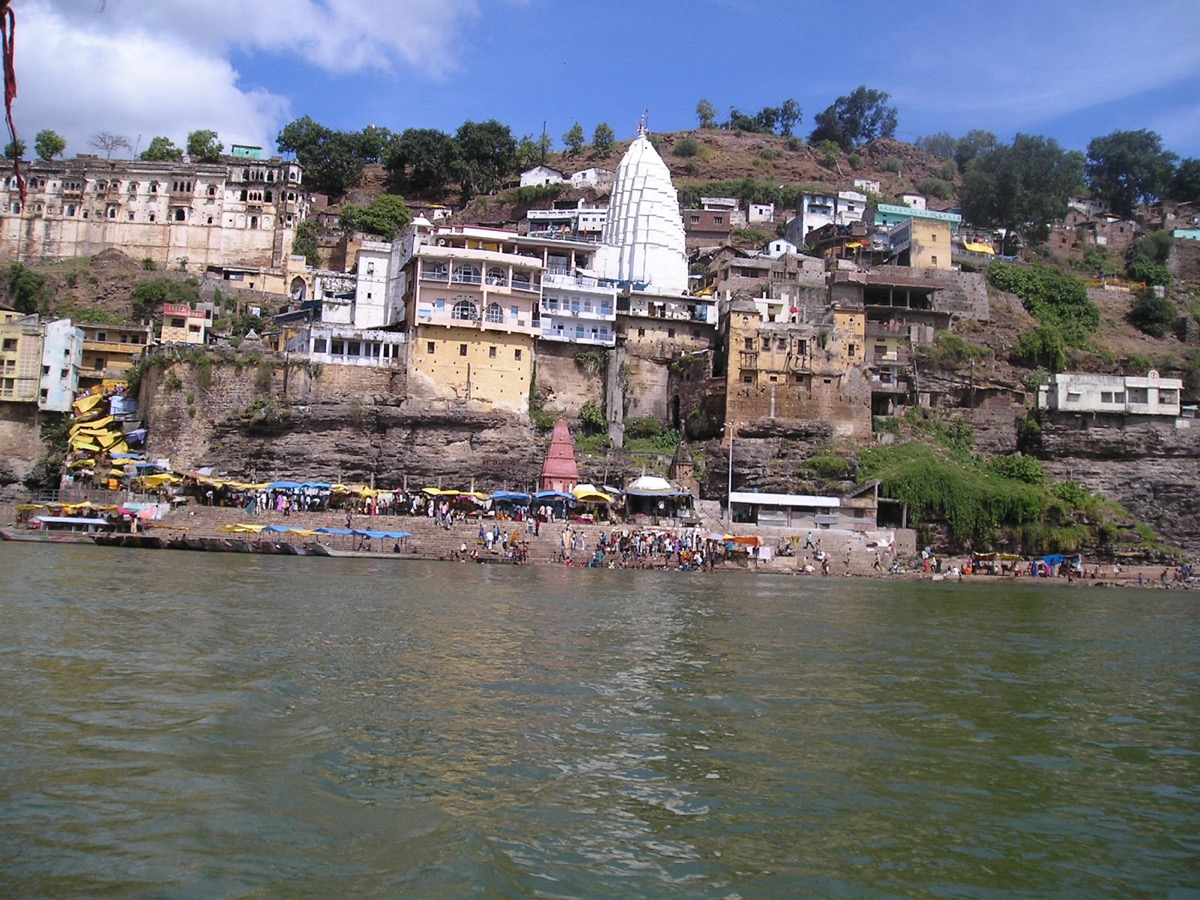
Introduction: Where the Sacred Syllable Takes Form
On a crescent-shaped island in the Narmadā river in central India, the most sacred syllable of Hinduism — Om (ॐ) — is believed to have assumed physical form. This is Omkareshwar (Omkāreśvara), one of the twelve Jyotirliṅgas of Lord Śiva, where the divine presence is held to be self-manifested rather than installed by human hands. The island of Māndhātā, approximately two kilometres long and one kilometre wide, rises from the waters of the Narmadā near the town of Khandwa in Madhya Pradesh, and its natural contours, when viewed from above, trace the outline of the Devanāgarī symbol ॐ — a geographical phenomenon that has inspired awe and devotion for millennia.
The Śiva Purāṇa (Koṭirudra Saṃhitā 1.18-22) lists Omkareshwar among the twelve supreme Jyotirliṅgas — pillars of infinite light through which Śiva manifested himself to settle a dispute between Brahmā and Viṣṇu over cosmic supremacy. The very name “Omkareshwar” means “Lord of the Omkāra” — the deity who presides over the primordial sound from which the universe emerged. The Māṇḍūkya Upaniṣad (1.1) declares: “Om ity etad akṣaram idaṃ sarvam” — “The syllable Om is all this” — and at Omkareshwar, that philosophical truth becomes topographical reality.
The Sacred Geography: Māndhātā Island
The Om-Shaped Island
The island of Māndhātā sits at the confluence of the Narmadā and its tributary the Kāverī (not to be confused with the South Indian river of the same name). The Narmadā divides into two channels around the island, creating the distinctive shape. The northern channel flows past the main temple complex, while the southern channel rejoins downstream, forming a natural moat that has contributed to the island’s spiritual isolation from the mundane world.
Hindu tradition attributes the island’s shape to divine design. The Śiva Purāṇa relates that when the Vināyaka (mountain-like) form of Oṁkāra manifested on earth, the very landscape arranged itself into the shape of the sacred syllable. Geological studies confirm that the island is a natural formation of Deccan trap basalt, sculpted over millennia by the Narmadā’s currents.
The Narmadā: River of Purification
The Narmadā holds a unique position among India’s sacred rivers. While the Gaṅgā purifies through bathing, the Narmadā is believed to purify through darśana (mere sight) alone. The Skanda Purāṇa (Reva Khaṇḍa 1.6-8) declares: “The Sarasvatī purifies in three days, the Yamunā in seven, the Gaṅgā at once, but the Narmadā purifies by the mere act of beholding her.” This extraordinary sanctity makes every stone in the Narmadā a natural Śiva Liṅga (bāṇaliṅga), and Omkareshwar, situated in the river’s heart, is considered the most concentrated point of this sanctifying power.
The Narmadā is also the only major river in India whose complete circumambulation (parikramā) is a recognized pilgrimage — the Narmadā Parikramā, a journey of approximately 2,600 kilometres along both banks. Pilgrims who undertake this arduous trek, often lasting months or even years, consider the darśana of Omkareshwar the spiritual climax of their journey.
The Temples: Omkareshwar and Amareshwar
Omkareshwar Temple
The main Omkareshwar Temple, dedicated to Lord Śiva as Omkāreśvara, sits on the southern face of Māndhātā island. The temple is built in the Nāgara style of North Indian temple architecture, with a towering śikhara (spire) that rises above the island’s skyline. The sanctum houses the Omkareshwar Jyotirliṅga — a naturally formed liṅga of dark stone, partially submerged in water that seeps up from the Narmadā below. Devotees descend a flight of steps to reach the garbhagṛha (inner sanctum), where the liṅga rests at a level close to the river itself.
The temple complex includes several subsidiary shrines and a spacious courtyard. The Siddhanātha Temple, adjacent to the main shrine, features exquisite medieval carvings depicting scenes from the epics and various forms of Śiva. The architectural style suggests construction during the Paramāra dynasty period (9th-14th centuries CE), though the site’s sanctity is far older.
Amareshwar Temple: The Jyotirlinga Debate
On the southern bank of the Narmadā, directly across from the island, stands the Amareshwar (Māmaleshwar) Temple. This temple houses another Śiva Liṅga that some traditions identify as the “true” Jyotirliṅga. The scholarly debate over which liṅga — the island’s Omkareshwar or the mainland’s Amareshwar — constitutes the actual Jyotirliṅga among the canonical twelve has persisted for centuries.
The Śiva Purāṇa’s account is ambiguous enough to support both claims. Some commentators, following the Koṭirudra Saṃhitā, hold that Omkareshwar on the island is the Jyotirliṅga. Others, citing the Śataruda Saṃhitā, maintain that Amareshwar is the authentic one. A popular reconciliation, widely accepted among pilgrims, holds that both liṅgas together constitute the complete Jyotirliṅga — making Omkareshwar unique among the twelve as the only site where the divine presence manifests in dual form. The traditional practice is to worship at both temples in a single pilgrimage, crossing the Narmadā by bridge or boat.
Mythological Origins
The Penance of the Vindya Mountains
The Śiva Purāṇa (Koṭirudra Saṃhitā 1.18-20) narrates the primary origin myth of Omkareshwar. The Vindhya mountain range, jealous of Mount Meru’s pre-eminence, performed severe penance to Lord Śiva at this very spot. The Vindhya fashioned a liṅga of earth and sand (pārthiva liṅga) and worshipped it with unwavering devotion, chanting the Praṇava mantra (Om) ceaselessly. Pleased with the mountain’s austerities, Śiva manifested as the Jyotirliṅga of Omkareshwar, granting the Vindhya the boon of being adorned with precious gems and becoming the abode of sages.
The Story of King Māndhātā
The island itself takes its name from the legendary King Māndhātā of the Ikṣvāku dynasty (Solar dynasty), an ancestor of Lord Rāma. According to the Skanda Purāṇa and local tradition, King Māndhātā performed tapas (austerities) on this island for an immense period, seeking the vision of Śiva. His devotion was so intense that Śiva appeared before him and blessed the island to bear his name for all time. Some Purāṇic accounts indicate that Māndhātā attained mokṣa on this island, and his spiritual energy continues to sanctify the ground.
The Devas and Asuras
Another tradition recorded in the Liṅga Purāṇa describes how the Devas (celestial beings) and Asuras (demons), after being defeated by demonic forces, collectively worshipped Śiva at this location. Their combined prayers, centred on the repetition of Oṁkāra, moved Śiva to manifest and destroy the enemies of the Devas. In gratitude, the gods established the liṅga here and named it Omkareshwar, the Lord invoked through the primordial Om.
Ādi Śaṅkarācārya and Omkareshwar
Omkareshwar holds a special place in the history of Hindu philosophy as the site where Ādi Śaṅkarācārya (c. 788-820 CE), the great exponent of Advaita Vedānta, met his guru Govindapāda (also known as Govinda Bhagavatpāda). According to the Śaṅkara Digvijaya, the traditional biography of Śaṅkara, the young Śaṅkara travelled from Kerala to the banks of the Narmadā in search of a qualified guru. He found Govindapāda meditating in a cave beneath the Omkareshwar temple on the banks of the Narmadā.
Upon being asked to identify himself, Śaṅkara responded with the famous verses beginning “Na mṛtyur na śaṅkā, na me jāti bhedaḥ” — “I have no fear of death, no distinction of caste” — culminating in the declaration “Cidānandarūpaḥ Śivo’ham Śivo’ham” (“I am Śiva, I am Śiva, the form of consciousness-bliss”). Govindapāda, recognizing the youth’s extraordinary realization, initiated him into the Daśanāmī Sannyāsa order and instructed him in the Brahmasūtra and Advaita philosophy.
The cave (guphā) where this momentous meeting is said to have occurred is still venerated on the Narmadā bank near the temple. For followers of the Advaita tradition, Omkareshwar is therefore not merely a Jyotirliṅga but the birthplace of the philosophical movement that would reshape Hindu thought for a millennium.
The Narmadā Parikramā Tradition
The circumambulation of the Narmadā river — Narmadā Parikramā — is one of the most arduous and spiritually rewarding pilgrimages in Hinduism. The journey follows the river from its source at Amarakaṇṭaka in eastern Madhya Pradesh to its mouth at Bharuch in Gujarat, then returns along the opposite bank — a total distance of approximately 2,600 kilometres.
Pilgrims traditionally walk barefoot, subsisting on alms and sleeping under trees or at riverside temples. The Reva Khaṇḍa of the Skanda Purāṇa prescribes the parikramā and describes its immense spiritual merit, declaring that one who completes it obtains the fruit of visiting all tīrthas in the universe (Reva Khaṇḍa 1.15-18).
Omkareshwar, situated roughly midway along the northern bank, serves as the pivotal waypoint of the parikramā. Many pilgrims who cannot undertake the full circumambulation instead perform a smaller parikramā of Māndhātā island itself — a walk of approximately seven kilometres around the island’s perimeter, passing numerous temples, ghāṭs, and meditation caves.
Other Sacred Sites on Māndhātā Island
Beyond the main Omkareshwar temple, the island hosts a remarkable concentration of sacred sites:
-
Siddhanātha Temple: An 11th-century temple with exceptional sculptural work, including depictions of Naṭarāja and the Daśāvatāra (ten incarnations of Viṣṇu). The temple’s Hemādpanthi-style architecture reflects the artistic sophistication of the Paramāra period.
-
Twenty-Four Avatāra Temple: A shrine dedicated to the twenty-four incarnations of Viṣṇu, reflecting the Vaiṣṇava presence on what is primarily a Śaiva island.
-
Gaurī Somnātha Temple: Dedicated to Goddess Pārvatī, this temple sits at the island’s eastern tip and offers panoramic views of the Narmadā.
-
Kabīr Cave: A cave associated with the saint-poet Kabīr, who is said to have meditated here. This site reflects the island’s importance across sectarian boundaries.
-
Ṛṇamukteśvara Temple: The “Lord who frees from debt” — both material and karmic. Pilgrims worship here specifically to seek release from the cycle of obligation.
Festivals and Worship
Mahāśivarātri
The Great Night of Śiva is celebrated with extraordinary fervour at Omkareshwar. The island, normally home to a modest population, swells to accommodate hundreds of thousands of pilgrims. Night-long vigils are held at both the Omkareshwar and Amareshwar temples, with continuous abhiṣeka (ritual bathing) of the Jyotirliṅga and chanting of the Rudra Sūkta and Śrī Rudram.
Kārtika Pūrṇimā and Narmadā Jayantī
Kārtika Pūrṇimā (the full moon of Kārtika, typically November) draws massive crowds for ritual bathing in the Narmadā. Narmadā Jayantī, celebrating the river goddess’s descent to earth, is observed on the seventh day of the bright half of Māgha month (January-February), with elaborate pūjā at the river ghāṭs and processions through the town.
Daily Worship
The Omkareshwar temple follows a rigorous daily schedule of worship beginning with the Maṅgala Āratī at dawn and concluding with the Śayana Āratī at night. The five daily āratīs (pañca-āratī) mark the rhythm of devotional life on the island, and the sound of temple bells, conch shells, and Vedic chanting over the waters of the Narmadā creates an atmosphere of profound sanctity.
Scriptural References
The scriptural authority for Omkareshwar’s sanctity rests on multiple Purāṇic texts:
- Śiva Purāṇa (Koṭirudra Saṃhitā 1.18-22): Lists Omkareshwar as the fourth Jyotirliṅga and narrates the Vindhya penance origin story.
- Skanda Purāṇa (Reva Khaṇḍa): Extensive treatment of the Narmadā’s holiness and the tīrthas along its banks, with Omkareshwar receiving special prominence.
- Liṅga Purāṇa (1.17-21): Provides an alternative account of the Jyotirliṅga’s manifestation through the collective worship of the Devas.
- Matsya Purāṇa (13.32-37): References the twelve Jyotirliṅgas and notes the particular efficacy of worship at the Narmadā tīrthas.
Conclusion: The Eternal Sound Made Stone
Omkareshwar stands as a living demonstration of Hinduism’s deepest philosophical truth: that the primordial vibration of Om pervades all creation. Here, the abstract becomes concrete — the sacred syllable takes the form of an island, the formless Śiva manifests as a pillar of light within a river whose very stones are liṅgas. For the pilgrim who crosses the Narmadā to set foot on Māndhātā island, the journey from the mundane to the sacred is not metaphorical but physical — a crossing of waters into a landscape shaped, according to faith, by the first sound of creation itself.
As the Māṇḍūkya Upaniṣad teaches, Om encompasses all states of consciousness — waking, dreaming, deep sleep, and the transcendent fourth (turīya). At Omkareshwar, the pilgrim is invited to experience all four, from the sensory richness of temple worship to the silent meditation in riverside caves where Śaṅkara once sat, seeking the teacher who would help him articulate the unity of Brahman. In this, Omkareshwar is not merely a place of worship but a place of ultimate knowledge — a tīrtha in the fullest sense, a “crossing place” from ignorance to illumination.