Introduction: The Hilltop Abode of the Renunciant God
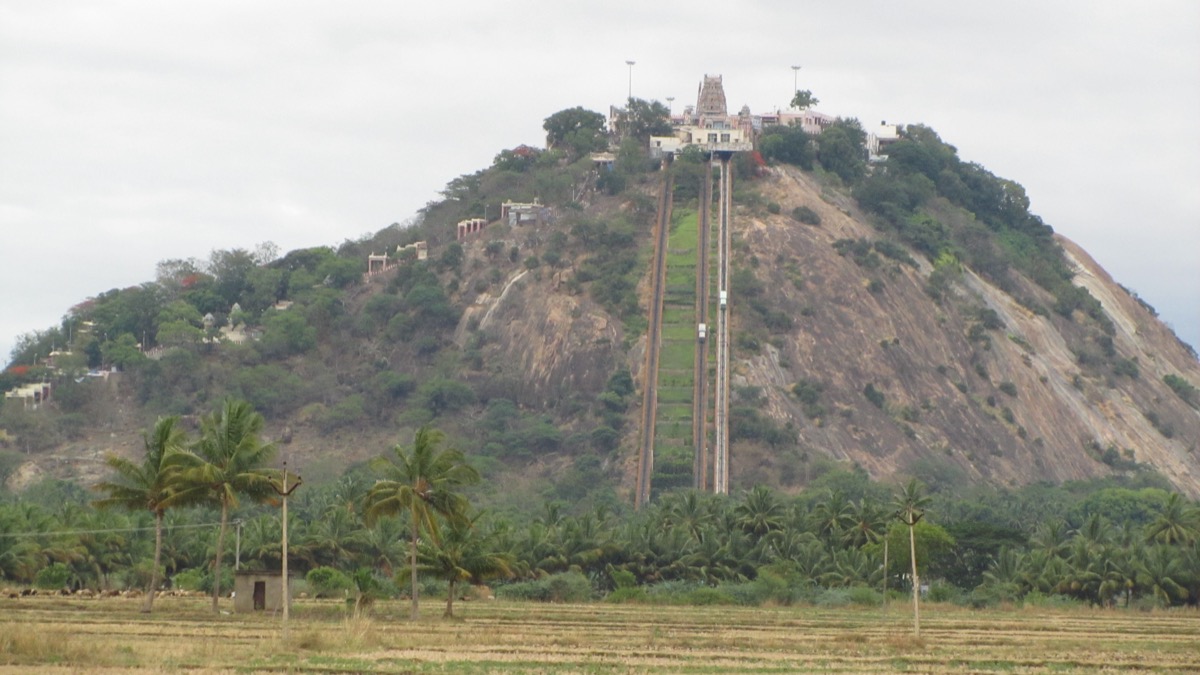
Rising 150 metres above the plains of southern Tamil Nadu, the Paḻani Hill (Paḻani Malai) bears upon its summit one of the most revered temples in the Śaiva tradition — the Arulmigu Daṇḍāyudhapāṇi Swāmī Temple, universally known as the Paḻani Murugan Temple. Among the six sacred battle-camp abodes (Āṟu Paṭai Vīṭu) of Lord Murugan — the divine commander of the celestial armies — Paḻani occupies a unique theological position. Here, Murugan is worshipped not as a warrior but as a renunciant: a young ascetic who has given up all worldly possessions and stands atop the hill with nothing but a staff (daṇḍa) in his hand and a loincloth (kaupīna) as his only garment.
This image of the supreme god of the Tamil people as a naked, dispossessed youth is one of the most powerful theological statements in all of Hindu iconography. It declares that true sovereignty lies not in wealth or weapons but in complete vairāgya (dispassion). The Tirumurugāṟṟuppaṭai of Nakkīrar (one of the earliest Sangam-era poems, c. 2nd century CE) celebrates Paḻani as the place where Murugan “stands as the Lord of the Hill, having renounced even the company of his consorts” (Tirumurugāṟṟuppaṭai, line 256-260).
The temple draws millions of pilgrims annually, especially during the festivals of Thai Pūcam (January-February) and Paṅkuṉi Uttiram (March-April), when the hills resound with the cries of “Hara Hara” and the rhythmic chanting of devotees bearing the kavadi — the iconic ceremonial burden that has become synonymous with Murugan worship worldwide.
The Legend of the Divine Fruit: Murugan’s Renunciation
The Contest Between Murugan and Ganesha
The foundational myth of Paḻani, told in the Kanda Purāṇam (Tamil version of the Skanda Purāṇa, composed by Kacciyappar in the 12th century), centres on a contest between the two sons of Śiva and Pārvatī: Gaṇeśa (Pillaiyar) and Murugan (Subrahmaṇya).
The sage Nārada once visited Mount Kailāsa bearing a divine fruit — the Jñāna Paḻam (Fruit of Knowledge/Wisdom). This fruit, according to some versions identified with the mango of immortality, could not be divided; it had to be given to one recipient alone. When both Gaṇeśa and Murugan desired the fruit, Śiva and Pārvatī devised a contest: whoever first circumambulated the three worlds (the triloka) would receive the prize.
Murugan, fleet and confident, immediately mounted his peacock vāhana and set off at tremendous speed to circle the cosmos. Gaṇeśa, however, possessed a different kind of wisdom. He simply walked around his parents, Śiva and Pārvatī, and declared: “My parents are the three worlds. There is nothing beyond them.” Pleased by his son’s devotion and philosophical insight, Śiva awarded the fruit to Gaṇeśa.
The Retreat to Palani
When Murugan returned from his cosmic journey and found the fruit already given, he was overcome with hurt and indignation. In a supreme act of renunciation, he declared: “The fruit is not merely a fruit; it is the fruit of knowledge itself. If knowledge cannot be given to me, I shall become knowledge itself.” He stripped himself of all ornaments, weapons, and divine regalia, took up a simple staff (daṇḍa), and departed for the Paḻani Hill, where he stood in meditation as a young ascetic.
Śiva and Pārvatī, distressed by the departure of their beloved son, followed him to Paḻani. Śiva addressed Murugan with the famous words: “Paḻam nī” (Tamil: “You are the fruit”) — meaning “You yourself are the essence of all knowledge and the supreme fruit.” From this declaration, according to folk etymology, the hill received its name: Paḻani.
The Kanda Purāṇam (Canto 5, Paḻaṉi Māhātmiyam) elaborates: Murugan, even after receiving his father’s acknowledgement, chose to remain atop the hill as a renunciant — teaching all beings that the highest attainment is not possession but liberation from possession. This is why the deity at Paḻani is called Daṇḍāyudhapāṇi — “He who holds the staff as his weapon.”
The Temple and Its Sacred Image
Bogar’s Navapāṣāṇa Mūrti
The principal deity image at Paḻani is one of the most remarkable in all of Hindu temple art. According to temple tradition and the hagiography of the Siddha saints, the mūrti was created by Bōgar (Bōganāthar), one of the eighteen Tamil Siddhas — the legendary alchemist-saints who practised a synthesis of yoga, medicine, and spiritual transformation.
Bōgar is said to have fashioned the image from navapāṣāṇam — an amalgam of nine sacred minerals or poisons (nava = nine, pāṣāṇam = mineral/poison). The exact composition is a closely guarded secret, but tradition holds that it includes mercury, sulphur, and several rare minerals processed through alchemical methods. The image has the remarkable property of remaining unaltered through centuries of daily abhiṣeka (ritual bathing) with milk, sandalwood paste, honey, and other substances — a fact that has fascinated metallurgists and historians of Indian alchemy.
The Siddha literary tradition, particularly the Bōgar Jñāṉa Cūttiram, describes how Bōgar travelled extensively (some traditions say as far as China) to gather the materials and knowledge necessary to create this image. He is said to have prepared the navapāṣāṇa compound specifically so that the medicinal properties of the minerals would infuse the substances used in abhiṣeka, transforming the temple’s sacred offerings into healing agents for the devotees who receive them as prasāda.
Temple Architecture
The Paḻani Hill temple complex is accessed by multiple routes: the traditional stone-step pathway of 693 steps, a winch-operated rope car, and a modern electric winch. The climb up the ancient stairway is itself considered an act of devotion, with many pilgrims ascending barefoot while chanting “Muruganukku Haro Hara.”
The main temple sits on the summit and follows the Dravidian architectural style, though it has been renovated and expanded many times over the centuries. The gold-plated vimāna (tower above the sanctum) gleams in the sunlight and is visible from miles around. The sanctum houses the navapāṣāṇa image of Daṇḍāyudhapāṇi in his characteristic form: standing upright, head shaved except for a tuft, wearing only a loincloth, and holding the staff.
Surrounding the main shrine are temples dedicated to Śiva (as Tiru Āviṉankuḍi Īśvarar), Goddess Pārvatī, Gaṇeśa, and other deities. The temple tank, Saravana Poigai, is associated with the mythological Śaravaṇa — the lake of reeds where Murugan was born from six sparks that flew from Śiva’s third eye.
The Āṟu Paṭai Vīṭu: Six Abodes of Murugan
Paḻani is the fifth of the six sacred abodes of Murugan, as enumerated in the Tirumurugāṟṟuppaṭai:
- Tirupparaṅkuṉṟam: Where Murugan married Devayāṉai (Devasenā)
- Tiruccēndūr: The seaside temple where Murugan defeated the demon Sūrapadma
- Tiruvāviṉankuḍi (Paḻani): Where Murugan stands as a renunciant (this temple)
- Tiruvērakam (Swamimalai): Where Murugan taught the meaning of “Om” to his own father Śiva
- Kuṉṟuttōṟāṭal (Tiruttani): Where Murugan married Vaḷḷi, the tribal maiden
- Paḻamudir Cōlai: The orchard temple in the hills near Madurai
Each abode represents a stage in Murugan’s mythology and a facet of his divine personality. Paḻani, as the abode of renunciation, is considered by many devotees to be the most spiritually elevated of the six — the place where the warrior-god transcends even his own divine weaponry to reveal the naked truth of the Self.
Kavadi Attam: The Sacred Burden
Origins and Meaning
The Kāvaḍi (literally “burden” or “yoke”) is the most distinctive ritual practice associated with Murugan worship, and Paḻani is its spiritual epicentre. The practice involves devotees carrying elaborately decorated semicircular structures on their shoulders — some adorned with peacock feathers, flowers, and images of Murugan — while dancing, chanting, and sometimes entering states of spiritual ecstasy during processions to the temple.
The mythological origin of the kavadi is traced to the legend of Iḍumban, a devoted asura (demon) who served the sage Agastya. When Agastya asked Iḍumban to transport two hills (Śivagiri and Śaktigiri) from the north to the south of India, Iḍumban carried them on a kavadi pole across his shoulders. When he set the load down to rest near Paḻani, young Murugan — already installed atop Paḻani Hill — refused to let the hill be moved. Iḍumban fought Murugan and was slain, but was later revived and became one of Murugan’s most devoted attendants. The kavadi pilgrimage re-enacts Iḍumban’s devotional journey, with the weight of the kavadi symbolising the burdens of karma that the devotee carries and offers to the Lord.
Forms of Kavadi
Kavadi practice ranges from the simple to the intensely ascetic:
- Pāl Kāvaḍi: Carrying pots of milk on a kavadi frame to offer as abhiṣeka
- Pū Kāvaḍi: A kavadi decorated with flowers
- Mayil Kāvaḍi: A large peacock-shaped kavadi (mayil = peacock), the most elaborate form
- Aṅga Kāvaḍi: Rolling on the ground along the entire pilgrimage route
- Vel Kāvaḍi: Kavadi with small vel (spear) piercings through the skin — an extreme practice of devotional austerity
The Tamil diaspora communities in Malaysia, Singapore, Sri Lanka, Mauritius, and South Africa have brought kavadi traditions to a global stage, particularly during the Thai Pūcam festival.
Thai Pūcam: The Great Festival
Thai Pūcam, celebrated in the Tamil month of Thai (January-February) when the star Pūcam (Puṣya nakṣatra) is ascendant, is the most important festival at Paḻani and in Murugan worship generally. The festival commemorates the occasion when Goddess Pārvatī gave Murugan the invincible vel (divine spear) to defeat the demons Sūrapadma, Siṃhamukha, and Tārakāsura.
At Paḻani, Thai Pūcam draws millions of devotees. The temple and the hill are illuminated, and a continuous stream of kavadi-bearing pilgrims ascends the steps throughout the day and night. The atmosphere is charged with devotional fervour: the air rings with the percussion of drums, the singing of devotional songs (especially Aruṇagirinātar’s Tiruppugazh), and the ecstatic cries of kavadi bearers.
The festival has deep astronomical significance as well. The Pūcam star (Puṣya) is considered auspicious in Hindu astrology, associated with nourishment and spiritual growth. Its conjunction with the full moon in the month of Thai creates what is believed to be a cosmically potent window for spiritual transformation and the fulfilment of vows.
Murugan and the Navagraha Connection
Tamil tradition associates Murugan with the planet Mars (Maṅgala/Cevvāy), and Paḻani is considered an important remedy site for those afflicted by unfavourable Mars positions in their horoscope (jātaka). The Jyotiṣa tradition holds that Mars governs courage, energy, siblings, and landed property; when afflicted (particularly in the Maṅgala Dōṣa affecting marriage compatibility), worship at Paḻani is prescribed as a remedy (parihāra).
More broadly, Murugan is associated with the removal of obstacles posed by all nine planetary deities (Navagraha), a belief reinforced by the navapāṣāṇa composition of the Paḻani image, which symbolically incorporates the influences of all nine celestial bodies.
Paḻani in Tamil Devotional Literature
The Tirumurugāṟṟuppaṭai of Nakkīrar (c. 2nd century CE), the earliest surviving extended poem dedicated to Murugan, devotes its fifth section to Paḻani (referred to as Āviṉankuḍi). The poem instructs a spiritual seeker to “go to the hill where the young Lord stands, having cast aside all attachment.”
Aruṇagirinātar’s Tiruppugazh (15th century) — a vast corpus of over 1,300 hymns to Murugan, set to complex rhythmic patterns (tāḷam) — contains numerous verses addressed specifically to the Lord of Paḻani. His most famous Paḻani verse begins: “Azhagāna mugattinaik kaṇṭu” (“Having seen your beautiful face…”) and describes the overwhelming experience of encountering the renunciant deity.
Kumaraguruparar’s Kaṇṭar Kali Veṇpā (17th century) and Piḷḷaittamiḻ are also devoted substantially to the Paḻani deity, celebrating him as the supreme teacher who reveals the meaning of the Praṇava (Om) to all seekers.
Conclusion: The Fruit Beyond All Fruits
Paḻani is not merely a hilltop temple; it is a theological declaration inscribed in landscape. The young god who renounced divine weapons to stand naked atop a hill with nothing but a staff teaches a lesson that reverberates through all schools of Hindu philosophy: the highest attainment is not accumulation but release, not power but surrender. As Śiva declared to his son: “Paḻam nī” — “You are the fruit.” The seeker who climbs the 693 steps to Paḻani’s summit, whether bearing a simple pot of milk or an elaborate kavadi, enacts this truth in their own body: the burden is carried up, offered to the Lord, and left behind. What remains is the lightness of liberation.