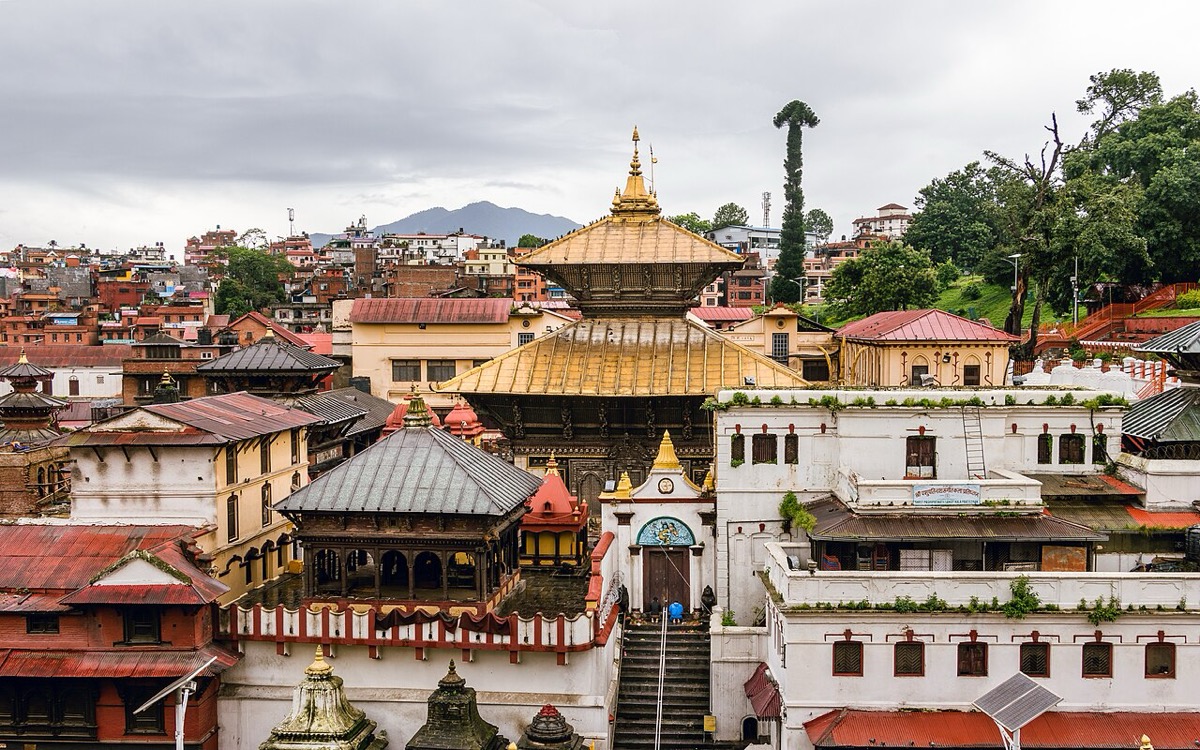
Introduction: The Lord of All Living Beings
Paśupatināth — “the Lord of all creatures” (from paśu, “living being/bound soul,” and pati/nātha, “lord/protector”) — stands on the western bank of the Bāgmatī river in the Deopatan district of Kathmandu, Nepal. This pagoda-roofed temple, gleaming with its gilded copper roof and silver-plated doors, is the most sacred Hindu shrine in the entire Himalayan kingdom and one of the holiest Śiva temples on earth. It was inscribed as part of the Kathmandu Valley UNESCO World Heritage Site in 1979.
The Mahābhārata (Anuśāsana Parva 17.49-50) records Śiva’s declaration: “I am Paśupati, the Lord of all beings. All creatures — from Brahmā to the blade of grass — are my paśus (bound souls), and I am their liberator.” This theological claim lies at the heart of the Paśupatināth temple’s significance: it is the place where Śiva in his aspect as the supreme protector and liberator of all souls is most fully manifest.
The temple’s antiquity is immense. While the current pagoda structure dates to the 17th century, the site has been a place of worship for over two millennia. The Gopālarājavaṃśāvalī (a medieval Nepalese chronicle) records the temple’s existence from the Licchavi period (c. 400-750 CE), and archaeological evidence suggests worship here from at least the 3rd century BCE.
Mythology and Sacred History
The Discovery of the Liṅga
The origin legend of Paśupatināth, as recorded in the Nepāla Māhātmya (a section of the Himavatkhaṇḍa of the Skanda Purāṇa), narrates that Śiva once took the form of a deer (mṛga) and wandered into the forest on the banks of the Bāgmatī. When the gods found him, they seized him by his horn, which broke off and fell to the ground. The broken horn became the sacred liṅga of Paśupatināth. The Purāṇa relates that this liṅga was later buried and lost for ages until a cowherd discovered it when his cow began pouring milk on a particular spot in the forest, revealing the buried Śivaliṅga.
The Mahābhārata Connection
The Anuśāsana Parva of the Mahābhārata contains extensive glorification of Śiva as Paśupati. In the famous dialogue between Yudhiṣṭhira and Bhīṣma, the dying patriarch recites the Śiva Sahasranāma (Thousand Names of Śiva), in which “Paśupati” appears as one of the most significant names (Anuśāsana Parva 17.30). Bhīṣma declares that worship of Śiva as Paśupati is the surest path to liberation:
“He who recites these names of Maheśvara at the sacred tīrtha of Paśupati, on the banks of a holy river, is freed from all bonds” (Mahābhārata, Anuśāsana Parva 17.150).
The Vana Parva (chapters 39-40) also references Nepal (Nepāla) as a sacred region where Śiva’s presence is especially tangible, and several scholars have identified the “Paśupati kṣetra” mentioned in the epic with the Kathmandu site.
The Paśupata Śaiva Tradition
The Paśupatināth temple is the spiritual epicenter of the Paśupata Śaiva tradition, the oldest organized school of Śaivism, founded by the sage Lakulīśa (c. 2nd century CE). The Paśupata Sūtras, attributed to Lakulīśa and commented upon by Kauṇḍinya in his Pañcārtha Bhāṣya, outline a rigorous path of liberation through five stages (pañcārtha): kriyā (ritual action), tapa (austerity), japa (recitation), dhyāna (meditation), and the final state of duhkhānta (the end of suffering).
The temple at Paśupatināth served as one of the principal centres for Paśupata practitioners, who were known for their radical asceticism — smearing themselves with ash (bhasma), dwelling in cremation grounds, and performing seemingly mad acts (such as laughing, singing, and dancing in public) as a means of transcending social conventions and ego. Sculptures of Lakulīśa, depicted seated in padmāsana holding a daṇḍa (staff) and a citron, are found throughout the temple complex.
The Four-Faced Mukha-Liṅga
Description and Iconography
The primary object of worship at Paśupatināth is the extraordinary caturmukha-liṅga — a liṅga with four faces carved on its four sides, representing Śiva’s four principal aspects. The faces, each facing a cardinal direction, are identified as:
- Sadyojāta (West): The creative aspect, associated with the earth element and the colour white
- Vāmadeva (North): The preserving aspect, associated with water and the colour yellow/red
- Aghora (South): The destructive/dissolving aspect, associated with fire and the colour dark blue/black
- Tatpuruṣa (East): The concealing aspect, associated with wind and the colour yellow
A fifth face, Īśāna, representing the liberating aspect and associated with ether (ākāśa), is understood to be present but invisible, pointing upward toward the zenith. This five-fold classification corresponds to the Pañcabrahmā theology articulated in the Taittirīya Āraṇyaka (X.43-47) and elaborated in Śaiva Siddhānta philosophy.
The mukha-liṅga is approximately one metre in height and is carved from a single block of black stone. Non-Hindus are not permitted to enter the main temple or see the liṅga directly, though they can view the posterior (western) face from across the Bāgmatī river.
Theological Significance
The caturmukha-liṅga embodies the Śaiva theological principle that Śiva is simultaneously the source of creation, preservation, destruction, concealment (tirodhāna), and grace (anugraha) — the five cosmic acts (pañcakṛtya). The Kāmikāgama, one of the foundational texts of Śaiva Siddhānta, states: “The liṅga with four faces reveals the Lord in his totality — as creator, sustainer, destroyer, concealer, and liberator” (Kāmikāgama, Pūrvabhāga IV.8).
Temple Architecture and Complex
The Main Pagoda Temple
The current temple structure is a two-storey pagoda in the traditional Nepalese style, with a copper roof plated with gold and four gilded pinnacles at the corners. The main śikhara rises to a height of approximately 23.6 metres (77 feet). The temple was rebuilt in its present form in the 17th century after damage, though the sanctum and the liṅga are far older.
The silver-plated entrance doors on the western side bear relief carvings of deities, and the tympanum above features images of Śiva and Pārvatī. The courtyard around the main temple contains numerous smaller shrines, including temples to Vaṭuka Bhairava, Hanumān, and the Aṣṭa-mātṛkās (eight mother goddesses).
The Cremation Ghāṭs
Perhaps the most visually and spiritually striking feature of the Paśupatināth complex is the series of cremation ghāṭs along the Bāgmatī river. Open-air cremation — the immemorial Hindu practice of returning the body to the five elements through fire — is performed here daily, visible to all. The Ārya Ghāṭ, closest to the temple, is reserved for members of the Nepalese royal family and persons of high status. The Bhasmeshwar Ghāṭ serves the general public.
The sight of funeral pyres burning along the river, with mourners performing the final rites while temple bells ring and āratī lamps are waved, is one of the most profound encounters with Hindu mortality theology. The Bṛhadāraṇyaka Upaniṣad’s teaching — “From death lead me to immortality” (I.3.28) — finds its most vivid expression in this landscape where the dead are cremated in the very shadow of Paśupatināth, the lord who liberates all souls from the cycle of death and rebirth.
The Deer Park
Within the temple grounds is a deer park (mṛga-sthala) that maintains a herd of deer — a living reference to the mythology of Śiva assuming deer form. The deer are considered sacred and are cared for by the temple administration. This park connects Paśupatināth to the broader tradition of Śiva as Mṛgapati (Lord of Deer), and pilgrims often spend time watching the deer as a meditative practice.
Mahā Śivarātri at Paśupatināth
The greatest festival at Paśupatināth is Mahā Śivarātri, which draws between 800,000 and one million pilgrims from Nepal and India. The festival transforms the entire Bāgmatī riverfront into a vast gathering of sādhus, devotees, and celebrants.
Thousands of Nāgā sādhus (ash-smeared naked ascetics belonging to the akhāḍā system), jōgīs, bābās, and other ascetics converge on the temple complex, many having walked for days from distant āśrams and forest retreats. They light sacred fires (dhunī), smoke cannabis (which is otherwise illegal in Nepal but traditionally tolerated during Śivarātri at this site), and perform dramatic displays of austerity — standing on one leg, holding arms aloft for years, or lying on beds of nails.
The temple itself conducts special abhiṣeka of the mukha-liṅga through the four yāmas (watches) of the night, with offerings of bael leaves, milk, honey, and sacred water. The vibration of “Om Namaḥ Śivāya” chanted by hundreds of thousands simultaneously creates an acoustic and spiritual experience described by many pilgrims as the closest they have come to the divine.
Other Festivals and Rituals
Teej
The Teej festival (Hartalika Teej), observed by married women for the longevity and prosperity of their husbands, draws massive crowds of women in red saris to Paśupatināth. The women fast, sing devotional songs, and worship Śiva and Pārvatī as the ideal divine couple.
Bala Chaturdashi
During the Bala Chaturdashi festival in the month of Mārgaśīrṣa (November-December), devotees spend the night at the temple performing jāgaraṇa (staying awake through the night) and then, at dawn, walk a prescribed route through the forest scattering seven types of seeds (saptabīja) in memory of deceased relatives. This unique tradition connects the temple to ancestor worship and the Hindu belief in the ongoing relationship between the living and the dead.
Daily Worship
The daily worship at Paśupatināth follows a rigorous schedule. The temple opens before dawn for the Nityapūjā (daily worship), which includes the abhiṣeka of the liṅga, ārādhana (devotional service), and the offering of prasāda. Four daily pūjās are performed, corresponding to the four faces of the liṅga and the four periods of the day.
The Bāgmatī River
The Bāgmatī river, on whose banks Paśupatināth stands, is Nepal’s holiest river, often called the “Gaṅgā of Nepal.” The Nepāla Māhātmya states that the Bāgmatī originates from the tears of Śiva, shed when he beheld the suffering of the world’s creatures. Bathing in the Bāgmatī at Paśupatināth is considered equal in merit to bathing in the Gaṅgā at Varanasi.
The river, unfortunately, faces severe pollution in its urban stretches through Kathmandu. Conservation efforts have been ongoing, with the recognition that the spiritual significance of the river demands environmental stewardship.
Spiritual Significance
Paśupatināth represents the most complete expression of Śiva’s role as the protector and liberator of all beings. The name “Paśupati” encodes the entire Śaiva soteriology: all sentient beings are paśus — souls bound by the three malas (impurities) of āṇava (ego), karma (action), and māyā (illusion). Śiva as Pati is the one who removes these bonds through his grace (śaktipāta).
The cremation ghāṭs along the Bāgmatī, visible from the temple, serve as a constant reminder of the central teaching of Śaivism: that death is not the end but a doorway, and that Śiva, the Lord of Paśupatināth, stands at that doorway to receive the soul and guide it toward liberation. To die at Paśupatināth, to have one’s ashes consigned to the Bāgmatī, is considered one of the most auspicious departures from the mortal world — a belief that has drawn the sick and the aged to the temple for centuries.
The Paśupata Sūtras conclude with the promise: “Duhkhānta — the end of suffering — this is the fruit for one who has taken refuge in Paśupati” (Paśupata Sūtra V.40). At the temple of Paśupatināth, this promise is made visible, tangible, and available to all who approach the four-faced liṅga with devotion.