Introduction: Where Three Sacred Rivers Embrace
Prayāgraj — formerly known as Allāhābād and revered since Vedic antiquity as Prayāga (“the place of sacrifice”) — is one of the most sacred cities in all of Hinduism. Its supreme spiritual significance derives from the Triveṇī Saṅgam, the point where three holy rivers converge: the Gaṅgā flowing from the north, the Yamunā arriving from the west, and the mythical Sarasvatī believed to join from underground through an invisible subterranean channel. This triple confluence is considered the “Tīrtha Rāja” — the King of All Pilgrimage Sites — a distinction affirmed repeatedly in the Purāṇas and the Mahābhārata.
The city stands at the eastern edge of the Gaṅgā-Yamunā Doāb (the fertile plain between the two rivers) in present-day Uttar Pradesh. At the exact point of confluence, pilgrims can observe the distinct colours of the rivers merging: the muddy brown of the Gaṅgā, the darker greenish-blue of the Yamunā, and — according to tradition — the invisible but spiritually perceptible current of the Sarasvatī. The Padma Purāṇa declares: “Of all tīrthas, Prayāga is the foremost. Of all rivers, the Gaṅgā is the foremost. Of all confluences, the Triveṇī is the foremost” (Padma Purāṇa, Ādi Khaṇḍa 31.46).
Mythological Origins: Brahmā’s First Yajña
The Primordial Sacrifice
The name Prayāga itself reveals the city’s mythological identity. According to the Matsya Purāṇa (103.1-6), after Lord Brahmā completed his creation of the universe, he needed to perform the first yajña (Vedic fire sacrifice) to consecrate the new creation. He surveyed the entire cosmos for a fitting location and chose the spot where the Gaṅgā and Yamunā met, declaring it the most auspicious point in all the worlds. The ten Prajāpatis (progenitors of creation) served as priests, and the sacrifice was so perfectly conducted that the site became permanently charged with sacred energy. From that moment, the land was known as Prayāga — “the foremost place of yajña” (pra- meaning “foremost” and yāga meaning “sacrifice”).
The Vāmana Purāṇa (37.1-12) adds that Brahmā’s sacrifice at Prayāga was attended by all the Devas, Ṛṣis, Gandharvas, and Apsarās. So pleased was Brahmā with the site that he declared: “He who bathes at the Saṅgam of Gaṅgā and Yamunā obtains the fruit of a thousand Aśvamedha Yajñas and a hundred Vājapeya sacrifices.”
The Invisible Sarasvatī
The third river at the Saṅgam, the Sarasvatī, holds a unique and mysterious status. In the Ṛg Veda (VII.95.2), Sarasvatī is praised as a mighty, visible river flowing from the mountains to the sea — “pure in her course from the mountains to the ocean.” Geological and hydrological evidence suggests that a major river once flowed through northwestern India but gradually dried up or changed course thousands of years ago.
Hindu tradition maintains that the Sarasvatī did not disappear but went underground (antarvahinī), flowing invisibly beneath the earth and surfacing at three places: Prayāga, Kurukṣetra, and the now-lost site of Vinaśana. At Prayāga, the Sarasvatī joins the Gaṅgā and Yamunā from below, making the confluence truly triple (triveṇī — “three braids”). The Bhāgavata Purāṇa (5.19.18) lists Prayāga among the holiest tīrthas precisely because of this subterranean meeting of the three rivers.
Scriptural Praise: The Tīrtha Rāja
No other tīrtha in Hinduism receives such sustained and superlative praise across the sacred literature as Prayāga.
In the Mahābhārata
The Mahābhārata devotes an entire section of the Vana Parva to the glories of Prayāga. In the Tīrthayātrā Parva (Vana Parva, chapters 82-88), the sage Pulastya tells Bhīṣma:
“Prayāga is the foremost of all tīrthas. At Prayāga, the Gaṅgā, the Yamunā, and the Sarasvatī flow together. He who bathes at the confluence of these three rivers is freed from all sins and attains the world of Brahmā.” (Mahābhārata, Vana Parva 85.68-70)
The text further states that merely resolving to go to Prayāga destroys half one’s sins, that the journey destroys three-quarters, and that bathing at the Saṅgam destroys them entirely (Vana Parva 85.72-74).
In the Purāṇas
The Matsya Purāṇa (106.1-12) declares that Prayāga is a “Kṣetra of three and a half krośas” (approximately 11 kilometres in extent), within which every act of charity, penance, or devotion yields infinite spiritual merit. The Agni Purāṇa (110.1-5) concurs, describing Prayāga as the place where even the gods come to bathe and where a single dip equals a lifetime of penance performed elsewhere.
The Padma Purāṇa elevates Prayāga above all other tīrthas with a striking metaphor: “Just as the serpent king Śeṣa cannot describe all the virtues of Viṣṇu even in a thousand years, so too the virtues of Prayāga are beyond enumeration” (Padma Purāṇa, Ādi Khaṇḍa 31.55).
The Kumbh Melā: The World’s Largest Gathering
Origins of the Kumbh
The Kumbh Melā, held at Prayāgraj in a cycle governed by Jupiter’s transit through specific zodiacal signs, is the most colossal religious gathering on the planet. In 2025, the Mahā Kumbh Melā at Prayāgraj drew an estimated 660 million visitors over the course of the festival, a number surpassing the population of most nations.
The mythological origin of the Kumbh traces to the Samudra Manthana (the churning of the cosmic ocean), narrated in the Bhāgavata Purāṇa (8.5-12) and the Viṣṇu Purāṇa (1.9). When the Devas and Asuras churned the ocean to obtain the Amṛta (the nectar of immortality), the divine physician Dhanvantarī emerged carrying a kumbha (pot) of the precious elixir. A fierce struggle ensued, during which Jayanta (Indra’s son, or in some versions, Garuḍa) fled with the pot across the sky. During the twelve-day celestial flight (equivalent to twelve human years), four drops of Amṛta fell to earth at four locations: Prayāga, Haridvāra, Ujjainī, and Nāsika. The Kumbh Melā is celebrated at these four sites in rotation, with the Prayāgraj Kumbh considered the most auspicious.
The Festival Cycle
The Kumbh cycle at Prayāgraj follows a specific astronomical pattern:
- Mahā Kumbh Melā: Once every 144 years (twelve complete Jupiter cycles), considered the most sacred
- Pūrṇa Kumbh Melā: Every twelve years, when Jupiter is in Aries and the Sun enters Capricorn
- Ardha Kumbh Melā: Every six years, midway between two Pūrṇa Kumbh Melās
- Māgha Melā: Annually during the month of Māgha (January-February), a smaller but significant gathering
The most auspicious bathing dates (known as Śāhī Snāna or “Royal Baths”) are determined by precise astronomical conjunctions. On these days, the Nāgā Sādhus — naked, ash-smeared ascetics belonging to ancient monastic orders (akhāḍās) — lead the procession to the Saṅgam in a spectacular display of devotion and martial discipline.
UNESCO Recognition
In 2017, UNESCO inscribed the Kumbh Melā on its Representative List of the Intangible Cultural Heritage of Humanity, recognizing it as “the largest peaceful congregation of pilgrims on earth” and praising its role in transmitting knowledge, social cohesion, and tolerance among diverse communities.
Akṣayavaṭ: The Immortal Banyan
Within the Allāhābād Fort, near the Saṅgam, stands the Akṣayavaṭ — the “Imperishable Banyan Tree” — a legendary tree believed to be indestructible and ageless. The Matsya Purāṇa (104.3-7) describes this tree as having existed since the beginning of creation, planted by Lord Brahmā himself as a witness to his first yajña. Its leaves, it is said, never fall; its branches never decay.
The Padma Purāṇa recounts that during the great cosmic floods (pralaya), when the entire earth was submerged, the infant form of Lord Viṣṇu (Bāla Mukunda) floated upon the floodwaters on a leaf of the Akṣayavaṭ, sucking his toe, waiting for the universe to be reborn. This image of the cosmic child resting on the banyan leaf above the waters of dissolution is one of the most evocative in Hindu iconography.
The Chinese pilgrim Xuanzang (Hiuen Tsang), who visited Prayāga around 643 CE, recorded the tree in his travelogue and noted that pilgrims considered it supremely meritorious to die at its foot. The Mughal emperor Akbar, recognizing the tree’s extraordinary significance, built the Allāhābād Fort around it in 1583. Access to the Akṣayavaṭ was restricted for centuries under the fort’s military control but has been opened to pilgrims in recent years.
The Allāhābād Fort and Pātālapurī Temple
Emperor Akbar constructed the massive Allāhābād Fort in 1583 CE at the confluence point, incorporating several ancient Hindu and Jain sacred sites within its walls. The fort houses the Pātālapurī Temple, an underground shrine believed to mark the entrance to Pātāla (the netherworld). Inside this subterranean temple complex are ancient idols of deities, sacred trees, and a well said to connect to the underground course of the Sarasvatī.
The Sarasvatī Kuṇḍa (well) within the fort complex is venerated as the point where the Sarasvatī surfaces before joining the Gaṅgā and Yamunā at the Saṅgam. Pilgrims visiting Pātālapurī often perform rituals for their deceased ancestors, as the site is considered especially efficacious for śrāddha (ancestral rites).
The Māgha Melā: The Annual Congregation
While the Kumbh Melā commands worldwide attention, the annual Māgha Melā is the spiritual heartbeat of Prayāgraj. Every year during the Hindu month of Māgha (January-February), hundreds of thousands of devotees — known as Kalpavāsīs — set up temporary camps along the Saṅgam banks and observe a month-long regimen of austerity. They bathe daily at dawn in the freezing waters, subsist on simple food, sleep on the ground, and devote themselves to prayer, scripture study, and charitable giving.
The Matsya Purāṇa (106.13-18) prescribes the Māgha Snāna (bathing during Māgha) at Prayāga as one of the most meritorious acts a Hindu can perform: “He who bathes at Prayāga during Māgha, even for a single day, obtains merit greater than performing austerities for a thousand years at any other place.”
Rituals and Practices at the Saṅgam
The Sacred Bath
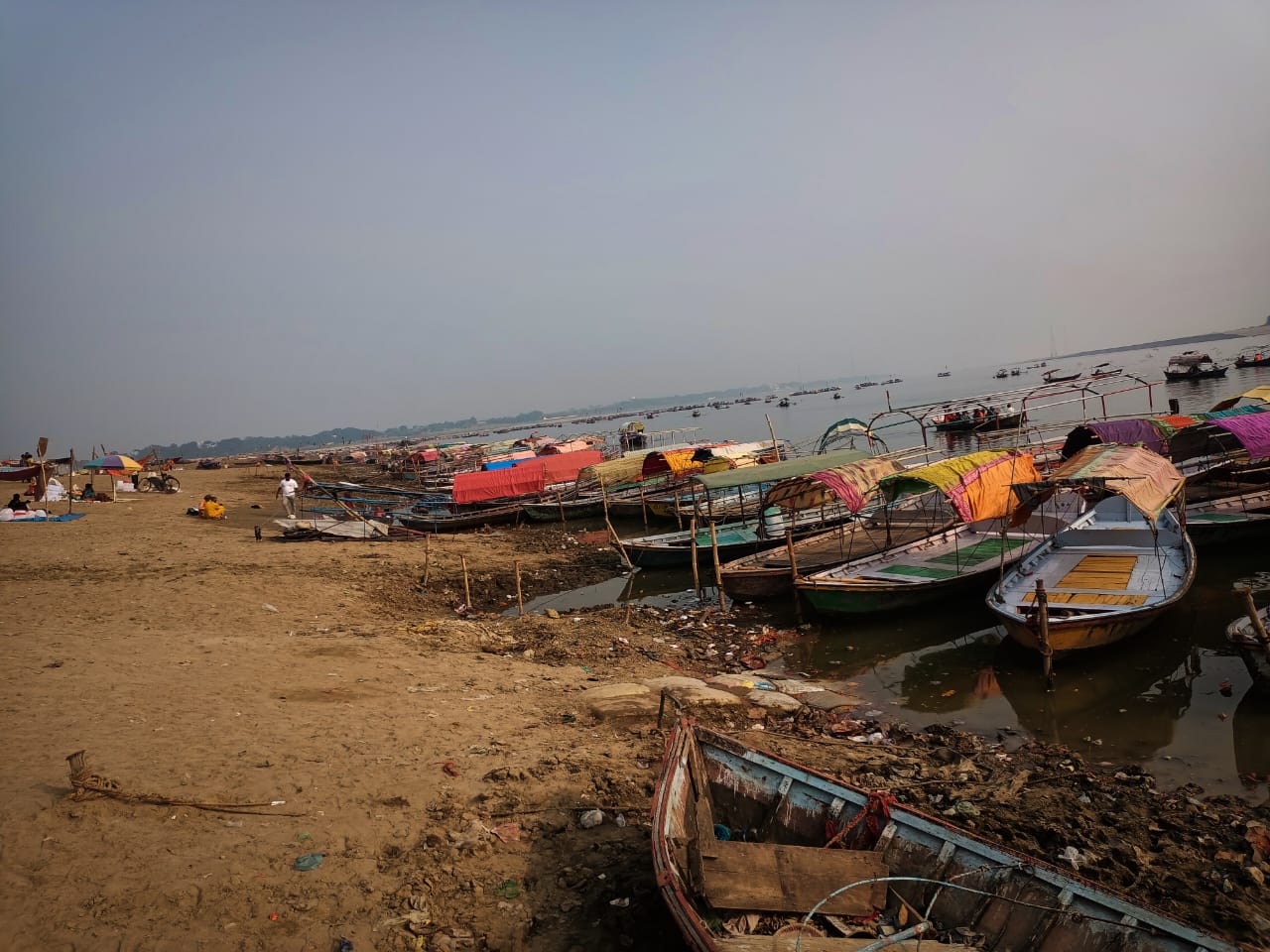
The central ritual at Triveṇī Saṅgam is the snāna (sacred bath). Pilgrims hire boatmen to row them to the exact point of confluence, where the three rivers meet. There, they immerse themselves fully, often chanting the Gaṅgā Stotra or the Triveṇī Prārthanā. Priests on the boats assist with saṅkalpa (ritual intention), where the pilgrim states their name, lineage, and the purpose of the bath while pouring water from their cupped hands.
Piṇḍadāna and Śrāddha
Prayāgraj is one of the most important sites for piṇḍadāna — the offering of rice balls to one’s deceased ancestors. The confluence of three rivers is believed to be an especially powerful conduit to the realm of the Pitṛs (ancestors). Many families travel to Prayāgraj specifically to perform the annual śrāddha ceremonies, ensuring the peace and spiritual progress of their departed loved ones.
Dāna (Charitable Giving)
The Purāṇas repeatedly emphasize that charity given at Prayāga yields infinite merit. The Matsya Purāṇa (106.20) states: “Whatever is given in charity at Prayāga — whether gold, silver, grain, clothing, or cows — never diminishes but multiplies a millionfold.” This teaching has made Prayāgraj a traditional centre for large-scale charitable donations, particularly during the Kumbh and Māgha Melā.
Historical and Cultural Significance
Ancient and Medieval History
The antiquity of Prayāga is attested by multiple sources. The Ṛg Veda (X.75.5-6) mentions the confluence region in its hymn to the rivers. The city served as a major centre during the Maurya, Gupta, and Mughal periods. The Aśokan pillar (3rd century BCE) at the fort bears inscriptions from three different rulers spanning over 1,500 years: the Gupta emperor Samudragupta (4th century CE), the Mughal emperor Jahāṅgīr (17th century), and the original Maurya edicts.
During the Indian independence movement, the city — then known as Allāhābād — played a pivotal role. The Nehru family’s ancestral home, Ānand Bhawan, served as a centre of the freedom struggle. Motilal Nehru, Jawaharlal Nehru, and Indira Gandhi all had deep connections to the city. In 2018, the Uttar Pradesh government officially renamed the city from Allāhābād to Prayāgraj, restoring its ancient Hindu name.
The Sarasvatī Debate
The question of the Sarasvatī’s existence has been the subject of scholarly and scientific inquiry. Satellite imagery and geological surveys (including studies by the Indian Space Research Organisation) have identified the dried paleochannel of a major river that once flowed through Rajasthan and Haryana, roughly corresponding to the Vedic descriptions of Sarasvatī. While the river may have ceased to flow on the surface thousands of years ago, the Hindu tradition that it continues underground at Prayāga remains a matter of deep faith, and the Triveṇī’s triple identity continues to define the spiritual geography of the Saṅgam.
Practical Information for Pilgrims
The Saṅgam is accessible by boat from the ghats along the northern bank of the Yamunā. During the Kumbh and Māgha Melā, pontoon bridges and temporary infrastructure are erected to accommodate the vast number of pilgrims. The ideal time for bathing is at dawn, particularly during the months of Māgha and Kārtika. The auspicious Amāvasyā (new moon) and Pūrṇimā (full moon) days are considered especially powerful for ritual bathing at the confluence.
Key sites to visit include the Triveṇī Saṅgam itself, the Akṣayavaṭ within the fort, the Pātālapurī Temple, the Hanumān Mandira (noted for its reclining Hanumān idol that gets partially submerged during floods), and the Ānand Bhawan museum. The city is well-connected by rail (Prayāgraj Junction), road, and air (Bamrauli Airport).
Conclusion: The Eternal Confluence
Prayāgraj stands as a living embodiment of Hinduism’s deepest spiritual intuitions: that water purifies, that sacrifice consecrates, and that the meeting of sacred currents — whether of rivers or of devotion — creates a point of transcendence. The Triveṇī Saṅgam is not merely a geographical feature but a theological statement, the place where the visible and the invisible, the earthly and the divine, merge into a single flow. As the Mahābhārata declares: “Prayāga is the navel of the earth. It is here that the world was born, and it is here that the world finds its redemption” (Vana Parva 85.80).
For the millions who journey each year to bathe at the Saṅgam — whether during the cosmic spectacle of the Mahā Kumbh Melā or in the quiet dawn of an ordinary Māgha morning — Prayāgraj offers the same timeless promise: that in the meeting of these three sacred waters, all sins are dissolved, all ancestors are honoured, and the soul draws closer to the infinite.