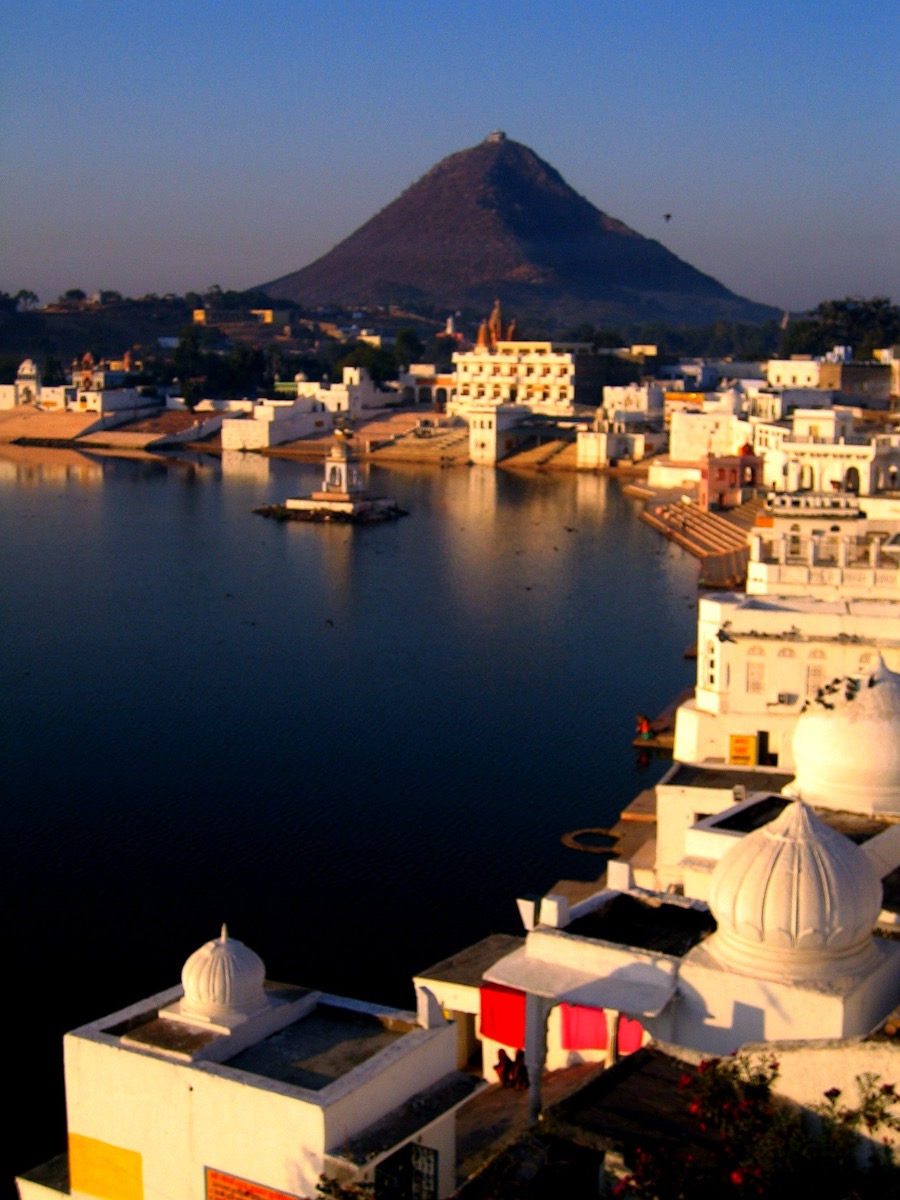
Introduction: The Lake Born of a Lotus
In the arid landscape of western Rajasthan, cradled in a valley of the Aravalli hills, lies one of the most ancient and sacred sites in all of Hinduism: Puṣkara — the “one created by a flower” (puṣpa + kara). This small town, located about 11 kilometres northwest of Ajmer in Rajasthan, is built around a sacred lake that tradition holds to be as old as creation itself, formed when Lord Brahmā dropped a lotus flower from his hand to mark the site where he would perform the first yajña (Vedic fire sacrifice).
Puṣkara’s unique significance in Hindu sacred geography rests on three extraordinary claims: it is home to the only dedicated Brahmā temple in the world; its lake is one of the Pañca Sarovara (five sacred lakes of Hinduism); and it is regarded by tradition as the site where the first Vedic sacrifice was performed by the Creator himself. The Padma Purāṇa (Sṛṣṭi Khaṇḍa, chapters 17-19) devotes extensive attention to the māhātmya (glorification) of Puṣkara, declaring: “Of all tīrthas on earth, Puṣkara is the greatest. Of all yajñas, Puṣkara is the holiest. Even the gods desire to dwell in Puṣkara” (Padma Purāṇa, Sṛṣṭi Khaṇḍa 17.3-4).
The Legend of Brahmā’s Lotus
The Creation of the Lake
According to the Padma Purāṇa and various other Purāṇic sources, Lord Brahmā, the creator deity, was surveying the earth to find a suitable location for performing a great yajña that would establish the cosmic order. He released a lotus from his hand, and the flower fell at three spots, creating three lakes: Jyeṣṭha Puṣkara (the eldest, the main lake), Madhya Puṣkara (the middle lake), and Kaniṣṭha Puṣkara (the youngest lake). These three lakes correspond to the three Puṣkara sites that exist to this day, though the main lake (Jyeṣṭha) is by far the most sacred and the centre of pilgrimage.
Brahmā’s Yajña and the Curse of Sāvitrī
The central legend of Puṣkara involves Brahmā’s great yajña and the circumstances that led to the Goddess Sāvitrī’s curse. When Brahmā was ready to perform the sacrifice, his wife Sāvitrī was not present (in some versions, she was delayed; in others, she refused to come). Since Vedic ritual requires the presence of the yajamāna’s (patron’s) wife, Brahmā married a local maiden, Gāyatrī (in some accounts, a milkmaid or a Gujar girl), and proceeded with the sacrifice.
When Sāvitrī arrived and found Gāyatrī seated in her place beside Brahmā, she was consumed with anger and pronounced a devastating curse: “You shall not be worshipped anywhere in the three worlds.” This curse, according to tradition, explains the extraordinary fact that despite being one of the Trimūrti (the Hindu trinity of Brahmā, Viṣṇu, and Śiva), Brahmā has virtually no temples dedicated to him anywhere in the world — except at Puṣkara.
The Padma Purāṇa tempers the curse: “Though Brahmā shall have no temples elsewhere, at Puṣkara he shall be worshipped until the end of the kalpa, and those who visit his temple shall receive the fruit of a thousand aśvamedha yajñas” (Padma Purāṇa, Sṛṣṭi Khaṇḍa 18.72-73). Sāvitrī herself has a temple on the hill overlooking the lake (the Sāvitrī Temple), and Gāyatrī has a temple near the Brahmā Temple, preserving the complete triangular drama of the legend in the sacred landscape.
The Brahmā Temple
Architecture and Worship
The Brahmā Temple of Puṣkara, dating in its present form primarily to the 14th century (though the site is believed to be far older), is a distinctive structure built of marble and stone. The temple’s most recognizable feature is its red spire (śikhara), which stands out vividly against the blue desert sky. The floor and walls are decorated with silver coins offered by devotees over the centuries, and the entrance features a large stone image of Haṃsa (the swan or goose), Brahmā’s vāhana (vehicle).
The sanctum houses a four-headed image of Lord Brahmā, the Caturmukha Brahmā, with each face oriented to one of the cardinal directions, symbolising Brahmā’s role as the creator who oversees the entire universe. The image is adorned with flowers, sandalwood paste, and saffron, and the daily worship follows a ritual sequence prescribed in the Brahma Purāṇa.
Why Brahmā Has No Other Temple
The question of why the creator deity has virtually no temples is one of the most discussed theological puzzles in Hinduism. Beyond the Sāvitrī curse narrative, several other explanations appear in different Purāṇic and philosophical texts. The Śiva Purāṇa (Vidyeśvara Saṃhitā, chapters 6-7) narrates the story of Brahmā’s lie about finding the top of Śiva’s cosmic liṅga of light, for which Śiva cursed him to have no worship. Philosophical traditions offer a metaphysical explanation: since Brahmā represents creation, and creation is the realm of māyā (illusion), the spiritual seeker naturally gravitates towards Viṣṇu (preservation of dharma) or Śiva (liberation from the cycle), rather than towards the creator of the phenomenal world.
Whatever the explanation, Puṣkara’s uniqueness as the sole site of Brahmā worship gives it an irreplaceable position in Hindu pilgrimage geography.
Puṣkara Lake: One of the Pañca Sarovara
The Five Sacred Lakes
Hindu tradition identifies five sacred lakes (Pañca Sarovara) that are considered the holiest bodies of water for ritual bathing: Mānasarovara (at the foot of Mount Kailāsa), Bindu Sarovara (at Siddhapura, Gujarat), Narayana Sarovara (at Porbandar, Gujarat), Pampa Sarovara (at Hampi, Karnataka), and Puṣkara Sarovara (at Pushkar, Rajasthan). Each of these lakes is associated with specific deities and spiritual benefits, but Puṣkara holds a special position as the lake created by Brahmā’s own lotus and sanctified by his yajña.
The 52 Ghāts
The Puṣkara lake is surrounded by 52 ghāts (stepped bathing places), each named after a deity, sage, or king who is believed to have bathed or performed worship there. The most important include:
- Brahmā Ghāṭ: The principal ghāt, believed to be the spot where Brahmā performed his yajña. Bathing here on Kārtika Pūrṇimā is considered supremely meritorious.
- Varahā Ghāṭ: Named after Viṣṇu’s boar incarnation, who is said to have appeared here.
- Gaū Ghāṭ: Where sacred cows are said to have drunk from the lake in ancient times.
- Jaipur Ghāṭ and Jodhpur Ghāṭ: Built by the Rajput maharajas of these kingdoms.
The ghāts are of various ages, with some dating to the Gupta period (4th-6th centuries) and others to the Mughal and Rajput periods. The sight of the white marble ghāts descending into the blue lake, with the Aravalli hills rising behind and temple spires reflected in the water, is one of the most photographed sacred landscapes in India.
Ritual Practices at the Lake
Bathing in Puṣkara lake is believed to wash away sins and grant spiritual merit equivalent to performing a thousand aśvamedha yajñas (horse sacrifices). Pilgrims perform various rituals at the ghāts, including:
- Snāna (ritual bathing): Particularly auspicious on Kārtika Pūrṇimā, eclipses, and during the month of Kārtika (October-November).
- Piṇḍa dāna (ancestral offerings): Puṣkara is considered one of the most effective sites for performing śrāddha rituals for deceased ancestors.
- Dīpa dāna (lamp offerings): Floating oil lamps on the lake at dusk is a popular devotional practice.
- Puṣpa dāna (flower offerings): Offering flowers, especially lotuses, to the lake.
Vedic and Scriptural Significance
References in the Mahābhārata
The Mahābhārata (Vana Parva, Tīrtha Yātrā Parva, chapters 80-82) contains an extensive account of Puṣkara’s sanctity as narrated by the sage Pulastya to Bhīṣma. Pulastya declares: “He who performs the Agnihotra in Puṣkara for twelve years, or he who bathes there even once with faith, attains the world of Brahmā” (Mahābhārata, Vana Parva 82.36). The epic also describes the various ṛṣis (sages) who performed tapasyā at Puṣkara, including Viśvāmitra, Bharadvāja, and Jamadagni.
References in the Purāṇas
Beyond the Padma Purāṇa’s extensive Puṣkara Māhātmya, the site is mentioned in the Skanda Purāṇa, the Brahma Purāṇa, the Vāyu Purāṇa, and the Matsya Purāṇa. The Skanda Purāṇa describes Puṣkara as the “king of all tīrthas” (tīrtharāja) and states that even the gods perform their most important yajñas here. The Ṛg Veda Saṃhitā itself contains references to a sacred site called Puṣkara, suggesting that the site’s sanctity extends back to the earliest stratum of Hindu scripture.
Other Sacred Sites in Puṣkara
The Sāvitrī Temple
Perched atop Ratnagiri hill overlooking the lake, the Sāvitrī Temple is dedicated to Goddess Sāvitrī, Brahmā’s first wife. Reached by a steep climb (or a ropeway installed in recent years), the temple offers panoramic views of the lake, the town, and the surrounding desert landscape. Many pilgrims visit this temple to seek Sāvitrī’s blessings for marital harmony, and the sunset view from the hilltop is considered one of the most beautiful in Rajasthan.
The Varāha Temple
Near the lake, the Varāha Temple is dedicated to Lord Viṣṇu in his boar (Varāha) incarnation. According to the Bhāgavata Purāṇa (III.13), Varāha lifted the earth from the cosmic waters; the Puṣkara tradition holds that the boar emerged from the lake itself, connecting the site to the mythology of cosmic rescue and renewal.
The Āpteshwar Temple
The Āpteshwar (or Aṭpeshwar) Temple, a Śiva temple located on the lakeside, is believed to date back to the 12th century. According to local tradition, Lord Śiva appeared here to bless Brahmā’s yajña, establishing a Śaiva presence at this predominantly Brāhma tīrtha.
The Raṅgjī Temple
The Raṅgjī Temple (also spelled Rangji), built in the South Indian Dravidian style with a towering gopura, is dedicated to Lord Raṅganātha (Viṣṇu). This Vaiṣṇava temple, built in the 19th century by a South Indian merchant family, introduces a striking architectural contrast to the predominantly Rajasthani-style temples of Puṣkara.
The Puṣkara Camel Fair
The World’s Largest Camel Fair
Every year in the month of Kārtika (October-November), Puṣkara hosts the famous Puṣkara Camel Fair (Puṣkara Melā), one of the world’s largest camel fairs and one of India’s most vibrant cultural events. Lasting approximately five days, the fair combines religious pilgrimage with livestock trading, cultural performances, and rural festivities. Up to 200,000 people and 50,000 camels, horses, and cattle gather on the sand dunes around the town.
The Kārtika Pūrṇimā Climax
The fair culminates on Kārtika Pūrṇimā (the full moon of Kārtika), considered the most auspicious day of the year for bathing in Puṣkara lake. On this night, hundreds of thousands of pilgrims descend to the 52 ghāts for a moonlit bath. The Padma Purāṇa states: “He who bathes in Puṣkara on the full moon of Kārtika is freed from all sins and attains the abode of Brahmā, where he dwells in bliss for millions of years” (Padma Purāṇa, Sṛṣṭi Khaṇḍa 19.45).
The combination of the ancient religious pilgrimage with the colourful desert fair — Rajasthani women in bright ghāghrā-cholīs, moustached Rābaṛī camel herders, folk musicians playing the rāvaṇhāṭhā and the kamaicā — creates an experience that is simultaneously deeply sacred and exuberantly festive.
Environmental Concerns and Conservation
In recent decades, Puṣkara lake has faced significant environmental challenges, including declining water levels, pollution from ritual offerings and urban waste, and encroachment on the lake’s catchment area. The lake, which was once described in the Purāṇas as deep and crystal-clear, has at times during droughts reduced to a fraction of its historical extent.
Conservation efforts by the Rajasthan government, the Puṣkara Temple Management Committee, and various environmental organisations have focused on rainwater harvesting, sewage treatment, restrictions on harmful ritual offerings (such as plastic-wrapped flowers), and the protection of the Aravalli watershed that feeds the lake. The health of Puṣkara lake is understood by devotees and administrators alike as both an ecological and a spiritual imperative.
Conclusion: The Creator’s Own Tīrtha
Puṣkara occupies a singular position in the vast network of Hindu sacred sites. It is the tīrtha of the Creator himself, the site where the first yajña was performed, the lake born from a divine lotus, and the home of the only Brahmā temple in existence. In a religious tradition that encompasses hundreds of thousands of temples and thousands of pilgrimage sites, this uniqueness gives Puṣkara an irreplaceable significance. As the Mahābhārata’s sage Pulastya counsels Bhīṣma: “A man who goes to Puṣkara, even if he merely thinks of going to Puṣkara, is cleansed of all sins and honoured in the world of Brahmā” (Vana Parva 82.40). The lotus that fell from the Creator’s hand continues to bloom in the sacred waters of this ancient lake, and its fragrance draws the faithful from across the world.