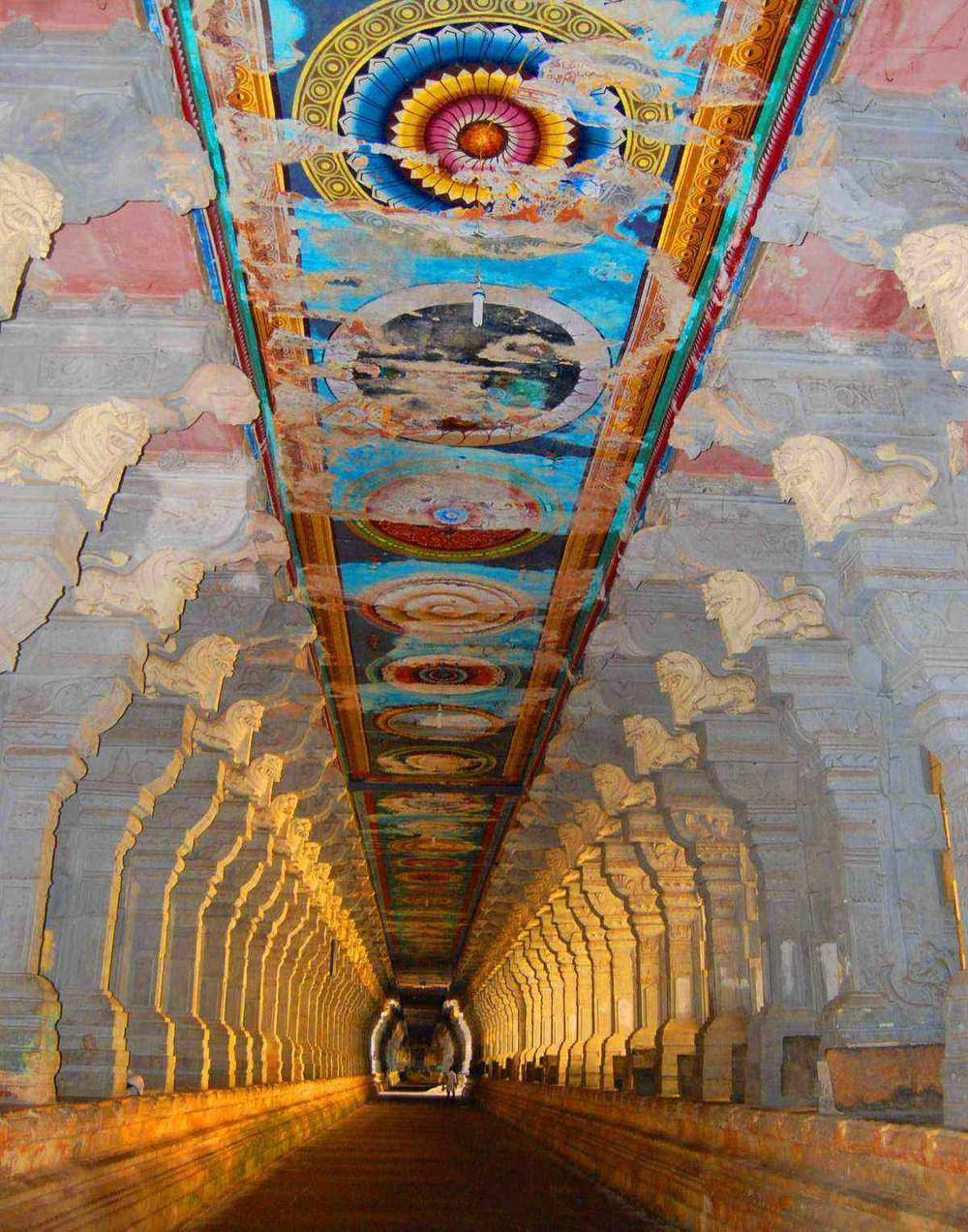
Rāmeshwaram (रामेश्वरम्) is one of the holiest pilgrimage destinations in Hinduism, situated on Pāmban Island in the Gulf of Mannar, at the southeastern tip of the Indian peninsula in Tamil Nadu. Revered as one of the four Char Dhāms (the four sacred abodes that every Hindu aspires to visit in their lifetime) and home to one of the twelve Jyotirlingas (self-manifested lingas of light), Rāmeshwaram occupies a unique place where the traditions of Shaivism and Vaishnavism converge in sacred harmony.
The Rāmāyaṇa Connection
Rāma’s Worship of Shiva
The sanctity of Rāmeshwaram is rooted in the epic Rāmāyaṇa. According to the Vālmīki Rāmāyaṇa (Yuddha Kāṇḍa, Sarga 22), Lord Rāma arrived at the southern shore of Bhārata after crossing forests and mountains in pursuit of the demon king Rāvaṇa, who had abducted Sītā. Before embarking on the perilous crossing to Lankā, Rāma wished to worship Lord Shiva to seek blessings for the success of his campaign and to atone for the sin of killing Rāvaṇa, who was a Brāhmaṇa by birth.
Rāma sent Hanumān to Mount Kailāsa to bring a Shivaliṅga, but when Hanumān was delayed beyond the auspicious hour, Sītā fashioned a liṅga from the sand of the seashore. This sand liṅga, known as Rāmanāthaswāmy (Lord of Rāma, i.e., Shiva who is the Lord worshipped by Rāma), became the main deity of the temple. When Hanumān returned with the stone liṅga from Kailāsa, Rāma, to honour his devotee’s effort, installed it nearby and decreed that worship should first be offered to the Kailāsa liṅga, known as Vishwanāthar or Kāshi Vishwanāth, before the Rāmanāthaswāmy liṅga.
Rāma Setu (Adam’s Bridge)
The Rāma Setu, also known as Adam’s Bridge, is the chain of limestone shoals stretching approximately 48 kilometres between Pāmban Island (Rāmeshwaram) and Mannar Island (Sri Lanka). According to the Rāmāyaṇa (Yuddha Kāṇḍa, Sarga 22-23), this bridge was constructed by the vānara (monkey) army under the engineering guidance of Nala and Nīla, enabling Rāma’s forces to cross the ocean to Lankā.
NASA satellite imagery has confirmed the existence of this submerged chain of shoals, which has fuelled both scientific and devotional interest. The geological formation, whether natural or bearing traces of ancient construction, remains a subject of study and reverence.
Rāmanāthaswāmy Temple
Architecture and the Great Corridor
The Rāmanāthaswāmy Temple is one of the most magnificent temple complexes in India. The temple as it stands today was largely built during the 12th to 17th centuries by the Pandya and Nayak rulers, though worship at the site is believed to date back thousands of years.
The temple’s most celebrated architectural feature is its great corridor (prākāra), which at approximately 1,220 metres (4,000 feet) in total length is the longest corridor in any Hindu temple in the world. The third corridor alone stretches about 197 metres (646 feet), lined with intricately carved granite pillars that create a breathtaking perspective of receding columns. The corridors are adorned with painted ceilings featuring mythological scenes, floral motifs, and geometric patterns that have been maintained and restored over centuries.
The temple complex features a massive gopuram (gateway tower) at the eastern entrance rising to a height of approximately 38.4 metres (126 feet). The temple covers an area of approximately 15 acres and is oriented along an east-west axis.
The Two Liṅgas
The sanctum sanctorum houses the Rāmanāthaswāmy Liṅga, the sand liṅga fashioned by Sītā and consecrated by Rāma. In a separate shrine within the same complex stands the Vishwanāthar Liṅga, the stone liṅga brought by Hanumān from Kailāsa. As per Rāma’s decree, pilgrims traditionally offer worship first at the Vishwanāthar shrine before proceeding to the main Rāmanāthaswāmy shrine, honouring Hanumān’s devotion.
The Twenty-Two Tīrthas (Sacred Wells)
One of the most distinctive aspects of pilgrimage to Rāmeshwaram is the ritual bathing in the temple’s twenty-two tīrthas (sacred wells or tanks). These wells are located within the temple complex, and pilgrims bathe in each one sequentially as an act of purification before entering the main sanctum.
Each tīrtha is believed to possess unique healing and spiritual properties. The tradition holds that bathing in all twenty-two tīrthas washes away sins and purifies the soul. The water in each well differs subtly in taste and temperature, which devotees attribute to their distinct sacred properties. Key tīrthas include:
- Agni Tīrtha — the sea shore itself, where pilgrims first bathe in the ocean
- Mahālakṣmī Tīrtha — associated with prosperity and the blessings of Goddess Lakṣmī
- Savitri Tīrtha — linked to the power of the Gāyatrī mantra
- Gāyatrī Tīrtha — associated with spiritual knowledge
- Saraswatī Tīrtha — connected to learning and wisdom
- Setu Mādhava Tīrtha — associated with Lord Viṣṇu’s blessings
- Śaṅkha Tīrtha — believed to cure skin ailments
- Brahmā Hatyā Vimochana Tīrtha — said to absolve even the gravest sins
Char Dhām Significance
Rāmeshwaram holds the position of the southern Dhām in the Char Dhām pilgrimage circuit established by Ādi Śaṅkarācārya in the 8th century CE. The four Dhāms are:
- Badrīnāth (North) — dedicated to Lord Viṣṇu, in Uttarākhaṇḍ
- Dvārakā (West) — dedicated to Lord Kṛṣṇa, in Gujarāt
- Purī (East) — dedicated to Lord Jagannāth, in Odisha
- Rāmeshwaram (South) — dedicated to Lord Shiva, in Tamil Nāḍu
Together these four sites sanctify the four cardinal directions of the Indian subcontinent, and completing the Char Dhām yātrā is considered one of the highest spiritual accomplishments for a Hindu devotee. Rāmeshwaram is unique among the four in being a Shaiva shrine, balancing the predominantly Vaishnava character of the other three.
Jyotirlinga Status
Rāmeshwaram is counted among the twelve Jyotirlingas, the most sacred Shiva temples where the deity is worshipped as a liṅga of radiant light. According to the Śiva Purāṇa, these twelve sites are places where Shiva manifested as an infinite column of light to assert his supremacy. The Jyotirlinga verse (dvādaśa jyotirliṅga stotram) lists Rāmeśvaram explicitly:
rāmeśaṃ ca ghuśmeśaṃ ca dvādaśaitāni nāmataḥ
The Rāmanāthaswāmy Liṅga, though fashioned from sand by Sītā’s hands, is venerated as a Jyotirlinga due to the divine sanctification by Lord Rāma himself. The convergence of Jyotirlinga and Char Dhām status makes Rāmeshwaram doubly sacred.
Scriptural References
Skanda Purāṇa
The Skanda Purāṇa contains an extensive section called the Rāmeśvara Khaṇḍa (also known as Setu Māhātmya) that glorifies Rāmeshwaram as a kṣetra (sacred field). It describes the spiritual merit of bathing at Setu (the bridge) and worshipping Rāmanāthaswāmy, declaring that even Brahmā and the devas consider pilgrimage to Rāmeshwaram as supremely meritorious.
The Skanda Purāṇa also elaborates the legend that after slaying Rāvaṇa, Rāma returned to Rāmeshwaram to perform a great yajña (fire sacrifice) to absolve the sin of Brahmahatyā (killing a Brāhmaṇa), as Rāvaṇa was learned in the Vedas and was the grandson of the sage Pulastya.
Rāmāyaṇa
The Vālmīki Rāmāyaṇa’s Yuddha Kāṇḍa provides the primary narrative of Rāma’s arrival at the ocean shore, the building of the bridge, and the campaign against Lankā. While the specific installation of the Shivaliṅga is elaborated more fully in later Purāṇic literature and regional traditions, the foundational connection between Rāma and this coastal site is firmly rooted in the oldest version of the epic.
The Pāmban Bridge
The Pāmban Bridge, connecting the island of Rāmeshwaram to mainland India, is itself a landmark of both engineering and pilgrimage. The original rail bridge, opened in 1914, was the first sea bridge in India, spanning approximately 2.06 kilometres across the Pāmban channel. A new road bridge was later constructed alongside it.
The Pāmban channel is known for strong currents and cyclonic weather, making the bridge crossing a dramatic prelude to the pilgrimage. The sight of the open sea on both sides as one crosses to the island has inspired awe in pilgrims for over a century.
Rituals and Worship
Daily Worship
The temple follows a rigorous schedule of daily worship (pūjā) based on Shaiva Āgama traditions. Six pūjās are performed daily, from the pre-dawn Pāliyāmaṛta pūjā to the evening Ardha Jāma pūjā. The rituals involve elaborate abhiṣeka (ritual bathing of the liṅga), alaṅkāra (decoration), and naivedya (food offerings).
Mahā Śivarātri
The most significant festival at Rāmeshwaram is Mahā Śivarātri, when hundreds of thousands of pilgrims gather to observe an all-night vigil of prayer, fasting, and worship. The temple is illuminated with thousands of oil lamps, and the atmosphere is charged with devotion.
Setu Snāna (Ritual Sea Bath)
Pilgrims traditionally begin their Rāmeshwaram pilgrimage with a bath in the sea at Agni Tīrtha, the beach adjacent to the temple. This is followed by the sequential bathing in the twenty-two tīrthas within the temple compound. The entire bathing ritual is considered a powerful act of purification equivalent to performing an aśvamedha yajña (horse sacrifice).
Spiritual Significance
Rāmeshwaram embodies the Hindu ideal of Shaiva-Vaishnava unity. Here, the greatest Vaishnava hero, Lord Rāma, worships Shiva with utmost devotion, demonstrating that the ultimate reality transcends sectarian boundaries. The Skanda Purāṇa declares:
“One who worships Rāmanātha at Setu attains liberation from the cycle of birth and death.”
The island’s geography, at the very edge of the Indian landmass where land meets ocean, adds to its liminal spiritual power. It is a place where the boundaries between the earthly and the divine, between Rāma’s mortal quest and Shiva’s eternal grace, dissolve into sacred unity.
For the devout Hindu, Rāmeshwaram is not merely a destination but a transformative experience — a place where the waters of twenty-two sacred wells, the echoing corridors of an ancient temple, and the salt breeze from the bridge Rāma built all whisper of the eternal dance between devotion and grace.