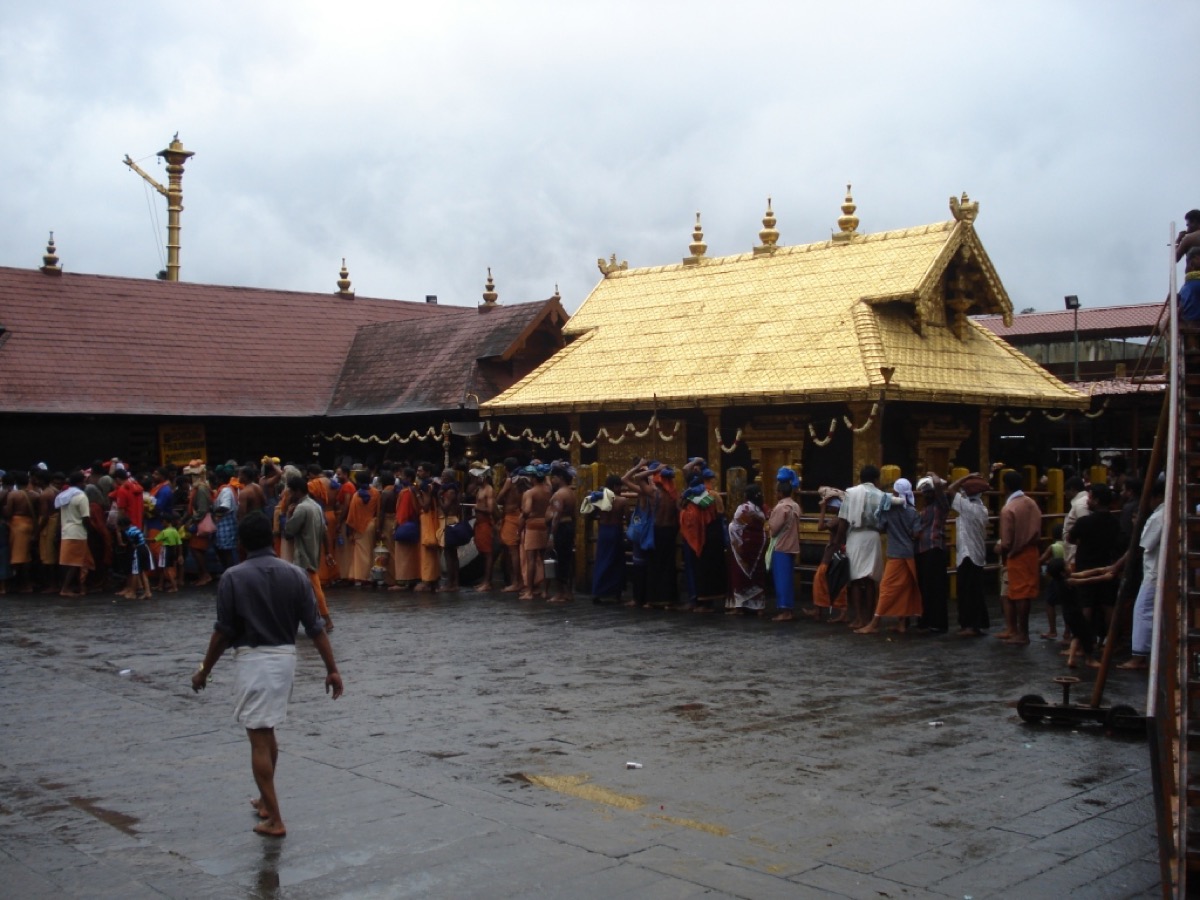
Śabarimalā Śrī Dharma Śāstā Temple (ശബരിമല ശ്രീ ധർമ്മ ശാസ്താ ക്ഷേത്രം), perched at an altitude of 914 metres (3,000 feet) amid the dense forests of the Western Ghats in Pathanamthitta district, Kerala, is one of the most extraordinary pilgrimage sites on Earth. Dedicated to Lord Ayyappan — also known as Dharma Śāstā and Maṇikaṇṭhan — this hilltop shrine draws an estimated 40 to 50 million devotees each year during the Maṇḍalam–Makaravilakku season, making it one of the largest annual gatherings of faith anywhere in the world, comparable in scale to the Kumbha Melā and the Hajj. The temple’s unique theological identity as the shrine of Hariharaputra — the son born of Lord Śiva and Lord Viṣṇu (in his Mohinī avatāra) — represents a rare and powerful synthesis of Śaiva and Vaiṣṇava traditions.
The Legend of Ayyappan: Hariharaputra
The mythology of Śabarimalā is rooted in the story of a divine birth that transcends sectarian boundaries. According to the Bhūtanātha Upākhyāna section of the Brahmāṇḍa Purāṇa, after the gods sought deliverance from the tyranny of a powerful demoness named Mahiṣī, the cosmic forces of Śiva and Viṣṇu converged to produce a saviour.
Mahiṣī was the sister of the infamous buffalo-demon Mahiṣāsura, whom Goddess Durgā had slain. Burning with rage and grief, Mahiṣī performed extreme penance and obtained a boon from Lord Brahmā that she could be destroyed only by a being born from the union of Śiva and Viṣṇu — a condition she believed to be impossible, since both were male deities. Empowered by this near-invincibility, Mahiṣī ravaged the three worlds, terrifying the Devas.
To fulfil the terms of the boon, Lord Viṣṇu assumed the enchanting female form of Mohinī. From the union of Śiva and Mohinī was born a radiant child — Hariharaputra (literally “son of Hari and Hara”), who bore a divine bell around his neck, earning him the name Maṇikaṇṭhan (“the one with a bell at the throat”). The infant was placed on the banks of the Pampā River, where Rājā Rājaśekhara of Paṇḍāḷam discovered and adopted him as his own son.
Maṇikaṇṭhan and the Slaying of Mahiṣī
The prince Maṇikaṇṭhan grew up in the Paṇḍāḷam royal household, displaying extraordinary martial skill and spiritual prowess. As the legend recounts, when the queen feigned illness and demanded tiger’s milk as her cure — a plot orchestrated to send the prince to his death in the forest — Maṇikaṇṭhan fearlessly ventured into the wilderness.
In the deep forests near what is now Erumeli, Maṇikaṇṭhan confronted and slew the demoness Mahiṣī, fulfilling the purpose of his divine incarnation. The Brahmāṇḍa Purāṇa narrates that Mahiṣī was in fact a Gandharva princess named Līlā cursed to assume demonic form, and that upon her death at Ayyappan’s hands, she was released from the curse. According to some traditions, she sought to marry the victorious prince, but Ayyappan, having pledged himself to eternal celibacy (naiṣṭhika brahmacaryam), declined. He promised that he would accept her when no new devotees came to him — a condition that, given his ever-growing following, amounts to perpetual celibacy.
After his triumph, Maṇikaṇṭhan is said to have returned to the palace riding atop a magnificent tiger, surrounded by a retinue of tigers — revealing his divine identity. He then ascended to the hilltop of Śabarimalā, where he merged into the sanctum, establishing his eternal presence. The Paṇḍāḷam Rājā built the first temple at this site, and the royal family of Paṇḍāḷam has maintained hereditary custodianship of specific rituals to this day.
The Eighteen Holy Steps (Pathinettāmpadi)
No feature of Śabarimalā is more iconic than the Pathinettāmpadi — the eighteen sacred steps that every pilgrim must ascend to reach the sanctum sanctorum (Sannidhanam). These steps, originally carved from granite and later covered with pañcalōha (an alloy of gold, silver, copper, iron, and tin) in 1985, carry profound spiritual symbolism.
Multiple interpretive traditions explain the significance of the number eighteen:
- The Five Senses (Pañcēndriya): Steps 1–5 represent the five sensory faculties — sight, hearing, smell, taste, and touch — which the devotee symbolically surrenders.
- The Eight Emotions (Aṣṭarāga): Steps 6–13 represent the eight emotions or mental tendencies — kāma (desire), krodha (anger), lobha (greed), moha (delusion), mada (pride), mātsarya (jealousy), asuya (malice), and dambha (vanity).
- The Three Guṇas: Steps 14–16 represent the three fundamental qualities of nature — sattva, rajas, and tamas.
- Knowledge and Ignorance: Steps 17 and 18 represent vidyā (knowledge) and avidyā (ignorance).
Another tradition holds that Lord Ayyappan was a master of eighteen weapons, and as he ascended to merge into the sanctum, he surrendered one weapon at each step. Yet another interpretation connects the eighteen steps to the eighteen hills that surround the Śabarimalā temple complex within the Periyar Tiger Reserve.
Only those devotees who carry the sacred Irumuḍikettu (the two-compartment bundle of offerings) and have completed the 41-day vratham are permitted to ascend the Pathinettāmpadi. A pilgrim who has climbed these steps eighteen times earns the title of Guruswāmī and, as tradition requires, must plant a young coconut tree at the Sannidhanam.
The 41-Day Vratham: A Discipline of Renunciation
The preparation for the Śabarimalā pilgrimage is itself a transformative spiritual practice. For 41 days before the journey, every pilgrim must observe a strict vratham (vow of austerity) that fundamentally reorders daily life:
- Dietary discipline: Complete vegetarianism; no alcohol, tobacco, or intoxicants.
- Celibacy: Strict abstinence from sexual activity.
- Dress code: Wearing only black or dark blue clothing, symbolizing renunciation and equality — every pilgrim, regardless of caste, wealth, or social status, appears identical.
- Barefoot walking: Devotees go barefoot throughout the vratham period.
- Daily worship: Twice-daily prayers, typically at dawn and dusk, with the continuous chanting of the mantra “Swāmiyē Śaraṇam Ayyappā” (“Lord, you are my refuge, Ayyappā”).
- Mālā-dhāraṇam: Wearing a sacred tulasī or rudrākṣa bead necklace with a locket bearing Lord Ayyappan’s image, received from a guru in a formal ceremony.
This 41-day period corresponds to the Maṇḍalam season (mid-November to late December) and mirrors the period of intense meditation that Lord Ayyappan himself is said to have observed. The vratham cultivates tapaḥ (austerity), śama (mental tranquility), and dama (self-control) — the very qualities extolled in the Bhagavad Gītā (16.1–3) as marks of the divine temperament.
During the vratham, every male devotee addresses and is addressed as “Swāmī” — erasing distinctions of caste, class, and social hierarchy. This radical egalitarianism is central to the Ayyappan tradition and gives the pilgrimage its unique communal character.
The Irumuḍikettu: The Sacred Bundle
Before departing for Śabarimalā, devotees prepare the Irumuḍikettu in a ceremony called Keṭṭunīra. This is a cloth bundle with two compartments:
- Muṉmuḍi (front compartment): Contains offerings for the deity — a coconut filled with ghee (nei abhiṣēkam), camphor, incense, sandalwood paste, turmeric, and other pūjā materials.
- Piṉmuḍi (rear compartment): Holds the pilgrim’s personal provisions — rice, jaggery, and other simple food items for the journey.
The Irumuḍikettu is placed on the devotee’s head and must be carried throughout the trek. Only those bearing this sacred bundle are permitted to climb the Pathinettāmpadi.
Erumeli and the Tradition of Petta Thullal
The pilgrimage traditionally begins at Erumeli, a town about 80 kilometres from Śabarimalā that holds special significance as the site where Maṇikaṇṭhan slew the demoness Mahiṣī. Erumeli is home to both the Dharma Śāstā Temple (Vaḷiyambalam and Ceriyambalam) and the Vāvar Paḷḷi (mosque), and it is here that one of the most extraordinary rituals of the pilgrimage takes place.
Petta Thullal is a frenzied, ecstatic dance performed by thousands of devotees in the streets of Erumeli. Smeared with turmeric and other colours, the pilgrims dance in wild abandon, re-enacting Lord Ayyappan’s victorious battle against Mahiṣī. The dance begins at the Ceriyambalam temple, surges through the town, and culminates at the Vāvar mosque — a powerful expression of the interfaith harmony that is central to the Śabarimalā tradition. Drums, chanting, and the rhythmic stomping of feet create an atmosphere of primal spiritual energy, as devotees shed their inhibitions and social identities in a cathartic celebration of good triumphing over evil.
The Vāvar Tradition: A Model of Interfaith Harmony
One of the most remarkable aspects of the Śabarimalā pilgrimage is the veneration of Vāvar Swāmī, a Muslim warrior-saint who, according to legend, was a devoted companion and sworn friend of Lord Ayyappan. The tradition holds that Vāvar fought alongside Maṇikaṇṭhan against Mahiṣī and her demonic forces at Erumeli. After the victory, when Ayyappan departed for Śabarimalā, he asked Vāvar to remain at Erumeli and instructed his devotees to always visit Vāvar first before proceeding to Śabarimalā.
This tradition has been honoured for centuries. The Vāvar Paḷḷi (Vāvar Mosque) at Erumeli, believed to be over 500 years old, stands between the two Hindu temples and is a mandatory stop for pilgrims on the traditional forest route. Hindu pilgrims enter the mosque, pay their respects, and receive kaṣāyam (a herbal preparation) before continuing their trek. The annual Candanakkuṭam (sandalwood pot) procession — in which a pot of sandalwood paste is ceremonially carried from the mosque to Śabarimalā — further embodies this interfaith bond.
This tradition of communal amity has prompted scholars and observers to describe Śabarimalā as a living example of India’s syncretic spiritual heritage, where the boundaries between religious communities dissolve in shared devotion.
The Temple: Architecture and Sacred Geography
The Śabarimalā Sannidhanam (temple complex) sits atop a hill surrounded by eighteen peaks within the Periyar Tiger Reserve, one of India’s most important wildlife sanctuaries. The sacred geography reinforces the temple’s character as a place of wilderness and renunciation — far from the comforts of civilization.
The temple itself is modest in size compared to the vast South Indian temple complexes. The garbhagṛha (sanctum sanctorum) houses the iconic pañcalōha (five-metal alloy) idol of Lord Ayyappan, about one and a half feet tall, depicted in his signature yogapattāsana posture — seated with a yogapaṭṭa (meditation band) around his knees, right hand in cinmudrā (the gesture of supreme consciousness). This idol replaced an earlier stone image after a devastating fire destroyed the temple in 1950.
The golden-roofed sanctum, the kodimaram (flagstaff), and the surrounding maṇḍapams form the core of the complex. The Māḷikappuṟattu Dēvī Temple, dedicated to the goddess associated with the Mahiṣī legend, is located nearby. The Pampā River — Kerala’s third longest river, revered as the Dakṣiṇa Gaṅgā (Ganges of the South) — flows at the base of the hill. Pilgrims take a purificatory bath (snānam) in the Pampā before beginning their ascent, mirroring the Vedic injunction to purify oneself before approaching the divine.
Maṇḍalam and Makaravilakku: The Pilgrimage Season
The temple opens for worship only during specific periods: the Maṇḍalam season (mid-November to late December, 41 days), Makaravilakku (around 14 January, corresponding to Makara Saṅkrānti), the Viṣu festival period (mid-April), and the first five days of each Malayalam month.
The Maṇḍalam Season
The Maṇḍalam season, commencing on the first day of the Malayalam month of Vṛścikam (mid-November), is the principal pilgrimage window. For 41 days, an unbroken stream of devotees — all clad in black, all barefoot, all carrying their Irumuḍikettu — trek through the forested hills to the Sannidhanam. The chant of “Swāmiyē Śaraṇam Ayyappā” echoes through the Western Ghats day and night, creating an extraordinary sonic and spiritual atmosphere.
Makara Jyōti and the Makaravilakku Festival
The culmination of the pilgrimage season is the Makaravilakku festival, held on the evening of Makara Saṅkrānti (14 January). As millions of devotees gather at the Sannidhanam, a brilliant flame — the Makara Jyōti — appears on the distant hilltop of Poṉṉambalamēḍu, approximately eight kilometres east of the temple. This flame, lit by the Travancore Dēvaswōm Board on the sacred hillock, coincides with the rising of the star Sirius (Makara Jyōti in astronomical terms) directly above it — creating a spectacular celestial-terrestrial conjunction that devotees regard as a divine manifestation.
At the very moment the Makara Jyōti is sighted, the sacred ornaments (Tiruvābharaṇam) — comprising the gold thidambu (divine casket) and ceremonial jewellery — are brought in a grand procession from the Paṇḍāḷam Palace and displayed before the deity. The confluence of the Makara Jyōti, the display of the Tiruvābharaṇam, and the overwhelming devotion of millions creates what many pilgrims describe as the most powerful spiritual experience of their lives.
Scale of the Pilgrimage
The sheer magnitude of the Śabarimalā pilgrimage defies easy comprehension. During a typical Maṇḍalam–Makaravilakku season:
- 40–50 million devotees visit the temple over approximately 60 days.
- On peak days, especially around Makaravilakku, crowds of 500,000 to 1 million pilgrims may be present simultaneously.
- The pilgrim trail stretches over 60 kilometres through dense forest from the base camps to the Sannidhanam.
- The pilgrimage has been compared in scale to the Kumbha Melā and the Hajj, and is among the top five largest periodic religious gatherings in the world.
The Kerala government deploys massive infrastructure — temporary medical camps, police contingents, fire services, and deforestation management — to support this annual influx. The Travancore Dēvaswōm Board, which administers the temple, coordinates operations that rival the logistical complexity of military campaigns.
The Women’s Entry Debate: Tradition and Constitutional Rights
Śabarimalā has been at the centre of one of India’s most significant legal and cultural debates in recent decades. Traditionally, women of menstruating age (approximately 10–50 years) were barred from entering the temple, based on Lord Ayyappan’s vow of celibacy (naiṣṭhika brahmacarya). Devotees maintained that this was not a discriminatory practice but an essential element of the deity’s svabhāva (inherent nature) — since Ayyappan is worshipped in his brahmacārī (celibate) form at Śabarimalā, the restriction was considered integral to the temple’s religious character.
On 28 September 2018, the Supreme Court of India, in a 4:1 verdict, struck down the age-based restriction as violating the right to equality (Article 14) and freedom of religion (Article 25) under the Indian Constitution. Justice Indu Malhotra, the sole dissenting voice, argued that the court should not interfere with the essential religious practices of a faith community.
The verdict triggered massive protests across Kerala and India, with millions of devotees opposing the decision. In November 2019, a larger bench of the Supreme Court, by a 3:2 majority, kept the matter pending for further review. The issue remains unresolved and continues to generate intense debate between those who view the restriction as unconstitutional discrimination and those who regard it as a protected religious practice tied to the specific form in which the deity is worshipped.
Spiritual Significance: The Path of Tattvamasi
The Śabarimalā pilgrimage is often interpreted through the lens of Advaita Vedānta. The greeting “Tattvamasi” (“Thou art That,” from the Chāndōgya Upaniṣad 6.8.7) is traditionally exchanged between Ayyappan devotees, affirming the Advaitic teaching that the individual self (ātman) is identical with the ultimate reality (Brahman). The entire pilgrimage — the 41 days of austerity, the shedding of social identity, the trek through the wilderness, the ascent of the eighteen steps, and the final darśan of the deity — is understood as an enacted metaphor for the spiritual journey from ignorance to liberation.
In this reading, the dense forest represents saṃsāra (the cycle of worldly existence), the physical hardship of the trek represents tapas (austerity), the surrender at each of the eighteen steps represents the progressive letting go of attachments, and the final vision of Lord Ayyappan in cinmudrā represents the realization of one’s true nature as Brahman. The chant “Swāmiyē Śaraṇam Ayyappā” is itself a practice of śaraṇāgati (total surrender), the culminating act of bhakti that the Bhagavad Gītā (18.66) prescribes as the supreme path: sarvadharmān parityajya mām ekaṃ śaraṇaṃ vraja — “Abandoning all dharmas, take refuge in Me alone.”
Śabarimalā thus stands not merely as a temple but as a complete spiritual ecosystem — a place where forest, hill, river, ritual, and renunciation converge to create one of the most intense and transformative pilgrimage experiences in the Hindu world.