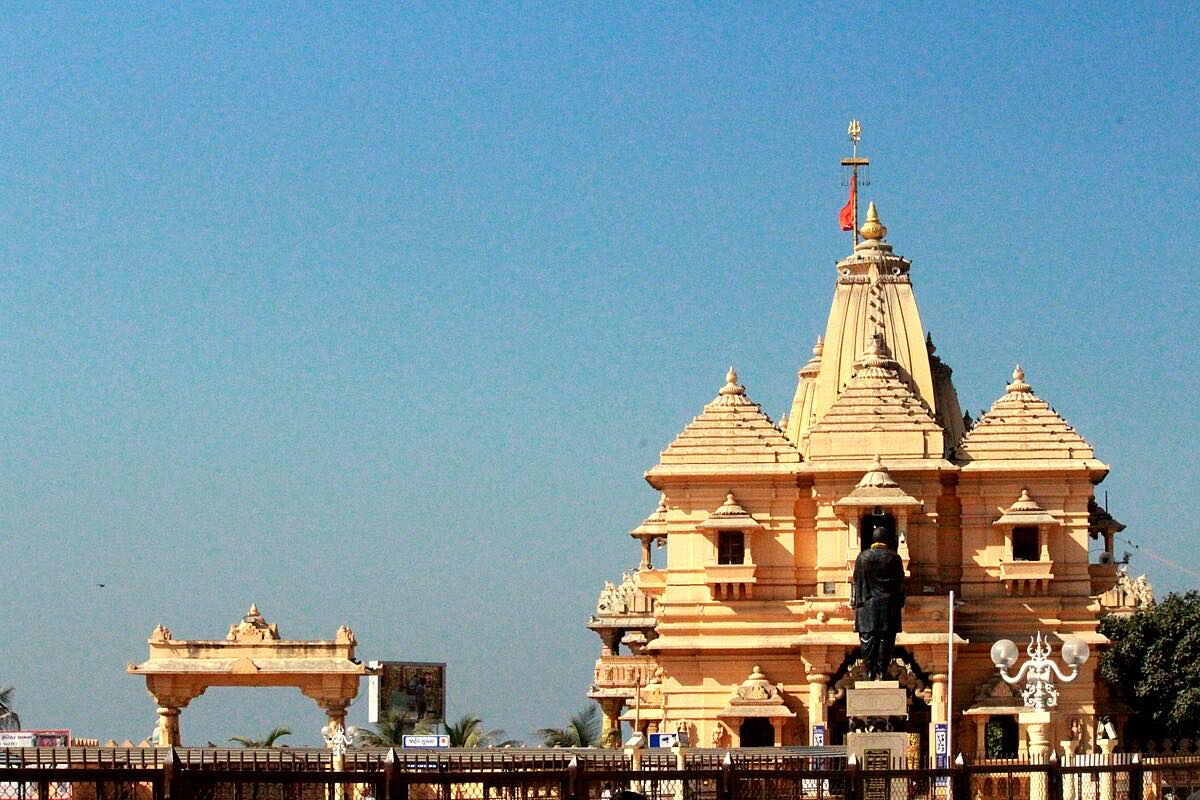
The Somnath Temple, standing majestically on the western coast of Gujarat at Prabhās Patan near Verāval, is revered as the first among the twelve sacred Jyotirlingas of Lord Shiva. Its name, derived from Sanskrit — Soma (the Moon god) and Nātha (Lord) — means “Lord of the Moon.” Across millennia, this temple has been destroyed and rebuilt at least seventeen times, making it one of the most powerful symbols of resilience and undying faith in the Hindu tradition.
The Legend of Soma and the Curse of Daksha
The origin of Somnath is rooted in an ancient Puranic narrative found in the Shiva Purāna and the Skanda Purāna. Soma (Chandra), the Moon god, was married to the twenty-seven daughters of Daksha Prajāpati, each representing a nakshatra (lunar constellation). However, Soma was deeply enamoured with Rohini and neglected his other wives. The aggrieved daughters complained to their father, and Daksha — after repeated warnings went unheeded — cursed Soma to waste away, losing his radiance and slowly fading into darkness.
As the Moon waned, the world was plunged into distress. The gods, sages, and all beings who depended on the Moon’s nourishing light appealed to Lord Brahmā for relief. Brahmā advised Soma to seek refuge in Lord Shiva and perform penance at the sacred Prabhāsa Kshetra on the shores of the Arabian Sea. Soma devotedly worshipped a Shivalinga at this spot, reciting the Mahāmrityunjaya Mantra and performing severe austerities.
Pleased with Soma’s devotion, Lord Shiva appeared and partially lifted the curse — decreeing that the Moon would wax and wane in a perpetual cycle, growing full for fifteen days and then diminishing for fifteen days. In gratitude, Soma built the first temple at this site, and the Shivalinga became known as Somnātha — the Lord who liberated Soma. The Shiva Purāna (Kotigeshwara Samhita, Chapter 12) records this as the establishment of the first Jyotirlinga, a self-manifested pillar of light representing the infinite nature of Shiva.
The Twelve Jyotirlingas and Somnath’s Pre-eminence
The concept of the Dvādasha Jyotirlinga — twelve self-manifested lingas of radiant light — is central to Shaiva devotion. The celebrated verse enumerating them begins:
Saurāshtre Somanātham cha Shrīshaile Mallikārjunam…
Somnath is named first, affirming its primacy. According to the Shiva Purāna, when Brahmā and Vishnu debated who was supreme, Shiva manifested as an endless column of fire — the original Jyotirlinga — that neither could find the beginning nor end of. The twelve Jyotirlingas on earth are believed to be places where this cosmic light pierced through, and Somnath at Prabhāsa Tīrtha is the foremost among them.
The Mahābhārata (Vana Parva, Chapters 118-119) also references Prabhāsa as one of the holiest tīrthas, where Lord Krishna spent his final days and where the Yādava dynasty met its end. This layering of sacred narratives makes Somnath one of the most scripturally significant sites in all of Hinduism.
A History of Destruction and Reconstruction
No temple in India — perhaps in the world — embodies the spirit of civilizational resilience as powerfully as Somnath. Historical records indicate that the temple was destroyed and rebuilt numerous times across the centuries:
The Ancient Temples
The earliest temple is traditionally believed to have been built by Soma himself in gold, then rebuilt by Rāvana in silver, by Lord Krishna in wood, and finally by King Bhimadeva I of the Solanki dynasty in stone around 1026 CE. While the gold and silver origins belong to sacred lore, archaeological evidence confirms the existence of substantial temple structures at the site from at least the early centuries of the Common Era.
Mahmud of Ghazni (1025-1026 CE)
The most historically documented destruction came at the hands of Mahmud of Ghazni in 1025-1026 CE. The Turkic sultan led a massive military expedition specifically targeting Somnath. According to the Persian chronicler al-Biruni and later accounts, the temple was enormously wealthy, with thousands of Brahmins serving the deity and donations flowing from across the subcontinent. Mahmud’s forces looted the temple treasury, demolished the structure, and carried away the famed Shivalinga’s fragments. Yet within decades, the temple was rebuilt by the Paramāra King Bhoja of Malwa and the Solanki King Bhimadeva I of Gujarat.
Subsequent Invasions
The temple endured further destructions by Allauddin Khalji’s generals in 1296 CE, by Muzaffar Shah I of the Gujarat Sultanate in 1394 CE, and again by Aurangzeb in 1665 CE, who ordered the temple demolished and a mosque constructed at the site. After each destruction, Hindu rulers and communities rebuilt the temple, often within a generation — a testament to the unshakeable devotion of the faithful.
The Modern Reconstruction
After India’s independence in 1947, Sardār Vallabhbhai Patel, India’s first Deputy Prime Minister and the architect of the nation’s political integration, visited the ruins of Somnath in November 1947. Deeply moved, he pledged that the temple would be rebuilt as a symbol of India’s cultural renaissance. Patel declared:
“The Somnath temple signifies that the power of reconstruction is always greater than the power of destruction.”
Patel initiated the reconstruction project, which was carried forward after his death in 1950 by K.M. Munshi and the Somnath Trust. The new temple was consecrated on 11 May 1951, with the first President of India, Dr. Rajendra Prasad, installing the Jyotirlinga. The reconstruction was a deeply emotional moment for the newly independent nation.
Architectural Splendour: The Chalukya-Solanki Style
The present Somnath temple is built in the Chālukya (also called Māru-Gurjara or Solanki) style of temple architecture, characterized by intricate stone carvings, a soaring shikhara (spire), and precise geometric proportions. Key architectural features include:
- Garbhagriha (sanctum sanctorum): Houses the sacred Jyotirlinga, worshipped daily with abhisheka (ritual bathing) of milk, water, and bilva leaves
- Sabhā Mandapa (assembly hall): A grand pillared hall where devotees gather for darshan and aarti
- Nritya Mandapa (dance hall): Reflecting the tradition of temple dance offerings to the deity
- Shikhara (spire): Rising approximately 50 metres, elaborately carved with deities, celestial beings, and geometric motifs
- Dhvajā Stambha (flag pillar): The temple flag flies atop a tall pillar, visible from great distances along the coast
The temple faces east, towards the Arabian Sea, and the play of sunrise light upon its sandstone facade creates a breathtaking golden illumination — reminiscent of its legendary origins as a temple of gold.
The Bāna Stambha: The Arrow Pillar
One of the most fascinating features of the Somnath temple complex is the Bāna Stambha (Arrow Pillar), erected on the sea-facing terrace of the temple. An inscription on this pillar declares that from this point on the coastline, there is no land in a straight line southward until one reaches Antarctica — the next landmass being the frozen southern continent. This pillar, pointing across the vast Indian Ocean, symbolizes the ancient Indian understanding of global geography and the temple’s position at the very edge of the subcontinent.
The concept is referenced in the traditional phrase *“Āsamudra,” *meaning “unto the ocean” — signifying that the temple stands at the boundary where the sacred land of Bhārata meets the infinite waters.
Scriptural References and Pilgrimage Significance
The Somnath tīrtha is referenced across a remarkable breadth of Hindu scriptures:
- Shiva Purāna (Kotigeshwara Samhita): Narrates the origin of the Jyotirlinga and Soma’s penance
- Skanda Purāna (Prabhāsa Khanda): An entire section dedicated to the glories of Prabhāsa Kshetra, enumerating the merits of pilgrimage
- Mahābhārata (Vana Parva and Mausala Parva): Describes Prabhāsa as a paramount tīrtha; the site of Krishna’s final leela
- Rig Veda (10.85): Contains hymns to Soma whose liberation by Shiva is the temple’s founding narrative
The Skanda Purāna prescribes that a pilgrim who bathes in the sacred Triveni Sangama at Prabhāsa — where the rivers Hirana, Kapilā, and Sarasvatī meet the sea — and takes darshan of the Jyotirlinga, is freed from all sins and attains the merit of performing a thousand ashvamedha yajnas.
Somnath Today: A Living Pilgrimage
Today, the Somnath temple is managed by the Shree Somnath Trust, originally chaired by Sardār Patel and later by K.M. Munshi. The temple complex includes:
- Light and Sound Show: A nightly presentation narrating the temple’s history, held at the old temple ruins adjacent to the new structure
- Somnath Museum: Houses artefacts, sculptural fragments, and historical records from the temple’s many incarnations
- Prabhāsa Pātan: The surrounding sacred precinct with temples dedicated to various deities, including Bhālkā Tīrtha (where Lord Krishna was struck by the hunter’s arrow) and Dēhotsarga (where Krishna left his mortal body)
- Triveni Sangama Ghāt: The sacred confluence for ritual bathing
The temple conducts elaborate daily puja, with the Shringar Aarti at dawn, Madhyāhna Aarti at noon, and the magnificent Sandhyā Aarti at dusk, when oil lamps illuminate the temple against the backdrop of the setting sun over the Arabian Sea.
Spiritual Significance
Somnath is far more than a historical monument. It is a living testimony to the Hindu understanding that the sacred cannot be permanently destroyed. Each reconstruction was not merely an architectural act but a spiritual assertion — that dharma endures, that devotion outlasts aggression, and that the light of Shiva’s Jyotirlinga is truly eternal and self-manifested.
For the millions of pilgrims who visit each year, Somnath represents the first point in the sacred geography of the Jyotirlinga circuit, the beginning of a journey through the luminous presence of Mahādeva across the length and breadth of Bhārata. To stand before the Somnath Jyotirlinga is to stand at the point where mythology, history, and living faith converge in an unbroken stream stretching back to the very origins of Hindu civilization.
Om Namah Shivāya — May the eternal light of Somnātha illuminate the path of all seekers.