Introduction: The Temple That Is a City
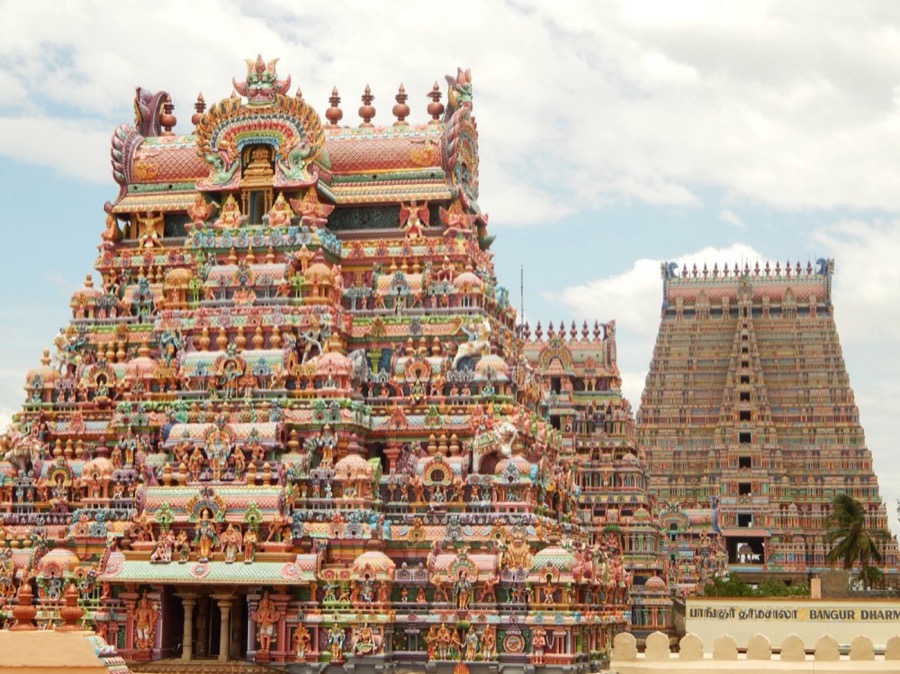
On a verdant island cradled between the twin channels of the Kāverī and the Koḷḷiḍam (Coleroon) near Tiruchirapalli in Tamil Nadu, the Śrī Raṅganāthasvāmī Temple at Śrīraṅgam rises as the largest functioning Hindu temple complex in the world. Spanning an extraordinary 156 acres (63 hectares), enclosed within seven concentric prākāras (fortified walls), pierced by 21 towering gopurams (gateway towers), and containing 81 separate shrines, the temple is not merely a place of worship — it is an entire sacred city, a terrestrial Vaikuṇṭha (heaven of Viṣṇu) manifested in stone.
The presiding deity is Lord Raṅganātha — Viṣṇu in his Yoga Nidrā (cosmic sleep) posture, reclining on the serpent Ādiśeṣa with his consort Śrī (Lakṣmī) at his feet. This reclining form, facing south (an unusual orientation explained by multiple legends), is one of the most beloved images of Viṣṇu in all of Hinduism. The Āḻvārs — the twelve Tamil poet-saints of the Bhakti movement — poured their most passionate devotion into hymns celebrating Raṅganātha, and their collective work, the Nālāyira Divya Prabandham (4,000 Sacred Compositions), accords Śrīraṅgam the supreme position among all 108 Divya Desams.
The Seven Prākāras: A Temple Within a Temple
Architecture of the Sacred
Śrīraṅgam’s most distinctive architectural feature is its system of seven concentric rectangular enclosures (prākāras), each defined by massive stone walls and entered through monumental gopurams. This layered design creates a progressive journey from the profane to the sacred, from the outer world of commerce and daily life to the innermost sanctum where Raṅganātha reclines in eternal repose.
The Outer Prākāras (7th to 5th): The outermost three enclosures function as a living town. Shops, residences, schools, and markets occupy the streets between the walls, and an entire community of temple functionaries, devotees, and merchants has lived within the temple’s embrace for centuries. The seventh prākāra, the outermost, was added during the Vijayanagara period (14th-17th century CE) and its wall remains partially unfinished.
The Middle Prākāras (4th and 3rd): These enclosures mark the transition from secular to sacred space. The celebrated 1000-Pillar Maṇḍapa (Kiḷi Maṇḍapam) stands in the fourth prākāra, a Vijayanagara-era marvel whose name refers to the parakeets (kiḷi) that once roosted in its stone rafters. Each pillar is carved with rearing horses (yāḷi), celestial dancers, and scenes from the Rāmāyaṇa and Bhāgavata Purāṇa. The Śeṣarāyar Maṇḍapa, also in this zone, is a massive granite hall with monolithic pillar-sculptures of legendary proportions.
The Inner Prākāras (2nd and 1st): Entry to these enclosures requires removing footwear and passing through ritual gateways. The second prākāra houses the shrine of Raṅganāyakī (Lakṣmī), the Goddess consort, and several important subsidiary shrines. The innermost prākāra, the sanctum sanctorum, contains the garbhagṛha where Raṅganātha reclines on Ādiśeṣa. Only Hindus are permitted within the innermost two enclosures, a tradition maintained since the temple’s founding.
The Rāja Gopuram
The Rāja Gopuram (Royal Gateway Tower) of the southern entrance to the first prākāra, completed in 1987 after centuries of work, rises to 72 metres (236 feet), making it one of the tallest gopurams in Asia. Its thirteen tiers are adorned with thousands of stucco figures depicting Viṣṇu’s avatāras, scenes from the epics, and celestial beings. Older gopurams in the inner prākāras, dating to the Chōḻa and Pāṇḍya periods (10th-14th centuries), display the evolution of Drāviḍa architectural styles across half a millennium.
Mythological Origins: The Liṅga That Rāma Worshipped
From Vaikuṇṭha to the Kāverī
The origin legend of the Raṅganātha vigraha (sacred image) connects the celestial and the terrestrial in a chain of divine transmission. According to the Śrīraṅga Māhātmya (a section of the Garuḍa Purāṇa and Brahmāṇḍa Purāṇa), the image of Raṅganātha originally resided in Vaikuṇṭha, Viṣṇu’s eternal abode. Brahmā, the creator-god, obtained the image through devoted worship and installed it in his own realm (Satya Lōka). From Brahmā, the image passed to the Solar Dynasty (Sūrya Vaṃśa) kings, who worshipped it through generations until it reached Rāma himself.
After the great war of the Rāmāyaṇa, Vibhīṣaṇa — the righteous brother of Rāvaṇa who had allied with Rāma — requested the Raṅganātha image as a gift. Rāma granted it, but with the condition that the image must never be set down during the journey to Laṅkā, for wherever it was placed, it would remain permanently. As Vibhīṣaṇa traveled southward, he paused at the island between the Kāverī and Koḷḷiḍam to perform evening sandhyā (twilight prayers). He entrusted the image to a young Brahmin boy — who was actually Gaṇeśa in disguise — and the boy placed the image on the ground. Despite Vibhīṣaṇa’s pleas, Raṅganātha declared that he wished to remain at this beautiful island, but as a consolation, he turned his face southward toward Laṅkā, so that Vibhīṣaṇa could always receive his grace.
This legend explains Raṅganātha’s distinctive south-facing orientation and establishes the temple’s claim to antiquity stretching back to the age of Rāma.
The Chōḻa King and the Discovery
Historical tradition attributes the “rediscovery” of the ancient temple to the early Chōḻa king Dharmavarman, who is said to have found the original shrine buried under dense forest while following a parrot that was chanting Vedic hymns. The king cleared the forest, uncovered the sanctum, and began the construction of the prākāra system that would grow over the next millennium.
The Āḻvārs: Poets of Divine Love
Nammāḻvār: The Supreme Among Saints
No discussion of Śrīraṅgam is complete without the Āḻvārs, the twelve Tamil Vaiṣṇava poet-saints whose hymns (6th-9th century CE) form the devotional bedrock of Śrī Vaiṣṇavism. Among them, Nammāḻvār (Śaṭhakōpan) holds the supreme position. His Tiruvāymōḻi — 1,102 verses of ecstatic devotion — is considered the “Tamil Veda” and is recited in its entirety during the annual Vaikuṇṭha Ēkādaśī festival at Śrīraṅgam.
Nammāḻvār’s verses to Raṅganātha throb with the ache of love-in-separation (viraha):
āṟṟēṉ vaḻi muḻuvatum āṟṟēṉ aravil tuyilum empirāṉ mēl aṉpu āṟṟēṉ
“I cannot endure the path, I cannot endure the fullness of love for my Lord who sleeps upon the serpent.”
The Śrī Vaiṣṇava tradition accords the Nālāyira Divya Prabandham equal status with the Sanskrit Vedas, and its ritual recitation (ārāyiram paṭṭi) is an integral part of daily worship at Śrīraṅgam.
Āṇḍāḷ: The Bride of Raṅganātha
Āṇḍāḷ (Gōdā Dēvi), the only female Āḻvār, is uniquely connected to Śrīraṅgam. Her Tiruppāvai — thirty verses sung during the Tamil month of Mārgazhi (December-January) — describes her longing to marry Lord Raṅganātha. According to tradition, Āṇḍāḷ’s devotion was so intense that she ultimately merged with the deity at Śrīraṅgam, becoming his eternal consort. The Tiruppāvai is recited every morning at the temple during Mārgazhi and is one of the most beloved devotional poems in Tamil literature.
Āṇḍāḷ’s other major work, the Nācciyār Tirumōḻi, contains the famous lines:
vaṭṭa nilaā kōṭṭ’ araviṉ mēl vaṇṭuyilum māl kaṭṭuraittu eṉ kaṭṭu viḻi kaḻikka vēṇum
“The Lord who sleeps in cosmic rest upon the coiled serpent — He alone can untie the knots of my longing eyes.”
Śrī Vaiṣṇavism: The Theological Centre
The Ācārya Tradition
Śrīraṅgam is the spiritual capital of Śrī Vaiṣṇavism, the philosophical and devotional tradition founded by Rāmānuja (1017-1137 CE). Rāmānuja himself spent the final decades of his life at Śrīraṅgam, where he composed his magnum opus, the Śrī Bhāṣya (commentary on the Brahma Sūtras), systematised temple worship, and established the administrative and liturgical structures that govern the temple to this day.
Rāmānuja’s theological contributions at Śrīraṅgam were revolutionary:
-
Viśiṣṭādvaita: He articulated the doctrine of “qualified non-dualism,” affirming that individual souls and the material world are real attributes of Brahman (Viṣṇu), neither identical to nor separate from the divine.
-
Temple reform: He democratised worship by opening temple rituals to devotees of all castes, arguing from scripture that Viṣṇu’s grace knows no social barriers.
-
Dual Vedānta: He established the practice of reciting both the Sanskrit Vedas and the Tamil Prabandham during temple rituals, honouring both the Sanskritic and Tamil devotional traditions as co-equal paths to the divine.
Rāmānuja’s mortal remains are enshrined in the temple in a sanctum called the Tiru Nārāyaṇa Tirumantram, where his preserved image receives daily worship as though he were still a living saint.
After Rāmānuja, the tradition divided into two sub-schools: the Vaṭakalai (Northern School), following Vedānta Deśika, and the Teṉkalai (Southern School), following Piḷḷai Lokācārya. Both schools maintain active presence at Śrīraṅgam, and their theological debates on the nature of divine grace — the “cat school” (mārjāra nyāya, where God actively saves the soul) versus the “monkey school” (markaṭa nyāya, where the soul must cling to God) — remain among the most subtle philosophical discussions in Hindu theology.
The 1000-Pillar Maṇḍapa and Artistic Treasures
Sculptural Heritage
The 1000-Pillar Maṇḍapa (Kiḷi Maṇḍapam), built during the Vijayanagara period by the Nāyak governors (16th century CE), is a masterwork of South Indian stone carving. Though the actual number of pillars is 953 (not exactly 1,000), each pillar is a unique sculptural composition featuring rearing yāḷis (mythical lion-horses), celestial apsarās (dancers), Viṣṇu’s ten avatāras, and scenes from the Bhāgavata Purāṇa.
The Śeṣarāyar Maṇḍapa, located in the fourth prākāra, houses enormous monolithic pillars carved as rearing horses with riders — a signature motif of Vijayanagara-Nāyak sculpture. The hall also contains remarkable pillar portraits of the Nāyak rulers who patronised the temple.
Other artistic treasures include:
- Vēṇugōpāla shrine paintings: Nāyak-era murals depicting Kṛṣṇa-līlā scenes with vivid colours and refined detail
- Garuda shrine: A separate temple for Viṣṇu’s eagle mount, featuring one of the largest Garuḍa images in South India
- Bronze processional images: The temple maintains a vast collection of bronze utsava mūrtis (festival images) dating from the Chōḻa period, considered among the finest examples of South Indian bronze casting
Vaikuṇṭha Ēkādaśī: The Festival of the Celestial Gate
The Most Sacred Day at Śrīraṅgam
Vaikuṇṭha Ēkādaśī, falling on the eleventh day of the bright fortnight in the Tamil month of Mārgazhi (December-January), is the most important festival at Śrīraṅgam. The Viṣṇu Purāṇa and Padma Purāṇa declare that the gates of Vaikuṇṭha (Viṣṇu’s heaven) open on this day for all devotees, and passing through the Paramapada Vāsal (“Gate to the Supreme Abode”) at Śrīraṅgam is believed to guarantee mokṣa.
The Paramapada Vāsal is a narrow doorway in the inner prākāra that remains sealed for 364 days a year. It opens only on Vaikuṇṭha Ēkādaśī morning, and hundreds of thousands of devotees queue through the night for the privilege of walking through this gate. The moment of opening is accompanied by the full recitation of the Tiruvāymōḻi, the blowing of conches, and the procession of Raṅganātha’s utsava mūrti through the gate.
The 21-day Vaikuṇṭha Utsavam (festival), of which Ēkādaśī is the climax, features nightly processions of the deity on spectacular vāhanas. The Garuḍa Sevai — when Raṅganātha rides his eagle mount Garuḍa through the torch-lit streets — is one of the most visually magnificent temple processions in India, drawing over a million devotees.
Other Major Festivals
- Panguni Uthiram (March-April): Celebrates the divine marriage of Raṅganātha and Raṅganāyakī
- Āḍi Pūram (July-August): Dedicated to Āṇḍāḷ, featuring the recitation of the Tiruppāvai
- Jēṣṭhābhiṣēkam (May-June): The annual bathing ceremony with sandal paste and sacred herbs
- Ratha Saptami (January-February): The chariot festival through the temple streets
Historical Resilience
The temple’s history is marked by periods of extraordinary devotion and devastating invasion. In 1311 CE, the armies of Malik Kafur, a general of the Delhi Sultanate, sacked Śrīraṅgam. According to temple chronicles (the Kōil Oḻugu, the temple’s administrative record spanning eight centuries), the priests hid the processional images and the Prabandham manuscripts, fleeing south to protect them. The main sanctum was desecrated, and the temple was occupied for over fifty years. It was restored by the Vijayanagara empire under Kumara Kampanna in the 1370s, and the subsequent Vijayanagara-Nāyak period produced the temple’s most spectacular architectural additions.
This history of destruction, preservation, and renewal is central to the temple’s identity. The priests who risked their lives to save the bronze images and the sacred texts are remembered as heroes of the tradition, and their descendants continue to serve as temple functionaries today.
The Sacred Island
Śrīraṅgam’s geographical setting enhances its spiritual symbolism. The temple sits on an island formed by the bifurcation of the Kāverī river, with the main Kāverī channel to the south and the Koḷḷiḍam to the north. This island (dvīpa) is understood as a natural maṇḍala — a sacred diagram protected by flowing water on all sides, mirroring the cosmic ocean on which Viṣṇu reclines.
The Kāverī river itself is celebrated in Tamil literature as Poṉṉi (“the golden one”) and Dakṣiṇa Gaṅgā (“Ganges of the South”). Bathing in the Kāverī at Śrīraṅgam, particularly on auspicious days, is considered equivalent to bathing in the Gaṅgā at Kāśī. The temple tank, Chandrapuṣkariṇī, is believed to have been consecrated by Chandra (the Moon god) and is used for the ritual immersion of the deity during special festivals.
Conclusion: The Eternal Abode
Śrīraṅgam is more than a temple; it is a civilization in miniature — a place where theology, art, music, poetry, and community life have intertwined for two millennia. From the transcendent philosophy of Rāmānuja to the passionate poetry of the Āḻvārs, from the soaring gopurams to the intimate darkness of the garbhagṛha where Raṅganātha sleeps in eternal bliss, the temple embodies the Vaiṣṇava conviction that the divine chooses to dwell among us. As Nammāḻvār sang: “Araṅgattammā paḷḷi koṇḍāy — O Lord of Araṅgam (Śrīraṅgam), You chose to lie down here so that we might find You.” For the millions who pass through its seven gates each year, that promise endures.