Introduction: The Temple Where Saturn Lost His Power
On the flat, palm-fringed coastal plain of Karaikal, in the Union Territory of Puducherry, stands a temple that draws millions not for the beauty of its gopurams or the antiquity of its inscriptions — though it possesses both — but for a singular promise: relief from the dreaded influence of Śani, the planet Saturn. The Dharbaranyeśvarar Temple at Thirunallar (also spelt Tirunallar) is, in the words of its own tradition, “the only temple where Śanīśvara lost his power before Lord Śiva.”
The name “Thirunallar” itself encodes the temple’s founding legend. It derives from “Thiru” (sacred/holy), “Nal” (a reference to King Nala), and “Āṟu” (to heal or be relieved) — literally, “the sacred place where Nala was healed.” This etymological kernel points to the narrative that has made the temple famous across the Hindu world: the story of King Nala, the righteous sovereign of the Mahābhārata, who lost everything to Saturn’s baleful gaze and regained it all through divine grace at this very site.
Yet Thirunallar is far more than a remedial shrine for astrological afflictions. It is an ancient Śaiva temple of the first order — a Pādal Petra Sthalam, one of the 275 temples glorified in the Tēvāram hymns of the great Nāyaṉmār saints. Its core structure dates to the Chola dynasty of the 9th century, and its walls bear inscriptions from the reigns of Rājendra I (r. 1012-1044 CE) and Rājadhirāja I (r. 1044-1052 CE). Within its precincts, devotees encounter not merely a planetary deity but the full depth of Tamil Śaivism — from the Svayambhū Liṅga of Dharbaranyeśvarar to the hymns of Tiruñāṇacampantar that survived the flames of a miraculous ordeal.
The Legend of King Nala: Saturn’s Wrath and Śiva’s Grace
The Righteous King and His Downfall
The story of King Nala and Damayantī is one of the most poignant episodes in Indian literature, told in the Vana Parva (Book of the Forest) of the Mahābhārata (chapters 52-79) and later expanded by the 12th-century poet Śrīharṣa in his celebrated Naiṣadha Carita. Nala was the king of Niṣadha, famed for his virtue, skill in horsemanship, and devotion to dharma. He won the hand of Princess Damayantī of Vidarbha in a svayaṃvara, chosen by her even over the celestial gods Indra, Agni, Varuṇa, and Yama, who had come to claim her.
But Nala’s prosperity attracted the malevolent attention of Kali (the spirit of the Kali Yuga, not the goddess) and, according to the Thirunallar tradition, the planet Śani (Saturn). When Nala committed a minor ritual impurity — failing to wash his feet properly before evening prayers — Śani found his opening. The planet’s influence entered Nala’s life, and what followed was catastrophic: Nala lost his kingdom in a game of dice to his cousin Puṣkara, was exiled with Damayantī into the forest, was separated from his beloved wife, was bitten by the serpent Karkoṭaka (which transformed his appearance beyond recognition), and wandered in abject misery as an unrecognisable servant.
The Sacred Bath at Nala Tīrtham
According to temple tradition, Nala’s wanderings eventually brought him to the region known as Darbāraṇyam — the “forest of darbha (kuśa) grass” — where Śiva dwelt as Dharbaranyeśvarar. A wise sage counselled Nala to bathe in the sacred tank associated with the temple and to worship the Lord of Darbāraṇyam.
When Nala immersed himself in the waters of the temple tank, the twelve years of Saturn’s affliction were instantly washed away. His original form was restored, his fortunes reversed, and he regained his kingdom, his wife, and his children. The tank was thereafter named “Nala Tīrtham” (the sacred waters of Nala), and the village itself became known as Thirunallar. A small pavilion at the centre of the tank today houses figurines of King Nala with Damayantī and their children, along with nine separate wells representing the Navagraha (nine celestial bodies).
Śani’s Own Submission
The temple preserves a complementary legend that explains why the Śani shrine here is uniquely powerful. According to this tradition, Śani Bhagavān himself grew distressed at being universally feared and despised. He approached Lord Śiva at Darbāraṇyam and prayed for relief from his reputation as a bringer of suffering. Śiva decreed that at Thirunallar, Śani would manifest not as a punisher but as an “Anugraha Mūrti” — a deity who bestows grace. Thus, devotees who worship Śani at Thirunallar after first offering prayers to Dharbaranyeśvarar are promised liberation from Saturn’s malefic effects.
This theological distinction sets Thirunallar apart from all other Śani temples: here, Saturn does not merely receive propitiation — he is himself a devotee of Śiva, and his power of affliction is nullified within the temple’s sacred boundaries.
Architecture and Sacred Geography
Chola Foundations and Later Expansions
The present masonry structure of the Dharbaranyeśvarar Temple was built during the Chola dynasty in the 9th century CE, though the site’s sacred associations are considerably older. The temple was significantly expanded during the reigns of the later Chola kings. The oldest surviving inscription, dating to the reign of Rājadhirāja I (1044-1052 CE), records donations made during the rule of his father Rājendra I. Additional inscriptions attest to endowments of land, gold, and jewels by successive Chola monarchs, linking the temple to the dynasty’s systematic promotion of Śaivism across the Kaveri delta region. Later expansions and renovations are attributed to the Vijayanagar rulers (14th-17th centuries).
The Temple Complex
The temple is oriented along an east-west axis, situated at the convergence of four broad streets in the traditional agrahāra (temple-town) pattern. Its principal architectural features include:
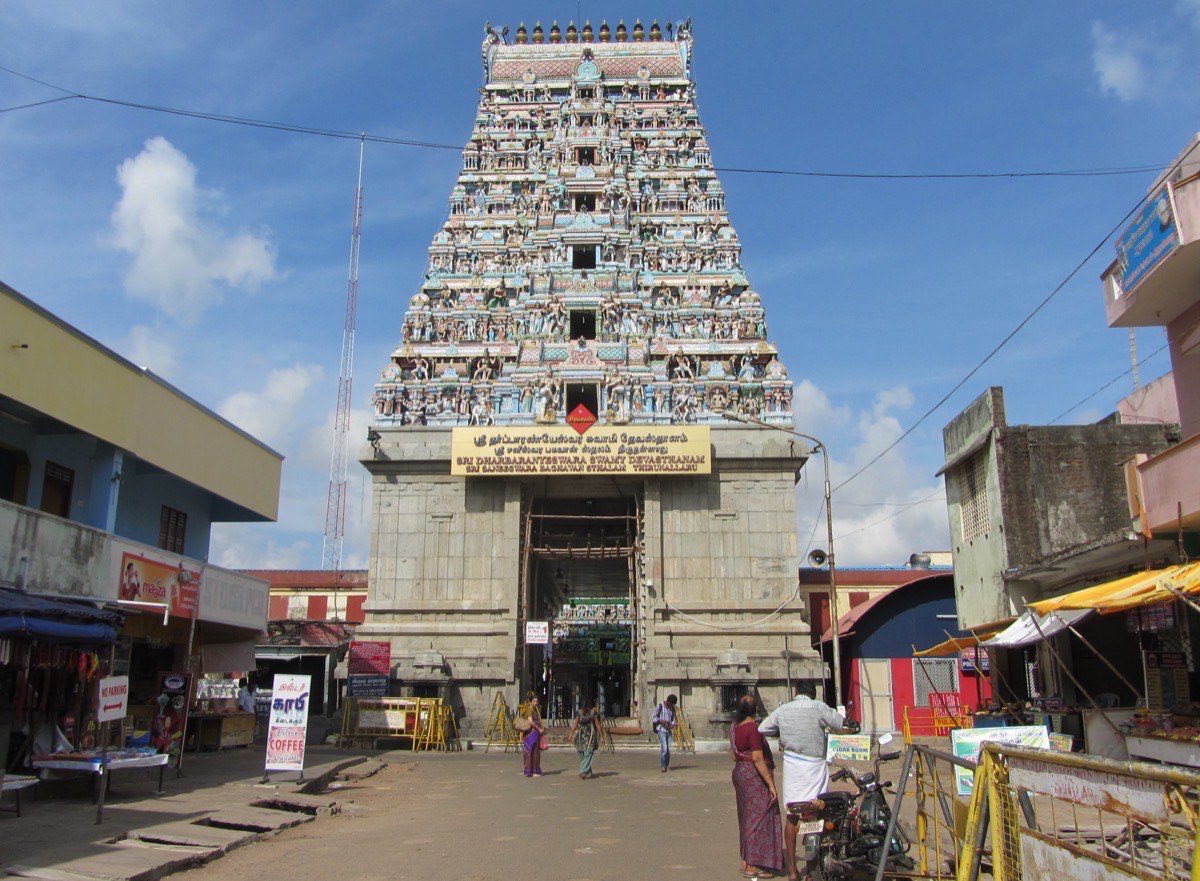
Gopurams (Gateway Towers): Three gopurams of seven, five, and three tiers respectively mark the entrances. The tallest, the rāja gopuram, is adorned with stucco sculptures of deities, mythological narratives, and celestial beings in the characteristic Dravidian style.
Three Prākāras (Enclosures): The temple has three concentric corridors (deva prākāras) surrounding the garbhagṛha. Each corridor houses subsidiary shrines, pillared mandapas, and sculptural panels.
Vasanta Maṇḍapa: The spring hall, lined with oil lamps along its pathways, is used for festival processions and seasonal celebrations.
Nala Tīrtham: The large rectangular temple tank lies to the northwest of the main complex. Steps descend on all four sides to the water. The central pavilion with its Nala figurines and Navagraha wells makes this tank architecturally and ritually unique among South Indian temple tanks.
The Sanctum: Svayambhū Liṅga and Śanīśvara
The garbhagṛha (innermost sanctum) houses the Svayambhū Liṅga — a self-manifested liṅga also called the Naleśvara Liṅga, after King Nala who worshipped it. The deity Dharbaranyeśvarar represents Śiva as the lord of the darbha grass forest.
The shrine of Śanīśvara (Śani Bhagavān) is a separate but integral part of the complex, and it is this shrine that draws the majority of devotees. The Śani idol here is notable for several iconographic distinctions: it is unusually small in size yet considered immensely powerful; it displays only two hands, with the right hand in abhaya mudrā (the gesture dispelling fear), rather than the four-armed depictions common elsewhere; and it faces east, whereas most Śani images in India face south. The shrine also features a golden crow mount (vāhana), and the emblems of Makara (Capricorn) and Kumbha (Aquarius) — the two zodiac signs governed by Saturn — are inscribed at the entrance.
Tēvāram: The Hymns of the Nāyaṉmār Saints
Sambandar’s Fire-Proof Hymn
Tiruñāṇacampantar (Sambandar), the 7th-century child-saint of Tamil Śaivism, venerated Dharbaranyeśvarar in a celebrated pathikam (decade of verses) compiled in the First Tirumurai of the Tēvāram canon. These verses praise Śiva as the lord of the darbha forest, dwelling amidst the sacred grass where sages perform their austerities.
The Sambandar pathikam on Thirunallar achieved legendary status through a remarkable event. During a theological debate with Jain scholars at Madurai, a trial by fire was proposed: both parties would cast their sacred texts into the flames, and the text that survived would prove the supremacy of its tradition. Sambandar chose the forty-ninth pathikam of his Tēvāram — the hymn sung at the shrine of Lord Dharbaranyeśvarar at Thirunallar — and placed it upon the fire. While the Jain cadjan leaf was reduced to ash, Sambandar’s leaf emerged unburnt. For this reason, the temple is also known as “Paccai Paṭikam Peṟṟa Thalam” — “the shrine that received the green (i.e. fresh, unburnt) pathikam.”
Appar and Sundarar
Tirunāvukkaracar (Appar), Sambandar’s contemporary and fellow Nāyaṉmār, also composed a pathikam of ten verses glorifying Dharbaranyeśvarar, compiled in the Fifth Tirumurai. Appar’s hymns dwell on the cosmic majesty of Śiva and the transformative power of devotion at this sacred site. Sundarar, the third of the Mūvar (the three great Tēvāram poets), likewise honoured the temple with his praise.
Because Thirunallar is celebrated in the Tēvāram, it holds the prestigious status of a Pādal Petra Sthalam — one of the 275 Śiva temples sung by the three great saint-poets. This places it within the most sacred tier of Tamil Śaiva pilgrimage sites, irrespective of its separate fame as a Navagraha temple.
Saptha Vidaṅga Sthalam
Thirunallar also belongs to the group of seven Saptha Vidaṅga Sthalams — temples where the processional deity (utsava mūrti) of Śiva, as Somāskanda (Śiva with Pārvatī and their son Murugan), is depicted performing a unique dance form. At Thirunallar, the processional deity is known as Nāka Vidaṅgar, and the dance he performs is the Unmatta Naṭanam (the Dance of Ecstasy). This places Thirunallar within the sacred dance geography of Tamil Śaivism, alongside Chidambaram and other celebrated sites of Śiva’s cosmic performance.
Sāḍe Sāti and the Pilgrimage Tradition
Understanding Sāḍe Sāti
In Vedic astrology (Jyotiṣa), Sāḍe Sāti refers to the approximately seven-and-a-half-year period during which Saturn (Śani) transits through the twelfth, first, and second houses from the natal moon. This period is widely regarded as one of life’s most challenging astrological transits, bringing difficulties in health, career, relationships, and finances. The transit occurs roughly every 29.5 years (the time Saturn takes to complete one orbit of the zodiac), so most individuals experience Sāḍe Sāti two or three times in their lives.
Thirunallar has become the paramount pilgrimage destination for devotees undergoing Sāḍe Sāti. The logic is theological as much as astrological: because this is the place where Śani himself surrendered his punitive power before Śiva, it is believed that sincere worship here can mitigate or nullify Saturn’s adverse effects.
Śani Peyarchi: Saturn’s Transit Festival
Every two and a half years, when Saturn transitions from one zodiac sign to the next (an event called Śani Peyarchi in Tamil), the temple witnesses an extraordinary surge of pilgrims. Hundreds of thousands of devotees converge on Thirunallar for the transit ceremony, making it one of the most attended astrological events in India. Special pūjās, abhiṣekas (ritual bathing of the deity), and homas (fire ceremonies) are performed to mark the transition and to seek Śani’s benevolence during his new zodiacal phase.
Ritual Protocol at Thirunallar
The traditional pilgrimage protocol at Thirunallar follows a prescribed sequence:
-
Bath in Nala Tīrtham: Devotees begin with a sacred bath in the temple tank, emulating King Nala’s purifying immersion. Some traditions hold that devotees should leave a piece of cloth at the tank as a symbolic shedding of afflictions.
-
Worship at the Vināyaka Shrine: After the bath, devotees visit the adjacent Gaṇeśa (Vināyaka) temple and break a coconut as an offering — following the standard Hindu practice of beginning all worship with Gaṇeśa.
-
Darśana of Śanīśvara: Devotees proceed to the Śani shrine, offering blue oleander flowers (kuvalai), sesame oil lamps, and small bundles of black sesame seeds wrapped in cloth and dipped in sesame oil, which are burnt before the deity.
-
Worship of Dharbaranyeśvarar: Finally, devotees visit the main sanctum of Śiva as Dharbaranyeśvarar and the adjacent shrine of the Goddess (Praṇeśvarī Ammaṉ, also known as Bogamārtha Pūṇmulai Ammai).
-
Navagraha Śānti Homa: Many devotees commission a Navagraha Śānti Homa (fire ceremony for planetary peace), performed by temple priests to pacify all nine celestial bodies simultaneously.
It is customary to visit Thirunallar once yearly, preferably on a Saturday (Śani’s day), and to bring family members whenever possible. A notable folk tradition advises devotees not to carry prasāda (consecrated food) home from this temple — a unique practice said to reflect the principle of leaving all negative influences behind at the shrine.
Śani in Hindu Theology and Astrology
Son of the Sun, Lord of Karma
Śani Deva is the son of Sūrya (the Sun god) and Chāyā (Shadow), born when Sūrya’s first wife Saṃjñā could not bear his intense radiance and left her shadow-self in her place. Śani’s dark complexion and stern disposition are said to derive from this origin — he is the child of light’s shadow, embodying the inescapable consequences of action (karma).
In the Navagraha system, Śani governs the zodiac signs of Makara (Capricorn) and Kumbha (Aquarius). His direction is west, his mount (vāhana) is the crow, and his associated substances include sesame (til), iron, black cloth, and the blue sapphire (nīlam). The Bṛhat Parāśara Horā Śāstra, the foundational text of Vedic astrology, describes Śani as the “great teacher” among planets — one who enforces karmic lessons through hardship but also rewards discipline, patience, and righteousness.
Temple tradition at Thirunallar emphasises this dual nature: “There is no other planet as generous as Śani, nor one causing greater harm.” The Śani of Thirunallar, manifesting as an Anugraha Mūrti, represents the benevolent aspect — Saturn as the bestower of wisdom and spiritual maturity through the crucible of experience.
Saturn’s Associations at Thirunallar
The Śani shrine at Thirunallar uniquely includes depictions of Saturn’s family: his wife Mandā Devī, Jyeṣṭhā Devī, and his sons Mandhi and Gulikan. The shrine also contains an image of King Daśaratha (Rāma’s father), who is honoured in Jyotiṣa tradition for his mastery over the Navagrahas. These iconographic details make the Thirunallar Śani sannidhi one of the most complete representations of Saturn’s mythological and astrological identity in any Indian temple.
Thirunallar and Shani Shingnapur: A Comparison
India possesses two preeminent Śani temples that together represent the northern and southern poles of Saturn worship. Shani Shingnapur in the Ahmednagar district of Maharashtra houses a Svayambhū (self-manifested) 5-foot black stone representing Śani on an open-air platform — the deity has neither a roof nor walls, and the village famously has no locks on its doors, trusting entirely in Śani’s protection. Shani Shingnapur receives 30,000 to 45,000 visitors daily, swelling to three lakh on Amāvāsyā (new moon day).
Thirunallar’s approach is theologically distinct. Here, Śani is not an independent cosmic force but a subordinate deity within a Śiva temple complex. The message is not “fear Saturn and propitiate him” but rather “seek Śiva’s grace, and even Saturn’s power dissolves.” The very structure of worship at Thirunallar — where devotees are directed to worship Śanīśvara first and then proceed to Dharbaranyeśvarar — enacts this theological hierarchy: Saturn is honoured, but Śiva is supreme.
This Śaiva contextualisation of planetary worship is characteristic of the Tamil Navagraha temple tradition, where all nine planetary deities are housed within or adjacent to Śiva temples across the Kaveri delta. Thirunallar, as the Śani sthalam of the Navagraha circuit, thus represents a sophisticated integration of Jyotiṣa (astrology) and Śaiva Siddhānta (Śaiva theology) that is unique to the Tamil religious landscape.
Festivals and Special Observances
Saturday Worship
Saturdays hold special significance at Thirunallar. While the main temple follows standard hours (6:00 AM to 1:00 PM and 4:00 PM to 9:00 PM), the Śani shrine remains open even during the afternoon break on Saturdays, accommodating the large influx of devotees. Special abhiṣekas with sesame oil, milk, curd, and honey are performed for the Śani mūrti.
Thai Amāvāsyā
The new moon day in the Tamil month of Thai (January-February) is considered especially auspicious for Śani worship. Devotees throng the temple for oil-lamp offerings and Navagraha pūjās.
Annual Brahmotsava
The temple’s annual Brahmotsava (grand festival) features processions of the processional deity Nāka Vidaṅgar through the four temple streets, accompanied by traditional nāgasvaram and tavil music, Vedic chanting, and the participation of the sixty-three Nāyaṉmār saints in sculptural form.
Other Observances
Pradoṣa (the thirteenth lunar day, sacred to Śiva), Mahāśivarātri, and the Tamil month of Ādi (July-August, associated with the Goddess) are also observed with special rituals.
The Navagraha Pilgrimage Circuit
Thirunallar is the seventh of the nine Navagraha temples concentrated in the Kumbakonam region of the Kaveri delta. Each temple enshrines one of the nine celestial bodies within a Śiva temple complex. The complete circuit, often undertaken as a single-day or multi-day pilgrimage, includes:
| Planet | Temple | Location |
|---|---|---|
| Sūrya (Sun) | Sūryanār Kōvil | Suryanarkoil |
| Candra (Moon) | Kailāsanāthar | Thingalur |
| Maṅgala (Mars) | Vaithīśvarankoil | Vaitheeswaran Koil |
| Budha (Mercury) | Svētāraṇyeśvarar | Thiruvenkadu |
| Guru (Jupiter) | Āpatsahāyeśvarar | Alangudi |
| Śukra (Venus) | Āgneśvarar | Kanjanur |
| Śani (Saturn) | Dharbaranyeśvarar | Thirunallar |
| Rāhu | Nāganāthasvāmi | Thirunageswaram |
| Ketu | Nāganāthasvāmi | Keezhperumpallam |
This circuit represents a uniquely Tamil synthesis of Jyotiṣa and Śaiva devotion, and Thirunallar, as the Saturn station, is invariably its most visited temple.
Conclusion: Grace Beyond the Stars
Thirunallar occupies a singular place in Hindu sacred geography. It is simultaneously a temple of astrology and a temple of theology, a place where the anxious calculations of planetary transits meet the liberating promise of divine grace. The story of King Nala — a righteous man brought low by cosmic forces beyond his control, restored not by astrological manipulation but by sincere devotion to Śiva — is the archetype that every Sāḍe Sāti pilgrim carries in their heart as they descend the stone steps of the Nala Tīrtham.
The Tēvāram saints who sang at this shrine understood what many modern devotees intuitively grasp: that the planets are not autonomous tyrants but instruments within a larger divine order. At Thirunallar, even Saturn — the most feared of the Navagrahas — is revealed as a devotee of Śiva, his power of affliction dissolved in the presence of the Lord of the darbha forest. The temple’s enduring message, inscribed in stone by Chola kings and sung in verse by Nāyaṉmār poets, is that no karmic burden is beyond the reach of grace.