Introduction: The Mountain That Is God
Tiruvaṇṇāmalai — a town of approximately 150,000 people in the Tiruvannamalai district of Tamil Nadu — is dominated by a single overwhelming presence: Aruṇācala, the “Red Mountain” (from aruṇa, “red/dawn-coloured,” and acala, “immovable/mountain”), rising 814 metres above sea level from the otherwise flat plain of the South Arcot region. This is not merely a mountain with a temple on it; in the theology of Tiruvaṇṇāmalai, the mountain itself is Śiva — the Tejo-liṅga, the liṅga of fire, the cosmic pillar of light through which the supreme reality made itself visible at the dawn of creation.
The Aruṇācala Māhātmya, preserved in the Skanda Purāṇa, records Śiva’s declaration: “Though in other places I take the form of the liṅga for the sake of worship, this hill (Aruṇācala) is my true form. Whoever merely thinks of Aruṇācala from any distance will attain liberation” (Skanda Purāṇa, Mahēśvara Khaṇḍa, Aruṇācala Māhātmya I.56). This extraordinary claim — that the mountain is not a symbol of God but God himself in visible, geological form — makes Aruṇācala unique even among the great sacred sites of India.
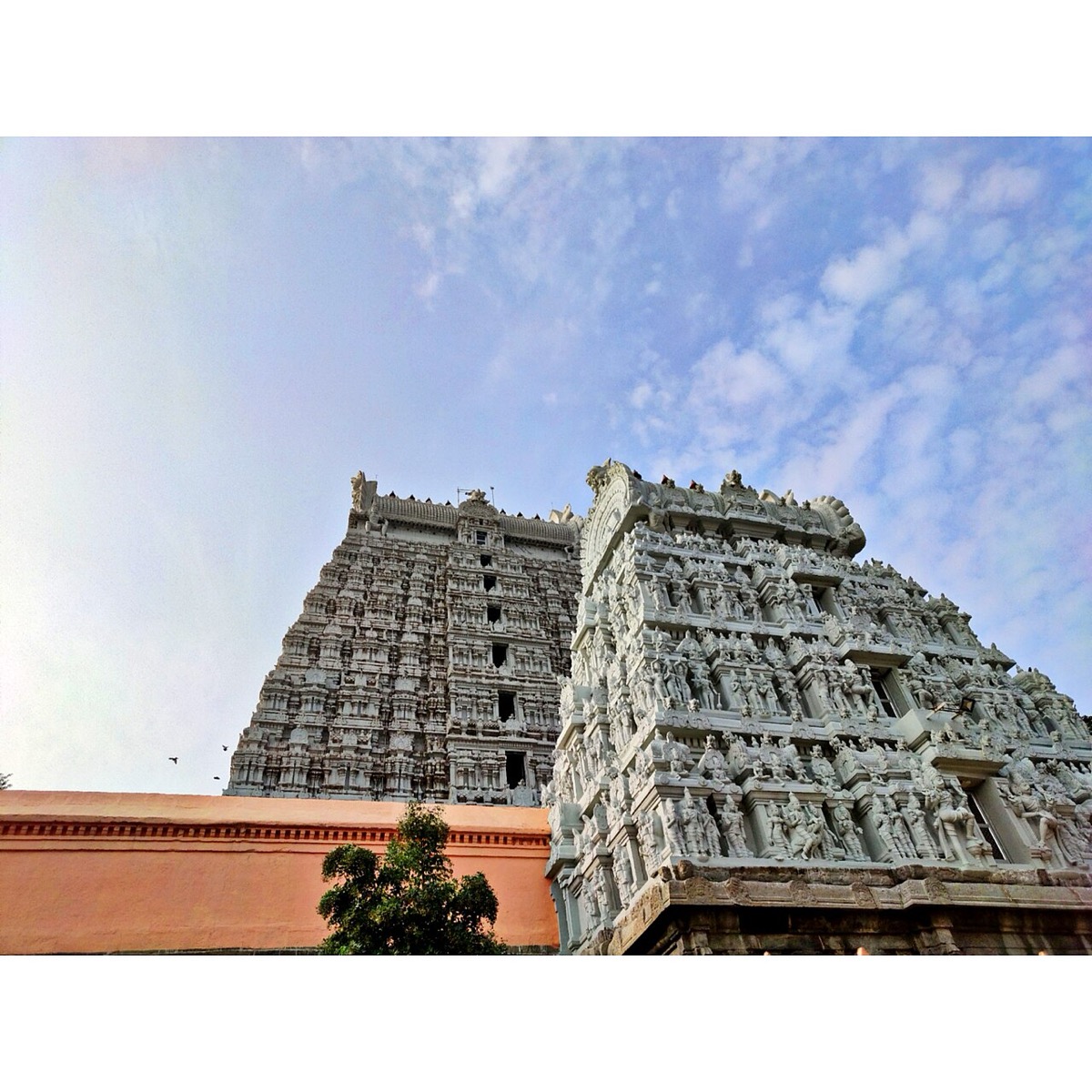
At the foot of the mountain stands the Aruṇācaleśvara Temple (also called Annamalaiyar Kovil in Tamil), one of the largest temple complexes in India, covering approximately 10 hectares (25 acres). Together, the mountain and the temple constitute one of the Pañcabhūta Sthalas — the five temples representing the five elements — specifically the sthala of Agni (fire/tejas), the most primal and transformative of the elements.
Mythology: The Pillar of Fire
The Contest of Brahmā and Viṣṇu
The foundational myth of Aruṇācala, narrated in the Liṅga Purāṇa (I.17), the Śiva Purāṇa (Vidyēśvara Saṃhitā 6-9), and the Skanda Purāṇa (Aruṇācala Māhātmya), tells of a cosmic contest between Brahmā and Viṣṇu. The two great gods, each claiming supremacy, fell into a dispute. To resolve the conflict, Śiva manifested as an infinite column of fire — a jyotistambha stretching endlessly upward and downward, without beginning or end.
Brahmā, taking the form of a swan (haṃsa), flew upward to find the top of the column. Viṣṇu, taking the form of a boar (varāha), burrowed downward to find its base. Neither succeeded: the column was infinite. Viṣṇu, humbled, acknowledged Śiva’s supremacy. Brahmā, however, falsely claimed to have found the top, enlisting the ketakī (screw pine) flower as a false witness. For this lie, Śiva cursed Brahmā to have no separate worship on earth and the ketakī flower to be excluded from Śiva pūjā.
The Purāṇas then narrate that Śiva, having demonstrated his supremacy as the infinite fire, condensed the column into the mountain of Aruṇācala for the benefit of devotees in the Kali Yuga: “In the age of Kali, when austerity is difficult and knowledge rare, I shall remain as this mountain — visible, accessible, and eternally radiating grace to all who approach” (Skanda Purāṇa, Aruṇācala Māhātmya I.45).
The Pañcabhūta Sthalas
Aruṇācala is one of the five Pañcabhūta Sthalas — temples representing the five classical elements of Hindu cosmology:
- Kāñcīpuram (Ēkāmranātha) — Earth (Pṛthvī)
- Tiruvaṇṇāmalai (Aruṇācaleśvara) — Fire (Agni/Tejas)
- Tiruvānaikkāval (Jambukēśvara) — Water (Āpas)
- Kālahastī (Kālahastīśvara) — Wind (Vāyu)
- Cidambaram (Naṭarāja) — Ether/Space (Ākāśa)
All five are in Tamil Nadu or Andhra Pradesh, and pilgrimage to all five is considered one of the great Śaiva observances. At Tiruvaṇṇāmalai, the fire element manifests most dramatically during the Kārttikai Dīpam festival, when a massive flame is lit atop the mountain.
The Aruṇācaleśvara Temple
Architecture and Antiquity
The Aruṇācaleśvara Temple is one of the largest and oldest temple complexes in South India. The temple has four towering gopurams (ornamental gateway towers) at the cardinal points, of which the eastern Rājagopuram is the tallest at approximately 66 metres (217 feet) — making it one of the tallest temple towers in India. This eleven-storey gopuram, built during the Vijayanagara period (16th century CE), is visible from miles away and serves as a monumental gateway to the sacred precinct.
The temple’s earliest structural elements date to the Pallava period (7th-9th centuries CE), with major additions by the Cōḻa dynasty (10th-13th centuries), the Hoysaḷa dynasty, and the Vijayanagara emperors. The temple’s recorded history, however, stretches back even further: the Tēvāram hymns of the Nāyanār saints (7th-8th centuries CE) celebrate this site extensively, and the temple is one of the most frequently praised in the entire Tēvāram corpus.
The Inner Sanctum
The garbhagṛha houses the Aruṇācaleśvara liṅga, a large Śiva liṅga made of stone, representing the fire element. The sanctum is oriented to face west — unusual for Śiva temples, which typically face east or north — and this westward orientation is interpreted as the liṅga “facing” the mountain, acknowledging the mountain as the true and supreme form.
The Unnamalai Amman shrine (dedicated to Pārvatī as “the Goddess who is inseparable from Aṇṇāmalai”) is located within the complex, with its own separate entrance. The temple also houses shrines to Gaṇeśa, Subrahmaṇya, and the sixty-three Nāyanārs.
The Thousand-Pillared Hall
The temple’s Thousand-Pillared Hall (Āyiram Kāl Maṇḍapam), built during the Vijayanagara period, is an architectural marvel featuring intricately carved granite pillars depicting mythological scenes, rearing horses (yāḷi), and floral motifs. Each pillar is distinct, and the hall serves as both a ceremonial space and a gallery of late-medieval Dravidian art.
The Kārttikai Dīpam Festival
The Great Flame on the Mountain
The Kārttikai Dīpam (Tamil: Kārttikai Tīpam) is the defining festival of Tiruvaṇṇāmalai and one of the most spectacular religious celebrations in all of India. Held on the full moon day of the Tamil month of Kārttikai (November-December), the festival culminates in the lighting of an enormous cauldron of ghee and camphor atop the summit of Aruṇācala. The resulting flame, known as the Mahā Dīpam, can be seen from a distance of over 30 kilometres, burning through the night as a visual echo of the cosmic pillar of fire that is the mountain’s mythological origin.
The lighting of the Mahā Dīpam is preceded by a ten-day festival (Brahmotsavam) at the Aruṇācaleśvara Temple, with daily processions of the utsava-mūrtis on various vāhanas. On the evening of the full moon, the entire town and the surrounding hills are illuminated with oil lamps — homes, shops, temples, and streets are lit, creating a sea of fire that mirrors the great flame above.
The theological significance is profound: the lighting of the flame re-enacts the primordial manifestation of Śiva as the column of fire. The Aruṇācala Māhātmya states: “On the night of Kārttikai, when the flame is lit upon the summit, Aruṇācala reveals its true nature — the infinite jyoti (light) that was, is, and shall be forever” (Skanda Purāṇa, Aruṇācala Māhātmya V.12).
An estimated one to two million devotees gather in Tiruvaṇṇāmalai for the Kārttikai Dīpam, making it one of the largest annual gatherings in South India.
Preparation of the Dīpam
The preparation of the Mahā Dīpam is itself a sacred ritual. The cauldron (mā-vilakku) requires approximately 3,000 kilograms of ghee and large quantities of camphor. The ghee is contributed by devotees and temple trusts. The flame is carried in procession from the sanctum of the Aruṇācaleśvara Temple to the summit, a journey of several hours, by specially designated priests. The lighting is timed to coincide with the lighting of a flame within the sanctum (the Bhāratī-dīpam), so that the inner and outer fires — the fire in the temple and the fire on the mountain — are one.
Girivalam: Circumambulation of the Mountain
The Sacred Circuit
Girivalam (from giri, “mountain,” and valam, “circumambulation” in Tamil) is the practice of walking around the base of Aruṇācala, following a 14-kilometre path that encircles the mountain. This practice is considered one of the most powerful spiritual observances at Tiruvaṇṇāmalai, and the Aruṇācala Māhātmya extols it in the strongest terms:
“Even the devas, ṛṣis, and siddhas cannot describe the full merit of circumambulating Aruṇācala. Every step taken on the Girivalam path is equivalent to performing an aśvamedha yajña” (Skanda Purāṇa, Aruṇācala Māhātmya III.18).
The Girivalam path passes eight cardinal liṅgam shrines (Aṣṭa-liṅgam), each representing one of the eight forms of Śiva (Aṣṭa-mūrti) and one of the eight directions. Devotees pause at each shrine for worship. The path also passes through several small temples, sacred tanks, and groves.
Full Moon Girivalam
While Girivalam can be performed on any day, the full moon night is considered especially auspicious. On Pūrṇimā (full moon) nights, particularly during the months of Kārttikai and Tai (January-February), hundreds of thousands of devotees walk the circuit, many barefoot. The sight of this vast river of humanity flowing around the mountain under the full moon, with oil lamps flickering along the path, is one of the most moving pilgrim experiences in India.
Ramaṇa Maharṣi, the sage most closely associated with Aruṇācala in modern times, affirmed the spiritual power of Girivalam: “Aruṇācala is the sacred centre of the earth. All other sacred mountains are only extensions of it. The circumambulation of it is the equivalent of circling the earth itself.”
Ramaṇa Maharṣi and Aruṇācala
The Sage of Aruṇācala
No account of Tiruvaṇṇāmalai is complete without the story of Ramaṇa Maharṣi (1879-1950), the sage who made Aruṇācala the spiritual destination it is for seekers worldwide. Born Veṅkaṭarāman Aiyar in Tiruccuḻi, Tamil Nadu, the young Ramaṇa experienced a spontaneous and permanent spiritual awakening at the age of sixteen. Shortly afterward, drawn by an irresistible pull, he left home and journeyed to Tiruvaṇṇāmalai, where he spent the rest of his life — first in the temple complex, then in caves on the mountain (notably Virūpākṣa Cave and Skandāśram), and finally at the āśram that grew around him at the base of the mountain.
Ramaṇa’s teaching was deceptively simple: the practice of ātma-vicāra — self-enquiry through the question “Who am I?” (Nān Yār?). By relentlessly turning attention back to the source of the “I”-thought, the seeker discovers that the individual self is illusory and that only the infinite Self (Ātman/Brahman) exists. This teaching, rooted in the Advaita Vedānta of Śaṅkarācārya but stripped of all scholastic complexity, attracted seekers from every tradition and nation.
Ramaṇa and the Mountain
Ramaṇa’s relationship with Aruṇācala was not merely one of a sage who happened to live near a mountain. He consistently identified Aruṇācala as his guru and as Śiva himself. His hymns to Aruṇācala — collected as the Pañcaratna (Five Gems) and the Aṣṭakam (Eight Verses) — are among the most beautiful devotional poems in Tamil literature:
“Aruṇācala! Thou dost root out the ego of those who think ‘Aruṇācala’ in their hearts. Abode of grace, Aruṇācala!” (Aruṇācala Aṣṭakam, verse 1).
Ramaṇa taught that the mountain radiates a spiritual force that naturally draws the mind inward, making self-enquiry spontaneous for those who dwell in its presence. He said: “Aruṇācala is the spiritual centre of the world. It is Śiva himself in the form of a mountain. By merely thinking of it, liberation is assured.”
The Āśram
Śrī Ramaṇāśramam, located at the southern foot of Aruṇācala, continues to function as a spiritual centre, drawing thousands of visitors annually from around the world. The āśram maintains the samādhi (burial shrine) of Ramaṇa Maharṣi, a meditation hall, a library of his teachings, and the old hall where he received visitors during the later decades of his life. The atmosphere of silence and self-enquiry that Ramaṇa established continues to pervade the space.
The Nāyanār Saints and the Tēvāram
Tiruvaṇṇāmalai is one of the most celebrated sites in the Tēvāram, the great corpus of Tamil Śaiva devotional poetry composed by the three principal Nāyanār saints: Tiruñāṇacampantar, Tirunāvukkaracar (Appar), and Cuntarar. All three composed padigams (hymn-sets of ten or eleven verses) on Aruṇācaleśvara, and the temple is classified as one of the 276 Pāḍal Petra Sthalams — the sites glorified in the Tēvāram.
Appar’s verses on Aruṇācala are especially beloved:
“Aṇṇāmalaiyāṉ tāḷ vaṇaṅki, aṉpil āṉ vēṇṭum aruḷai vēṇṭil…” — “If you seek the grace that comes from love, worship the feet of the Lord of Aṇṇāmalai…”
The Tēvāram tradition establishes Tiruvaṇṇāmalai as one of the premier Śaiva pilgrimage sites of Tamil Nadu, placing it alongside Cidambaram, Madurai, and Kāśī in the hierarchy of sacred places.
Spiritual Significance
Tiruvaṇṇāmalai-Aruṇācala embodies two complementary spiritual truths. First, the mountain-as-Śiva teaches that the divine is not remote or abstract but present in the visible, tangible world — in the rock, the trees, the red earth of the hillside. The mountain does not “represent” God; it is God, and to walk around it, to gaze upon it, to sit in its shadow, is to be in the direct presence of the supreme reality.
Second, Ramaṇa Maharṣi’s teaching of self-enquiry reveals that the same reality found in the mountain is found within the seeker’s own heart. The external Aruṇācala and the internal Self are one. As Ramaṇa wrote: “Aruṇācala, the inner Self, shines within the Heart. Oh Aruṇācala, do thou shine as the Self, so that there may be no night (of ignorance)” (Aruṇācala Pañcaratna, verse 2).
The Kārttikai Dīpam, the great flame that blazes on the summit, is the annual revelation of this truth: the mountain of fire illuminates the darkness, just as the Self illuminates the mind. At Tiruvaṇṇāmalai, the outer pilgrimage around the mountain (Girivalam) and the inner pilgrimage of self-enquiry (ātma-vicāra) converge in a single point — the heart, where Śiva as Aruṇācala eternally abides.