Introduction: Where the Godāvarī Begins
At the foot of the mist-shrouded Brahmāgiri hill in the Sahyādri range of western Mahārāshtra, approximately 28 kilometres from the city of Nāshik, stands the ancient temple of Trimbakeshwar (Tryambakeśvara) — one of the twelve Jyotirliṅgas of Lord Śiva. The name Tryambakeśvara means “Lord of the Three-Eyed One,” an epithet of Śiva, and the temple’s most remarkable feature is a liṅga with three faces representing the Hindu trinity: Brahmā, Viṣṇu, and Maheśvara (Śiva). This is the only Jyotirliṅga in India where all three deities of the Trimūrti are embodied in a single sacred form.
The sanctity of Trimbakeshwar is amplified by its geographical setting. From the summit of Brahmāgiri hill, the Godāvarī — India’s second-longest river and the holiest waterway of the Deccan — begins its 1,465-kilometre journey eastward to the Bay of Bengal. The Śiva Purāṇa (Koṭirudra Saṃhitā 1.21-22) counts Trimbakeshwar among the twelve self-manifested liṅgas of divine light, placing it alongside Somnātha, Viśvanātha, and Mahākāleśvara in the sacred geography of Śaivism.
The Jyotirliṅga: Pillar of Infinite Light
The Twelve Jyotirliṅgas
The concept of the Jyotirliṅga — a liṅga of light — originates in the Śiva Purāṇa’s account of an ancient dispute between Brahmā and Viṣṇu over cosmic supremacy. To settle the matter, Śiva manifested as an infinite column of blazing light (jyotistambha) that pierced through the three worlds. Neither Brahmā, who soared upward as a haṃsa (swan), nor Viṣṇu, who dug downward as Varāha (boar), could find its end. Humbled, both acknowledged Śiva’s supremacy. Where this column of light touched the earth, twelve sacred sites emerged — the Dvādaśa Jyotirliṅgas (Śiva Purāṇa, Vidyeśvara Saṃhitā 12.1-44).
The traditional verse (Dvādaśa Jyotirliṅga Stotram) enumerating the twelve liṅgas places Trimbakeshwar alongside:
saurāṣṭre somanāthaṃ ca śrīśaile mallikārjunam | ujjayinyāṃ mahākālaṃ … tryambakaṃ gautamītaṭe ||
“…and Tryambaka on the bank of the Gautamī (Godāvarī).”
The Unique Three-Faced Liṅga
Unlike most Jyotirliṅgas, which present a single form of Śiva, the Trimbakeshwar liṅga is a natural stone formation with three visible protrusions, traditionally identified as the faces of Brahmā, Viṣṇu, and Rudra (Śiva). The central and most prominent face represents Śiva; the face on the viewer’s left represents Viṣṇu, and the one on the right represents Brahmā. The liṅga sits in a depression in the floor of the sanctum, and water from an underground spring naturally collects around it, symbolising the perpetual abhiṣeka (bathing) performed by nature itself.
The three-faced form has deep theological significance. It affirms that while Śiva is the supreme reality (Paramaśiva), the functions of creation (Brahmā), preservation (Viṣṇu), and dissolution (Rudra) are unified in a single divine principle. This teaching finds resonance in the Śvetāśvatara Upaniṣad (4.1-2), which describes the one God who presides over all sources and is the origin of the three fundamental powers.
A jewelled crown, said to belong to the Pāṇḍavas and later consecrated by the Peshwas, traditionally adorns the liṅga during special abhiṣeka ceremonies. This crown, studded with diamonds, emeralds, and other precious stones, is placed on the liṅga on festival days with elaborate rituals.
The Godāvarī: River of Liberation
Brahmāgiri and the River’s Source
The Godāvarī river, called Dakṣiṇa Gaṅgā (“Ganges of the South”) and Gautamī, originates from a spring on Brahmāgiri hill directly behind the Trimbakeshwar temple. The Brahma Purāṇa (chapters 71-78) narrates the mythological origin: the sage Gautama, falsely accused of killing a cow through the trickery of jealous sages, performed intense penance to Śiva on Brahmāgiri. Pleased with his devotion, Śiva released a lock of his matted hair (jaṭā), from which the Gaṅgā descended to earth as the Godāvarī, purifying the land and absolving Gautama of the false sin.
The Padma Purāṇa (Uttara Khaṇḍa 6.15-22) declares: “Where the Gautamī flows, there sin cannot abide. Bathing in the Godāvarī at Trimbaka destroys the accumulated sins of seven lifetimes.” This scriptural promise has made the site a magnet for pilgrims seeking spiritual purification.
Kuśāvarta Kuṇḍa
Adjacent to the Trimbakeshwar temple lies Kuśāvarta Kuṇḍa, a sacred tank considered the formal source-point of the Godāvarī. According to tradition, Sage Gautama placed a blade of kuśa grass (darbha) at the spot where the river emerged, and the water swirled around it in a vortex (āvarta), giving the kuṇḍa its name. Pilgrims perform piṇḍa-dāna (ritual offerings for the deceased) and tarpaṇa (water oblations to ancestors) at Kuśāvarta, as the Garuḍa Purāṇa (Pretakhaṇḍa 10.56-58) prescribes that ancestral rites performed at the source of a sacred river yield results ten million times greater than those performed elsewhere.
The Kumbh Mela Connection
Siṃhastha Kumbh at Nāshik-Trimbakeshwar
Every twelve years, when Jupiter (Bṛhaspati) enters the zodiac sign of Leo (Siṃha), the Siṃhastha Kumbh Mela is celebrated at Nāshik and Trimbakeshwar. This is one of the four Kumbh Mela sites (along with Prayāga, Haridvāra, and Ujjain) and draws millions of pilgrims for the sacred bath (śāhī snāna) in the Godāvarī and at Kuśāvarta Kuṇḍa.
The mythological basis for the Kumbh at Nāshik-Trimbakeshwar is the Samudra Manthana (churning of the cosmic ocean) narrative from the Bhāgavata Purāṇa (8.5-12). When the pot (kumbha) of amṛta (nectar of immortality) was being carried by Jayanta (son of Indra) through the heavens, four drops fell at four earthly locations — one of them at Nāshik, near the banks of the Godāvarī. The astronomical alignment of Jupiter in Leo reactivates this cosmic event, making the waters especially purifying during the Kumbh period.
The most recent Siṃhastha Kumbh at Nāshik-Trimbakeshwar was held in 2015, attracting over 30 million pilgrims. The royal processions of nāgā sādhus, the elaborate rituals at Kuśāvarta, and the spiritual discourses by saints from all sampradāyas make it one of the grandest religious gatherings on earth.
Nārāyaṇa Nāgbalī Pūjā
The Unique Ritual of Trimbakeshwar
Trimbakeshwar is the only recognized temple in India where the Nārāyaṇa Nāgbalī pūjā is traditionally performed. This complex, multi-day ritual is prescribed for removing specific spiritual afflictions believed to result from ancestral curses (pitṛ-doṣa), the sin of killing a serpent (sarpa-hatyā), or other karmic debts carried across lifetimes.
The Nārāyaṇa Balī portion addresses the spiritual needs of ancestors who died untimely, violent, or unnatural deaths — souls believed to be trapped as pretas (restless spirits) rather than proceeding to their appropriate afterlife. The ritual involves the creation of a symbolic body from darbha grass, the recitation of specific Vedic mantras, and the immersion of offerings in the Godāvarī, effectively providing the departed soul with the funerary rites it may have been denied.
The Nāgbalī portion addresses the sin of harming snakes (nāgas), who are considered semi-divine beings in Hindu tradition. The Garuḍa Purāṇa warns that killing a serpent brings a curse (nāga-doṣa) that can manifest as skin diseases, obstacles in marriage, or childlessness across generations. The Nāgbalī ritual at Trimbakeshwar, involving worship of metallic serpent images, Vedic recitations, and offerings to Brahmin priests, is believed to neutralize this curse permanently.
These rituals, typically performed over three to five days, require the guidance of specialized priests from hereditary Trimbakeshwar Brahmin families who have preserved the liturgical traditions for centuries.
The Temple: Peshwa-Era Architecture
Architectural Features
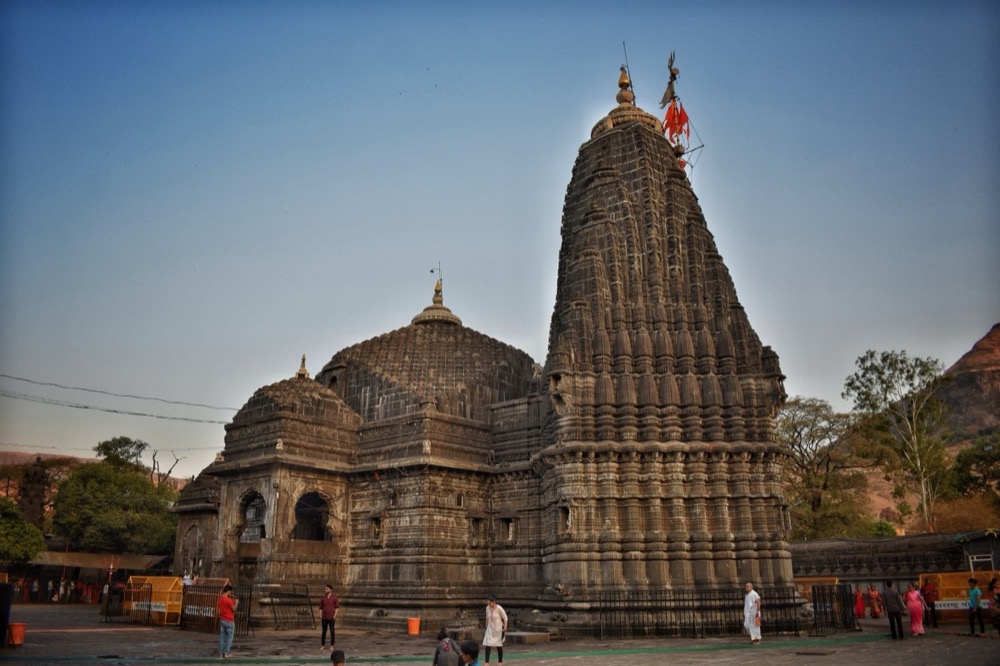
The present Trimbakeshwar temple was built by Peshwa Bālājī Bājīrāo (Nānāsāheb Peshwa) between 1755 and 1786 CE, replacing an older structure. It is a masterwork of Hemāḍpanthī-influenced Marāṭhā architecture, constructed entirely from locally quarried black basalt stone.
The temple features an ornate garbhagṛha (sanctum sanctorum) housing the Jyotirliṅga, a maṇḍapa (pillared hall), and a spacious courtyard. The shikhara (tower) rises in the Nāgara style, adorned with elaborate carvings of deities, celestial musicians, lotus motifs, and mythological scenes from the Purāṇas. The temple’s exterior walls bear exquisitely detailed relief panels depicting episodes from the Rāmāyaṇa, Mahābhārata, and Śiva’s cosmic dance (tāṇḍava).
The courtyard contains smaller shrines dedicated to various deities, including Gaṇeśa, Pārvatī, and the Daśa-mahāvidyās (ten Tantric goddesses). A massive Nandī (Śiva’s bull mount) carved from a single stone block faces the sanctum from across the courtyard.
The Sacred Tank and Surrounding Tīrthas
The temple complex is surrounded by several sacred water bodies and subsidiary tīrthas. Besides Kuśāvarta Kuṇḍa, important sites include:
- Gangā Dvāra: The point where the Godāvarī is channelled from the hillside into a stone spout, marking the river’s symbolic “gateway”
- Bilvakeśvara: A shrine on Brahmāgiri hill dedicated to Śiva, surrounded by bilva (wood-apple) trees sacred to Mahādeva
- Nīla Parvata: A peak near Brahmāgiri associated with Śiva’s meditation before the descent of the Godāvarī
Scriptural References and Purāṇic Lore
The Śiva Purāṇa Account
The Śiva Purāṇa’s Koṭirudra Saṃhitā (chapters 20-22) dedicates extensive passages to Trimbakeshwar. It narrates how Śiva, pleased with Sage Gautama’s penance, established himself permanently as a Jyotirliṅga at the site, declaring: “Here I shall remain for eternity as Tryambaka, granting liberation to all who worship me with devotion. The very sight of this liṅga shall destroy the sins of a thousand births” (Koṭirudra Saṃhitā 22.8-10).
The Gautama Connection
The Brahma Purāṇa’s Gautamī Māhātmya (chapters 71-108) provides the most detailed account of the region’s sanctity. Sage Gautama’s āśrama on Brahmāgiri is described as a place where twelve years of famine struck, yet Gautama’s tapas produced enough grain to feed all the sages of the region. When jealous rivals plotted against him using a magical cow that died at his touch, Gautama’s remorse and subsequent penance became the catalyst for the Godāvarī’s descent — transforming personal tragedy into a river of cosmic purification.
Connections to the Mahābhārata
The Vana Parva of the Mahābhārata (chapters 85-88, the Tīrtha-yātrā Parva) includes Trimbakeshwar among the sacred sites visited by the Pāṇḍavas during their forest exile. Sage Lomaśa tells Yudhiṣṭhira: “Bathe at the source of the Gautamī, O king, and you shall obtain the merit of a thousand Aśvamedha sacrifices and ascend to the world of Brahmā” (Vana Parva 85.34-35).
Festivals and Observances
Mahāśivarātri
The Great Night of Śiva is the most important annual festival at Trimbakeshwar. Hundreds of thousands of devotees gather for the night-long vigil, during which the Jyotirliṅga receives continuous abhiṣeka with milk, honey, curd, ghee, and Godāvarī water. The jewelled crown is placed on the liṅga during the midnight worship, and the temple resonates with the chanting of the Śrī Rudram and Mahāmṛtyuñjaya Mantra.
Śrāvaṇa Somavāra
Every Monday during the holy month of Śrāvaṇa (July-August), special worship is offered at Trimbakeshwar. Devotees observe fasts, carry kāvaḍs (decorated pots of Godāvarī water) on foot from the river to the temple, and perform rudrābhiṣeka. This tradition mirrors the kāvaḍ yātrā seen at other Śiva tīrthas but holds special significance here due to the proximity of the Godāvarī’s source.
Tripurārī Pūrṇimā
This full-moon day in the month of Kārtika commemorates Śiva’s destruction of the three demonic cities (Tripura). At Trimbakeshwar, a grand procession carries the deity’s utsava mūrti (processional image) through the temple town, accompanied by traditional Marāṭhā dhol-tāśā drumming and Vedic chanting.
The Living Tradition
Trimbakeshwar remains one of the most spiritually charged pilgrimage destinations in India. Its convergence of sacred elements — the Jyotirliṅga, the source of the Godāvarī, the Kumbh Mela tradition, and the unique Nārāyaṇa Nāgbalī rites — creates a tīrtha of extraordinary depth and complexity. The Padma Purāṇa summarises it thus: “There is no tīrtha equal to Trimbaka, no river equal to the Gautamī, no liṅga equal to Tryambakeśvara. He who worships here is freed from all bonds” (Padma Purāṇa, Uttara Khaṇḍa 6.41-42).
For the millions who journey to Brahmāgiri’s foot each year — whether for the grand spectacle of the Kumbh, the solemn rites of Nārāyaṇa Nāgbalī, or simply the daily darśana of the three-faced liṅga — Trimbakeshwar embodies the promise that the divine is present wherever water, stone, and faith converge.