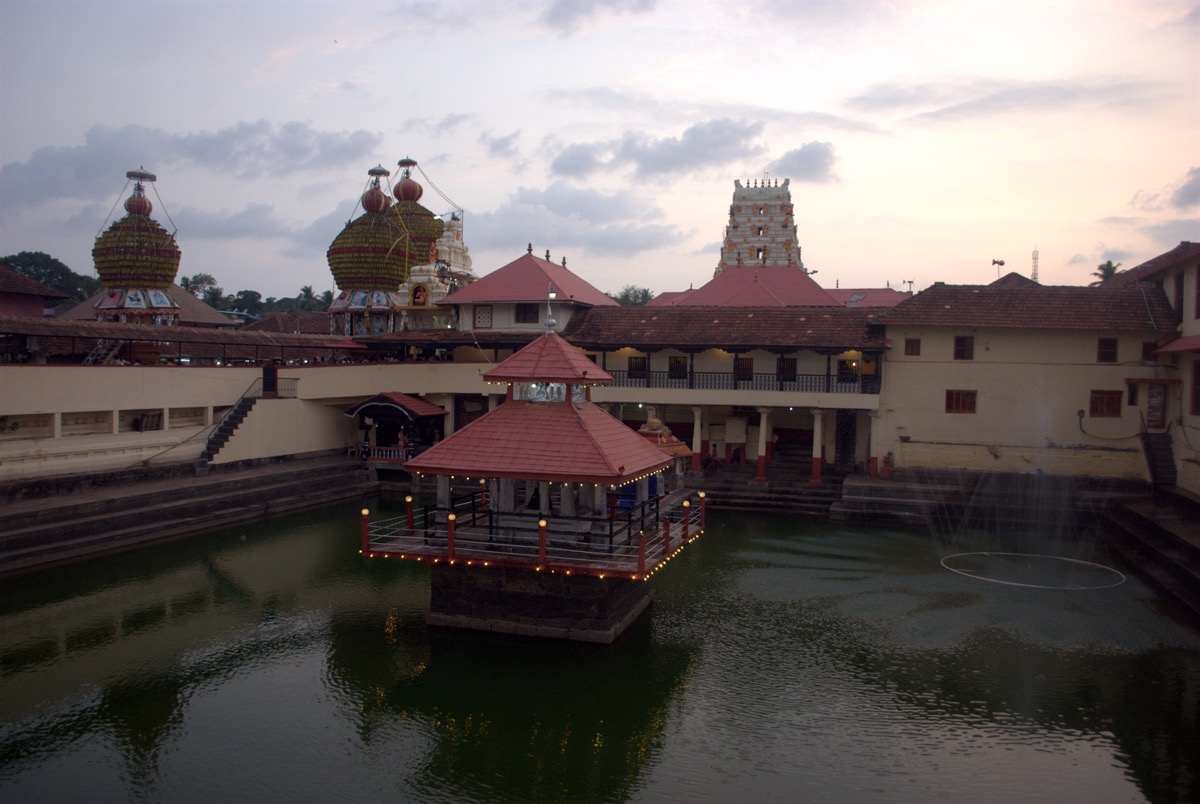
The Udupi Sri Krishna Matha, nestled in the coastal town of Udupi in Karnataka’s Dakshina Kannada region, stands as one of the most significant Vaishnavite pilgrimage centres in India. Founded in the 13th century by the philosopher-saint Madhvācārya (1238—1317 CE) --- the proponent of Dvaita Vedānta (dualistic philosophy) --- this sacred complex is far more than a single temple. It is the living headquarters of an entire philosophical tradition, an administrative marvel of rotating monastic governance, and a cultural fountainhead that gave rise to the Haridāsa literary movement, the tradition of Udupi cuisine, and the enduring ideal that devotion transcends all social barriers.
Unlike many ancient temples whose origins are lost in mythological mist, the Krishna Matha’s founding is documented with relative historical precision. The Sumadhva Vijaya, a hagiographic chronicle composed by Nārāyaṇa Paṇḍitācārya (Madhvācārya’s own disciple’s son), provides a detailed account of how the idol of Lord Kṛṣṇa arrived in Udupi and how the institutional framework of the Ashta Mathas came into being.
The Founding: Madhvācārya and the Discovery of the Kṛṣṇa Idol
Madhvācārya, born as Vāsudeva in the village of Pājaka (near modern Udupi) around 1238 CE, took sannyāsa at a remarkably young age under Acyutaprekṣa and was given the monastic name Pūrṇaprajña (later Ānandatīrtha, and popularly Madhva). After establishing his Dvaita philosophical system through extensive commentaries on the Brahma Sūtras, the Bhagavad Gītā, and the principal Upaniṣads, he turned to institutionalizing the worship of Lord Viṣṇu in his Kṛṣṇa form.
The story of the idol’s discovery is extraordinary. According to the Sumadhva Vijaya and local tradition, Madhvācārya was once meditating on the seashore near Malpe (the port area of Udupi) when he spotted a merchant vessel in dire distress during a violent storm. Through the power of his prayers, he calmed the tempest and guided the ship safely to shore. Grateful beyond measure, the ship’s captain offered the saint any cargo he desired. Madhvācārya asked only for a large lump of gopīcandana (sacred clay from Dvārakā) that the crew had loaded as ballast to steady the vessel.
When the massive block of gopīcandana was broken open, it revealed not one but two exquisite idols concealed within: one of Bālakṛṣṇa (the child Kṛṣṇa holding a churning rod and rope) and one of Balarāma. The Sumadhva Vijaya records that the idol was so heavy that no ordinary person could lift it, but Madhvācārya raised it effortlessly, as though lifting an infant. He carried the Bālakṛṣṇa mūrti to Udupi on his shoulders and installed it in a new shrine adjacent to the ancient Anantēśvara Temple (a Śiva temple that had stood in Udupi for centuries), thus founding the Sri Krishna Matha around 1260 CE.
The Ashta Mathas: Eight Monasteries of Dvaita Vedānta
To ensure the perpetual and systematic worship of Lord Kṛṣṇa and the propagation of Dvaita philosophy, Madhvācārya established eight monasteries (mathas) around the central Krishna temple. He selected eight of his most distinguished sannyāsī disciples and appointed them as the founding pontiffs (pīṭhādhipatis) of these institutions. The eight mathas, named after their original locations, are:
- Palimaru Matha (first pontiff: Hṛṣīkeśa Tīrtha)
- Adamaru Matha (first pontiff: Narasiṃha Tīrtha)
- Kṛṣṇāpura Matha (first pontiff: Janārdana Tīrtha)
- Puttige Matha (first pontiff: Upendra Tīrtha)
- Shiroor Matha (first pontiff: Vāmana Tīrtha)
- Sode Matha (first pontiff: Viṣṇu Tīrtha)
- Kaniyoor Matha (first pontiff: Rāma Tīrtha)
- Pejavara Matha (first pontiff: Adhokṣaja Tīrtha)
Madhvācārya organized these eight pontiffs into four pairs --- Palimaru–Adamaru, Kṛṣṇāpura–Puttige, Shiroor–Sode, and Kaniyoor–Pejavara --- each pair initiated together and sharing a special bond. The headquarters of all eight mathas were consolidated in the town of Udupi, surrounding the central Krishna temple, creating a unique monastic campus that has no parallel in Hindu temple administration.
Each matha maintains its own lineage of pontiffs in an unbroken succession (paramparā) from the original disciple of Madhvācārya to the present day --- a living chain spanning over 750 years. Beyond their duties at Udupi, the mathas operate educational institutions, gośālās (cow shelters), charitable kitchens, and Vedic study centres across Karnataka and beyond.
The Paryāya System: A Democratic Rotation of Sacred Authority
The most remarkable institutional innovation of the Udupi Krishna Matha is the Paryāya (literally “turn” or “rotation”) system, whereby each of the eight mathas takes charge of the temple’s worship and administration for a fixed period in cyclic order.
Originally, Madhvācārya assigned each of the eight pontiffs an opportunity to conduct worship on a rotational basis once every two months, so that all eight had a turn within a single year. Over the centuries, this interval was gradually extended. The decisive reform came in 1522 CE when Śrī Vadirāja Tīrtha of Sode Matha --- one of the most celebrated pontiffs in the matha’s history and a towering figure in the Haridāsa literary tradition --- formalized the present two-year Paryāya cycle. His reasoning was practical: a two-year term gave each pontiff sufficient time to perform daily worship, manage the matha’s affairs, and still travel across India to propagate Dvaita philosophy.
The Paryāya Mahotsava
The handover ceremony, known as the Paryāya Mahotsava, takes place on the Makara Saṅkrānti day (around January 14—18) once every two years and is one of the grandest religious festivals in coastal Karnataka. The celebrations begin days in advance with preliminary rituals called muhūrthas:
- Bāle Muhūrtha: Ceremonial procurement of bananas
- Kaṭṭige Muhūrtha: Collection of firewood for the temple kitchen
- Akki Muhūrtha: Gathering of rice from devotees for mass feeding
- Bhaṭṭa Muhūrtha: Final grain collection ceremony
On the night before the transfer, the incoming pontiff (ārohaṇa svāmī) takes a sacred bath at Daṇḍatīrtha near Kapu in the early hours. A grand procession then moves from Joḍukaṭṭe through the Car Street (Ratha Bīdhi) to the Krishna Matha, accompanied by Vedic chanting, traditional nāgasvaram and tavil music, folk performances, drumming, and thousands of torchbearers. At the Sarvajña Pīṭha inside the matha, the outgoing pontiff (avarohaṇa svāmī) formally hands over the sacred articles --- the Akṣayapātra (inexhaustible vessel), the Sattuṅga (ceremonial spoon), and the keys to the shrine --- to his successor. The most recent Paryāya took place on January 18, 2026, when Śrī Vedavardhana Tīrtha Svāmī of Shiroor Matha assumed charge for the 2026—2028 term, with over two lakh devotees attending and annadāna (free meals) arranged for approximately 90,000 people over two days.
Kanakana Kiṇḍi: The Window of Divine Grace
Perhaps the most emotionally stirring element of the Udupi Krishna Matha is Kanakana Kiṇḍi (“Kanaka’s Window”) --- a small, silver-plated aperture with nine holes (Navagraha Kiṭikī) in the western wall of the sanctum through which devotees glimpse the idol of Lord Kṛṣṇa. The window is inextricably linked to the legend of Kanakadāsa (c. 1509—1609 CE), one of the greatest poet-saints of the Haridāsa movement.
Kanakadāsa, born Timmappa Nāyaka into the Kuruba (shepherd) community, was originally a chieftain and warrior in the Vijayanagara Empire. After a devastating defeat in battle left him near death, he experienced a spiritual awakening and devoted himself entirely to Lord Kṛṣṇa, composing some of the most profound devotional poetry in Kannada literature. When Kanakadāsa made a pilgrimage to Udupi, the prevailing social customs of the time barred him from entering the temple due to his caste. Undeterred, he sat behind the temple on the western side and poured out his devotion in song.
According to the beloved tradition, Lord Kṛṣṇa was so moved by Kanakadāsa’s pure devotion that the idol turned from its east-facing position to face west (paścimābhimukha), and the western wall cracked open to create a window through which the Lord could behold His devotee and the devotee could behold the Lord. The presiding pontiff at the time, Śrī Vadirāja Tīrtha, recognized the miracle, welcomed Kanakadāsa, and arranged a permanent dwelling for him behind the temple.
To this day, the Krishna idol faces west rather than east --- a unique orientation among Hindu temples --- and the Kanakana Kiṇḍi remains the primary point of darśana for all devotees, regardless of caste or social standing. The window has become one of the most powerful symbols of devotional egalitarianism in Hindu tradition.
Temple Architecture and Sacred Geography
The Udupi Sri Krishna Matha complex blends Dravidian temple architecture with the distinctive coastal Karnataka building tradition. The temple is relatively modest in scale compared to the grand temple complexes of Tamil Nadu or Odisha, but its spiritual significance far outweighs its physical size.
Key architectural features include:
- The Sanctum (Garbhagṛha): Houses the Bālakṛṣṇa idol, approximately two feet in height, depicting the infant Kṛṣṇa holding a churning rod (mathani) in one hand and a rope in the other. The idol is adorned with jewels and garments that change according to the festival calendar.
- The Navagraha Kiṭikī (Kanakana Kiṇḍi): The nine-holed silver-plated window on the western wall, through which all darśana takes place.
- Svarna Gopura: The main tower, recently renovated with a stunning gold-plated roof using approximately 100 kg of gold and 900 kg of silver, giving the temple its resplendent appearance.
- Madhva Sarovara: A large temple tank (puṣkariṇī) in front of the matha, used for ritual bathing and religious ceremonies.
- Ratha Bīdhi (Car Street): The processional street surrounding the temple complex, used during festivals for chariot processions.
- Anantēśvara Temple: The ancient Śiva temple adjacent to the Krishna Matha, predating Madhvācārya’s founding, representing the harmonious coexistence of Śaiva and Vaiṣṇava traditions.
Udupi itself bears the epithet Rajata Pīṭha (“Silver Throne”), a name linked to the legend that Lord Paraśurāma directed a king to fashion a silver pedestal with serpent imagery to atone for sarpa doṣa. The town is also known as Śivallī, after the Śivallī Brahmin community that has served as the priestly custodians of the temple for centuries.
Daily Worship: The Fourteen Rituals
The Udupi Krishna Matha maintains an elaborate daily worship schedule comprising fourteen distinct rituals (pūjās), a pattern believed to have continued without interruption for over 800 years. These rituals span from before dawn to late at night:
- Nirmalya Visarjana Pūjā --- Removal of the previous day’s flower offerings at dawn
- Uṣaḥkāla Pūjā --- Early morning worship
- Akṣayapātra Gopūjā --- Worship of the sacred cows with the Akṣayapātra
- Pañcāmṛta Abhiṣeka Pūjā --- Bathing the idol with the five nectars (milk, curd, ghee, honey, and sugar)
- Udvartana Pūjā --- Anointing with fragrant pastes
- Kalaśa Pūjā --- Sacred vessel worship
- Tīrtha Pūjā --- Holy water ceremony
- Alaṅkāra Pūjā --- Decoration of the deity with ornaments and garments
- Avasara Sanakādi Pūjā --- Offering to the celestial sages
- Mahā Pūjā --- The grand midday worship (the principal service)
- Cāmara Sevā Pūjā --- Fanning the deity with ceremonial whisks
- Rātri Pūjā --- Evening worship
- Maṇṭapa Pūjā --- Worship in the pavilion
- Śayanōtsava Pūjā --- The final ceremony, putting the Lord to rest for the night
Special sevās that devotees may sponsor include Lakṣa Dīpotsava (lighting of one hundred thousand lamps), Kṣīra Abhiṣeka (milk-bath for the idol), Sahasranāmārcana (chanting of the Thousand Names), and Vāyustuti Parāyaṇa (recitation of the hymn to Vāyu/Hanumān composed by Madhvācārya).
Udupi Cuisine: The Temple Kitchen as Cultural Fountainhead
The Udupi Krishna Matha is the birthplace of Udupi cuisine, one of the most influential vegetarian culinary traditions in the world. Developed by the Śivallī Brahmins to offer diverse and elaborate naivedya (food offerings) to Lord Kṛṣṇa, this sāttvika (pure vegetarian) cuisine eschews onion, garlic, and all non-vegetarian ingredients while achieving remarkable variety and flavour through the generous use of coconut, rice, jaggery, and freshly ground spices.
The Annadāna Tradition
The daily Annadāna (sacred mass feeding) at the Krishna Matha is one of the most awe-inspiring traditions in Indian temple culture. Every day, thousands of devotees and visitors sit together on the floor of the communal dining hall, where prasāda is served on banana leaves --- a meal of rice, sambar (lentil-vegetable stew), rasam (spiced tamarind soup), seasonal vegetables, pāyasa (sweet pudding), and buttermilk. The meal is consumed within about thirty minutes, and no distinction of caste, class, or background is observed among the diners.
The tradition is sustained through the four muhūrtha ceremonies that precede each Paryāya, ensuring adequate stocks of rice, firewood, and provisions for the entire two-year term. The Akṣayapātra --- the “inexhaustible vessel” that is one of the sacred articles handed over during the Paryāya ceremony --- symbolizes the eternal promise that no devotee who comes to the Lord’s door shall go hungry.
Influence on Global Vegetarian Culture
From this temple kitchen, the Udupi culinary tradition spread across India and the world through the network of “Udupi hotels” (vegetarian restaurants) established by Śivallī Brahmins. Iconic South Indian dishes such as masala dosa, idlī, vāḍa, upma, and bisibēle bhāth trace their standardized forms to the Udupi temple kitchen tradition. Today, Udupi-style restaurants exist in virtually every major city in India and across the globe.
The Haridāsa Movement and Dāsa Sāhitya
The Udupi Krishna Matha is the spiritual epicentre of the Haridāsa movement --- a devotional literary and musical tradition that flourished in Karnataka from the 14th to the 17th century and produced some of the finest devotional poetry in any Indian language.
The movement’s roots lie in Madhvācārya’s Dvaita philosophy, which emphasized personal devotion (bhakti) to Lord Viṣṇu/Kṛṣṇa as the supreme path to liberation. The great pontiffs of the Ashta Mathas were themselves poet-saints; Śrī Vadirāja Tīrtha (1480—1600 CE) of Sode Matha composed the Tīrtha Prabhanda and numerous devotional songs in Kannada, while Śrī Vyāsatīrtha (1460—1539 CE) of Sode Matha mentored the two greatest Haridāsas:
- Purandaradāsa (c. 1484—1564 CE), revered as the “father of Carnatic music,” who composed thousands of kīrtanas and systematized the pedagogy of South Indian classical music
- Kanakadāsa (c. 1509—1609 CE), the warrior-turned-mystic whose compositions in Kannada --- including Mohanataraṅgiṇī, Nalacharitre, and Rāmadhānya Charitre --- are masterpieces of devotional literature that championed social equality
The literary corpus produced by the Haridāsas, known as Dāsa Sāhitya, encompasses devotional songs (kīrtanas, padas, ugābhōgas), philosophical allegories, and narrative poems. This tradition is inseparable from the Udupi Krishna Matha --- the mathas served as patrons, the temple provided the devotional focus, and the philosophical framework of Dvaita Vedānta supplied the intellectual foundation.
Connection to Dvaita Philosophy
The Udupi Sri Krishna Matha is not merely a place of worship but the institutional headquarters of Dvaita Vedānta, the philosophical system founded by Madhvācārya that posits a fundamental and eternal distinction (bheda) between God (Brahman/Viṣṇu), individual souls (jīvas), and the material world (jaḍa). In contrast to Ādi Śaṅkarācārya’s Advaita (non-dualism), Madhvācārya taught that the soul and God are eternally distinct, and that liberation (mokṣa) consists not in merging with Brahman but in the soul’s eternal, blissful experience of God’s perfections.
The daily worship at the Krishna Matha embodies Dvaita principles: the devotee stands before the window (kiṇḍi), gazing at the Lord who is ontologically distinct from the gazer, yet bound to the devotee by love. Every pūjā, every kīrtana, every meal served in the communal hall is an act of sevā (service) to a personal God who is supremely real, supremely independent (svātantrya), and supremely compassionate.
The mathas continue to be centres of Vedāntic scholarship, maintaining pāṭhaśālās (traditional schools) where students study Madhvācārya’s commentaries alongside the Vedas, Upaniṣads, and Brahma Sūtras in the traditional guru-śiṣya format.
Festivals and Celebrations
Beyond the grand Paryāya, the Udupi Krishna Matha celebrates several major festivals:
- Madhva Navamī: Observed on the ninth day of the bright half of Māgha month (January—February), this festival commemorates the day Madhvācārya is believed to have departed for Badarikāśrama to join his guru Veda Vyāsa (c. 1317 CE). Special pūjās are performed, the Madhva Vijaya (hagiographic poem) is recited, and a chariot procession carries the portrait or utsava mūrti of Madhvācārya through the Ratha Bīdhi.
- Kṛṣṇa Janmāṣṭamī: The birthday of Lord Kṛṣṇa is celebrated with elaborate decorations, midnight worship, and cultural programmes.
- Makara Saṅkrānti: Coincides with the Paryāya festival in alternating years and is always celebrated with special rituals.
- Rathotsava: Annual chariot festival where the deity is taken in procession on a grand wooden chariot through the streets of Udupi.
- Lakṣa Dīpotsava: The spectacular “Festival of One Hundred Thousand Lamps,” when the entire temple complex is illuminated with oil lamps, creating a breathtaking spectacle.
Modern Administration and Outreach
In the contemporary period, the Ashta Mathas have expanded their activities far beyond the confines of Udupi. Each matha runs educational institutions (from primary schools to engineering colleges), hospitals, community halls, and charitable trusts. The pontiffs of the Ashta Mathas are prominent public figures in Karnataka, frequently involved in social welfare initiatives, interfaith dialogue, and cultural preservation.
The Pejavara Matha, under the leadership of the late Śrī Viśveśa Tīrtha Svāmī (1931—2019), was particularly notable for its progressive social outreach, including campaigns for temple entry for all communities and initiatives for Dalit empowerment. The Palimaru Matha has been active in Vedic education and environmental conservation. Each matha brings its own emphasis and personality to its Paryāya term, ensuring that the Krishna Matha remains a dynamic, evolving institution rather than a static monument.
The temple today attracts millions of pilgrims and tourists annually, drawn by the unique combination of philosophical depth, architectural beauty, culinary tradition, and the enduring legend of Kanakana Kiṇḍi --- a reminder that the Lord’s grace flows not through the grandest gates but through the smallest window, opened by the purest devotion.