Introduction: The City Where Time Bows to Śiva
Ujjainī — known in antiquity as Avantikā, Ujjayinī, and Viśālā — stands as one of the most ancient and spiritually potent cities on the Indian subcontinent. Situated on the eastern bank of the sacred Kṣiprā (Shipra) river in present-day Madhya Pradesh, this city has been a seat of royal power, astronomical learning, literary genius, and above all, devotion to Lord Śiva in his fearsome and compassionate form as Mahākāla — the Lord of Time and Death.
The Skanda Purāṇa declares: “Avantikā is the most excellent among all tīrthas. In Avantikā dwells Mahākāla, the destroyer of the god of death himself” (Skanda Purāṇa, Avantī Khaṇḍa 1.1-3). As one of the seven sacred cities (Sapta Purī) where liberation is said to be assured, and home to one of the twelve Jyotirliṅgas — the self-manifested liṅgas of infinite light — Ujjainī occupies a place of supreme importance in Hindu sacred geography. The Garuḍa Purāṇa enumerates these seven cities: “Ayodhyā, Mathurā, Māyā (Haridvāra), Kāśī, Kāñcī, Avantikā, and Dvārakā — these seven cities are the givers of mokṣa” (Garuḍa Purāṇa 1.81.1-2).
Mythological Origins: The Birth of Mahākāla
The Legend of Chandrasena and the Demon Dūṣaṇa
The most widely recounted origin legend of the Mahākāleśvara Jyotirliṅga is found in the Śiva Purāṇa (Koṭirudra Saṃhitā). King Chandrasena of Ujjainī was a devoted worshipper of Lord Śiva. When enemy kings Ripudamana and Siṃhāditya, allied with the demon Dūṣaṇa, laid siege to the city, the terrified citizens prayed fervently to Śiva for deliverance.
A simple cowherd boy named Śrīkhar, a Brāhmaṇa named Vedapriya, and Goddess Pārvatī’s attendant Vṛddhamālā all offered sincere prayers. Moved by the devotion of the humble and the learned alike, Lord Śiva manifested in his terrifying Mahākāla form, annihilating the demon Dūṣaṇa and routing the invading armies. Pleased by the devotion of King Chandrasena and the citizens, Śiva chose to remain in Ujjainī forever as the Mahākāleśvara Liṅga, promising eternal protection to the city and its inhabitants (Śiva Purāṇa, Koṭirudra Saṃhitā 1.34-42).
Svayambhū: The Self-Manifested Liṅga
Unlike most temple liṅgas, which are ritually installed and consecrated through mantra-śakti (the power of sacred syllables), the Mahākāleśvara Liṅga is regarded as svayambhū — self-manifested. The Śiva Purāṇa states that the liṅga derives currents of power (śakti) from within itself, making it inherently more potent than any ritually established image. This self-originating nature is central to the temple’s extraordinary spiritual authority.
Dakṣiṇāmūrti: The Only South-Facing Jyotirliṅga
The most distinctive feature of the Mahākāleśvara Liṅga is its orientation. Among all twelve Jyotirliṅgas, Mahākāleśvara alone faces south (dakṣiṇa) — a direction associated in Hindu cosmology with death, Yama (the god of death), and the realm of the departed. This south-facing position is called Dakṣiṇāmūrti, and it carries profound theological significance.
In the Tantric Śaiva tradition, the Dakṣiṇāmūrti orientation signifies Śiva’s mastery over death itself. As Mahākāla (“Great Time” or “Great Death”), Śiva confronts and transcends the power of mortality. The devotee who worships the south-facing Mahākāleśvara is symbolically placing himself under the protection of the one deity who has conquered time, thereby gaining freedom from the fear of untimely death. The Liṅga Purāṇa (1.17.12-15) explains that Śiva assumed the form of Mahākāla specifically to demonstrate that he is the ultimate sovereign over kāla (time) and mṛtyu (death).
The Temple: Architecture Across the Ages
Ancient and Medieval History
The Mahākāleśvara Temple’s origins reach back to antiquity. Archaeological and literary evidence suggests a grand Śiva temple existed in Ujjainī as early as the Gupta period (4th-6th century CE). The poet Kālidāsa, who flourished during the reign of Vikramāditya and is intimately associated with Ujjainī, references the evening worship at the Mahākāla temple in his masterpiece Meghadūta (“The Cloud Messenger”):
“Having reached Avantī, whose villages are beautiful… enter the city of Viśālā… There you will hear the drums of the Mahākāla temple at twilight, their deep sound rising like the first notes of a concert” (Meghadūta, Pūrvamegha, verses 30-35).
The temple underwent construction and embellishment under King Udayāditya and King Naravarman in the 12th century CE, showcasing the Bhūmija style of architecture characteristic of the Paramāra dynasty.
Destruction and Restoration
In 1234-35 CE, Sultan Iltutmish of Delhi raided Ujjainī and destroyed the temple complex. The Jyotirliṅga was reportedly cast into the nearby Koṭitīrtha Kuṇḍa (sacred tank), and the jaladhārī (the structure supporting the liṅga) was looted. The temple lay in ruins for approximately five centuries.
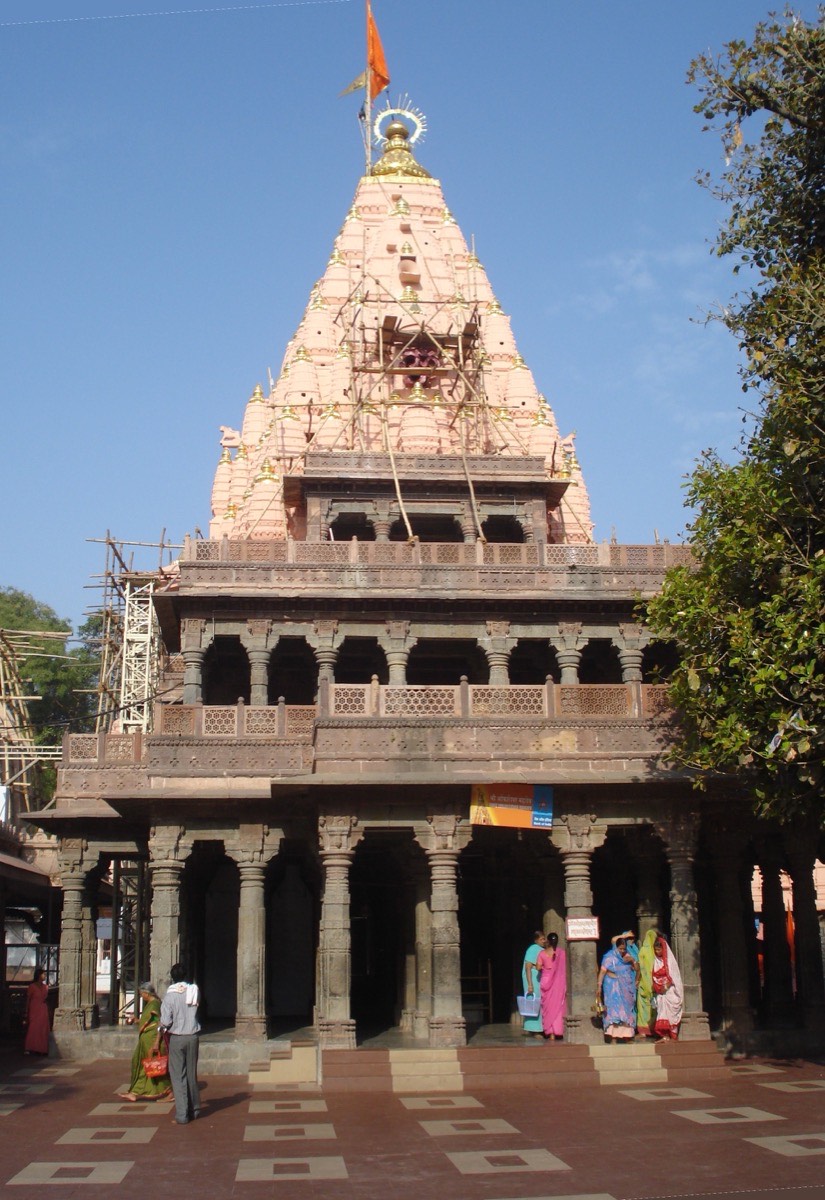
The present temple was reconstructed during the Marāṭhā period in the 18th century by Rāṇojī Śinde (Scindia), the Marāṭhā general and Dīwān under Peśvā Bājīrāo I. The restored temple blends Marāṭhā, Bhūmija, and Cālukya architectural styles, rising in five levels — one of which is underground, housing the sanctum of the Jyotirliṅga itself.
Temple Layout
The temple complex is an imposing multi-storey structure:
- Ground level (underground): The garbhagṛha (sanctum sanctorum) containing the Mahākāleśvara Jyotirliṅga
- First level: The Oṃkāreśvara Liṅga
- Second level: The Nāgacandreśvara shrine, depicting Śiva and Pārvatī seated upon a ten-hooded serpent — opened to the public only once a year on Nāga Pañcamī
- Surrounding shrines: Pārvatī (north), Gaṇeśa (west), Kārttikeya (east), and Nandī (south)
The tall śikhara (spire) features intricate carvings and is topped with a golden kalaśa (finial) and a saffron flag that flutters above the city skyline.
The Bhasma Āratī: Dawn Worship with Sacred Ash
The Bhasma Āratī of Mahākāleśvara is one of the most extraordinary rituals in all of Hinduism. Performed every day before dawn, beginning around 4:00 AM, this ceremony is unique to the Mahākāleśvara temple and draws pilgrims from across the world.
The ritual involves anointing the Mahākāleśvara Liṅga with bhasma (sacred ash). Traditionally, this ash was associated with cremation grounds — a direct invocation of Śiva’s identity as the ascetic who dwells in śmaśānas (cremation grounds), smearing his body with the ashes of the dead as a reminder of life’s impermanence. Today, the bhasma is prepared from purified cow dung cakes in accordance with scriptural prescriptions.
The ceremony unfolds in stages: priests process to the sanctum accompanied by the sound of conch shells and bells, a sacred fire is kindled, the liṅga is bathed and then coated rhythmically with ash while Vedic mantras are chanted, and finally the āratī (lamp offering) is performed with oil lamps swung in circular motions. The atmosphere in the underground sanctum during Bhasma Āratī — dense with smoke, reverberating with ancient chants, illuminated by flickering flames — is described by devotees as an encounter with the raw, primordial power of Śiva as Mahākāla.
The philosophical meaning is profound: ash (bhasma) represents the ultimate state of all material existence. Everything that is born must eventually be reduced to ash. By adorning the liṅga with bhasma, the ritual enacts Śiva’s teaching that attachment to the material world is futile, and that true liberation lies in recognizing the imperishable ātman beneath the perishable body.
Ujjainī as Sapta Purī: The Seven Sacred Cities
Ujjainī’s inclusion among the Sapta Purī — the seven cities that grant mokṣa — places it alongside Ayodhyā, Mathurā, Haridvāra, Kāśī (Vārāṇasī), Kāñcīpuram, and Dvārakā. The Garuḍa Purāṇa’s declaration that these seven cities are mokṣadāyikā (bestowers of liberation) means that death within the sacred boundaries of Ujjainī releases the soul from the cycle of saṃsāra.
The Avantī Khaṇḍa of the Skanda Purāṇa is the primary scriptural text devoted to the sacred geography of Ujjainī, describing in exhaustive detail the city’s temples, tīrthas (sacred bathing spots), and the spiritual merits gained by pilgrimage to each.
Siṃhastha Kumbha Melā: The Great Gathering
Every twelve years, when the planet Jupiter (Bṛhaspati) enters the zodiac sign of Leo (Siṃha Rāśi), Ujjainī hosts the Siṃhastha Kumbha Melā — one of the four great Kumbha Melā gatherings and among the largest religious congregations on earth. According to legend, during the Samudra Manthana (churning of the cosmic ocean), drops of the divine nectar (amṛta) fell at four locations: Prayāga (Allahabad), Haridvāra, Nāsik, and Ujjainī.
During Siṃhastha, millions of pilgrims, sādhus, and ascetics converge on the banks of the Kṣiprā for ritual bathing at astronomically auspicious moments. The Akhāḍās (monastic orders) of Nāgā Sādhus lead grand processions (śāhī snāna) to the river, their naked, ash-covered bodies a living embodiment of Śiva’s own ascetic nature. The next Siṃhastha is anticipated in 2028.
Other Sacred Sites of Ujjainī
Kāla Bhairava Temple
Kāla Bhairava, the fearsome guardian form of Śiva, is the koṭwāl (divine magistrate) of Ujjainī. The Kāla Bhairava temple is one of the most important Bhairava shrines in India. According to tradition, no pilgrimage to Ujjainī is complete without paying respects to Kāla Bhairava, who guards the city’s eight gates and passes judgment on the karma of its inhabitants. Uniquely, the offering made to Kāla Bhairava here is madirā (liquor) — a practice rooted in Tantric tradition.
Harsiddhī Temple
The Harsiddhī Temple, one of the 51 Śakti Pīṭhas (seats of the Goddess), is dedicated to Goddess Annapūrṇā (Harsiddhī). According to the Śakti Pīṭha tradition, the elbow of Satī fell here when Lord Viṣṇu’s Sudarśana Cakra dismembered her body. The temple is flanked by two towering pillars adorned with lamps, creating a spectacular sight when illuminated during Navarātri. Kālidāsa is said to have been a devoted worshipper of Harsiddhī, and tradition credits the goddess with inspiring his literary genius.
The Kṣiprā (Shipra) River
The Kṣiprā river, flowing through the heart of Ujjainī, is one of the sacred rivers of India. Bathing in the Kṣiprā, especially during Siṃhastha, is believed to wash away the accumulated sins of many lifetimes. The Rāma Ghāṭ on the Kṣiprā is the principal bathing site for pilgrims and the focal point of the Kumbha Melā.
Astronomical Significance: India’s Prime Meridian
Ujjainī holds a unique place in the history of astronomy. The city sits almost exactly on the Tropic of Cancer, and ancient Indian astronomers chose the meridian passing through Ujjainī as India’s prime meridian (rekhā) for calculating longitudes and planetary positions. The great astronomer-mathematician Varāhamihira (505-587 CE) worked in Ujjainī, and the Sūrya Siddhānta — one of the foundational texts of Indian astronomy — uses the Ujjainī meridian as its zero reference.
This astronomical significance is not divorced from the city’s sacred character. The Hindu understanding of kāla (time) as both a physical phenomenon and a cosmic force governed by Mahākāla gives Ujjainī’s role as a centre of time-keeping a deeply spiritual dimension. The city where time is measured is the city where the Lord of Time resides.
Kālidāsa and the Literary Heritage
The great Sanskrit poet Kālidāsa (c. 4th-5th century CE), often called the “Shakespeare of India,” is indelibly associated with Ujjainī. His Meghadūta contains the most celebrated poetic description of the city, portraying its gardens, palaces, women, and the evening worship at the Mahākāla temple with unmatched lyrical beauty. The Raghuvaṃśa and Vikramorvaśīya also contain references to Ujjainī’s splendour.
The legendary King Vikramāditya, patron of the “nine gems” (navaratna) of his court — including Kālidāsa — ruled from Ujjainī, and the Vikrama Saṃvat calendar (beginning 57 BCE) that bears his name remains in use across India and Nepal today.
Conclusion: The Abode of the Lord of Time
Ujjainī endures as a living testament to the Hindu vision of the sacred city — a place where the cosmic and the terrestrial interpenetrate, where astronomical science and spiritual aspiration converge, and where the Lord of Time himself keeps eternal watch. From the pre-dawn Bhasma Āratī in the underground sanctum to the twelve-yearly tide of humanity at the Siṃhastha Kumbha, from the Tantric offerings at the Kāla Bhairava shrine to the timeless verses of Kālidāsa echoing through the centuries, Ujjainī remains what the Skanda Purāṇa proclaimed it to be: the foremost among tīrthas, the city that conquers death, the eternal abode of Mahākāla.
As the Avantī Khaṇḍa declares: “He who remembers Avantikā and Mahākāla at the time of death is freed from all bonds and attains the supreme state” (Skanda Purāṇa, Avantī Khaṇḍa 1.50-52).