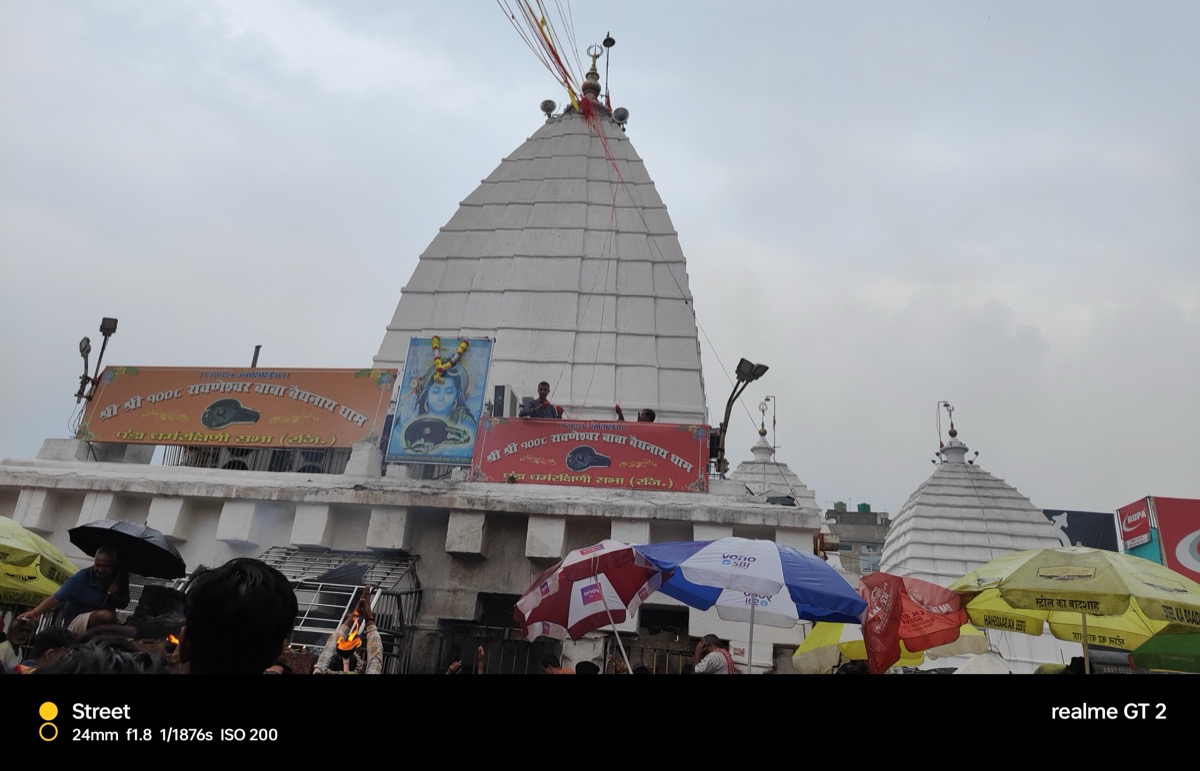
Bābā Vaidyanātha Dhāma, commonly known as Baidyanāth Dhām, stands as one of the most sacred pilgrimage sites in Hinduism. Located in the ancient town of Deoghar (literally “abode of the gods”) in Jharkhand, eastern India, this temple enshrines one of the twelve Jyotirliṅgas — the self-manifested pillars of cosmic light representing Lord Shiva’s infinite nature. What makes Vaidyanātha uniquely significant is its rare dual status: it is simultaneously venerated as a Jyotirliṅga and a Śakti Pīṭha, the only site among the twelve Jyotirliṅgas to hold both distinctions. The name Vaidyanātha — “Lord of Physicians” — identifies Shiva in his compassionate aspect as the divine healer, drawing millions who seek spiritual restoration, physical healing, and liberation from suffering.
The Legend of Rāvaṇa and the Healing Lord
The origin mythology of Vaidyanātha Jyotirliṅga is narrated in the Koṭi Rudra Saṁhitā section of the Śiva Purāṇa, and centres on an extraordinary episode involving Rāvaṇa, the mighty king of Laṅkā. Despite being classified among the asuras, Rāvaṇa was one of Lord Shiva’s most fervent devotees — a master of the Sāma Veda and an accomplished player of the vīṇā who composed the celebrated Śiva Tāṇḍava Stotram in praise of Mahādeva.
Desiring to make his capital Laṅkā invincible, Rāvaṇa resolved to bring Shiva’s presence there permanently. He travelled to Mount Kailāsa and undertook severe penance (tapas), performing such extreme austerities that he began offering his own ten heads, one by one, as sacrificial oblations into a sacred fire. Each time he severed a head, it would regenerate, yet the pain and devotion were genuine. When Rāvaṇa was about to sever his tenth and final head, Lord Shiva — moved by this unparalleled display of devotion — appeared before him. Mahādeva healed all of Rāvaṇa’s wounds, restoring each severed head, and for this act of divine surgery earned the epithet Vaidyanātha — the Supreme Physician. This healing dimension distinguishes Vaidyanātha from all other Jyotirliṅgas, which typically emphasise cosmic power, destruction of ignorance, or liberation.
Pleased with Rāvaṇa’s devotion, Shiva granted him a sacred Ātmaliṅga — a Jyotirliṅga embodying his own essence — with a strict condition: the liṅga must never be placed upon the ground before reaching Laṅkā. If set down even once, it would become permanently fixed at that spot.
The Divine Stratagem
As Rāvaṇa journeyed southward carrying the precious Ātmaliṅga, the Devas grew alarmed. A Shiva-empowered Rāvaṇa in Laṅkā would be truly invincible. Lord Viṣṇu devised a stratagem: he influenced Varuṇa, the god of waters, to create an urgent pressure in Rāvaṇa’s body, forcing him to seek relief. At that critical moment, Lord Gaṇeśa appeared disguised as a young Brāhmaṇa boy. Rāvaṇa, desperate, entrusted the liṅga to the boy with instructions not to place it down. But the cunning Gaṇeśa, calling out thrice for Rāvaṇa’s return and receiving no response, deliberately set the liṅga upon the ground at the spot that became Deoghar.
When Rāvaṇa returned, he found the Jyotirliṅga immovably established. Despite his immense strength, he could not budge it. In his frustrated rage, he pressed his thumb into the liṅga — and the mark of this indentation is believed to be visible on the sacred liṅga to this day. Rāvaṇa then performed further penance at the site, and Shiva, appearing once more, consoled him and granted additional boons. The place where the asura king worshipped became Vaidyanātha Dhāma, and the surrounding town came to be called Deoghar — the dwelling-place of the gods.
The Śakti Pīṭha: Where Satī’s Heart Fell
Vaidyanātha’s significance extends beyond its Jyotirliṅga status through its identification as one of the 51 Śakti Pīṭhas. According to the Devī Bhāgavata Purāṇa and other Śākta texts, after Satī immolated herself in the sacrificial fire of her father Dakṣa’s yajña, the grief-stricken Shiva wandered the universe carrying her body. To restore cosmic order, Lord Viṣṇu released his Sudarśana Cakra, which dismembered Satī’s body into fifty-one parts that fell across the subcontinent.
At Deoghar, Satī’s hṛdaya (heart) is believed to have fallen, establishing this as the Hṛdaya Pīṭha — the Heart Shrine. The presiding goddess here is Jayādurgā, whose temple stands adjacent to the main Shiva shrine. This convergence of Śiva and Śakti — the Jyotirliṅga and the Śakti Pīṭha — in a single sacred complex is extraordinarily rare and is considered to represent the ultimate union of masculine and feminine divine principles. The two temple pinnacles are ritually connected by sacred red threads (lāl dhāgā), symbolising the eternal bond between Shiva and Śakti.
The Temple Complex: Twenty-Two Sacred Shrines
The Vaidyanātha temple complex is an expansive sacred precinct housing twenty-two interconnected temples, each dedicated to a different deity. The complex is enclosed by spacious white-stone courtyard walls and represents a comprehensive devotional universe.
The Main Shrine
The central Vaidyanātha temple rises seventy-two feet from its base, its east-facing structure designed to resemble a blooming lotus — a symbol of purity and spiritual awakening. One of the temple’s most remarkable architectural features is that the entire structure was reportedly carved from a single rock, lending it exceptional unity and grandeur. According to tradition, it was built by Viśvakarmā, the divine architect of the gods.
The śikhara (tower) is crowned with three ascending gold vessels, donated by Rājā Pūran Singh, the king of Gidhour, as acts of devotion. Above these vessels sits the Candrakānta Maṇi — an eight-petalled lotus jewel of extraordinary beauty. The entire tower is surmounted by a Pañcaśūla (five-pronged trident), symbolising the destruction of the five cardinal vices: kāma (lust), krodha (anger), lobha (greed), moha (delusion), and mātsarya (jealousy).
Within the sanctum sanctorum, the sacred Jyotirliṅga is approximately five inches in diameter, set upon a four-inch stone slab. The indentation attributed to Rāvaṇa’s thumb is pointed out by the temple priests to devotees.
The Twenty-One Subsidiary Temples
The remaining twenty-one temples within the complex are dedicated to a comprehensive pantheon of Hindu deities:
- Mā Pārvatī Mandira — directly adjacent to the main shrine, with peaks connected by sacred threads
- Mā Kālī Mandira — honouring the fierce aspect of the Divine Mother
- Mā Annapūrṇā Mandira — goddess of nourishment
- Lakṣmī Nārāyaṇa Mandira — Viṣṇu with his consort Lakṣmī
- Nīlakaṇṭha Mandira — Shiva as the blue-throated one
- Mā Jagat Jananī Mandira — the Universal Mother
- Gaṇeśa Mandira — commemorating Gaṇeśa’s role in the founding legend
- Brahmā Mandira — one of the rare temples dedicated to Lord Brahmā
- Mā Sandhyā Mandira — goddess of twilight
- Kāla Bhairava Mandira — the fierce guardian aspect of Shiva
- Hanumān Mandira — the devoted servant of Lord Rāma
- Manasā Mandira — the serpent goddess, especially popular in eastern India
- Mā Sarasvatī Mandira — goddess of learning and arts
- Sūrya Nārāyaṇa Mandira — the Sun god
- Mā Baglā Mandira — one of the ten Mahāvidyās
- Narmadeśvara Mandira — Shiva associated with the Narmadā river
- Śrī Rāma Mandira — Lord Rāma, the ideal king
- Mā Gaṅgā Mandira — personification of the sacred river
- Ānanda Bhairava Mandira — the blissful aspect of Bhairava
- Gaurī Śaṅkara Mandira — Shiva and Pārvatī together
- Mā Gāyatrī Mandira — the Vedic mother of mantras
This comprehensive assembly of deities makes the Vaidyanātha complex a complete pilgrimage in itself — a devotee can worship nearly every major deity of the Hindu pantheon within a single sacred compound.
Architecture and Design
The Vaidyanātha temple follows the Nāgara style of North Indian temple architecture, characterised by its curvilinear śikhara that tapers gracefully to its apex. The temple’s lotus-form design is significant in Hindu architectural symbolism — the lotus (padma) represents purity rising from the mud of worldly existence, mirroring the spiritual journey of the devotee.
The east-facing orientation follows the classical Āgamic prescription that the entrance of a Shiva temple should face the rising sun, allowing the first rays of dawn to illuminate the sacred liṅga. The temple’s white-stone construction gives it a luminous quality, especially in the early morning and at dusk when the complex is bathed in warm light.
The courtyard layout, with the main shrine at the centre surrounded by subsidiary temples, follows the maṇḍala principle of sacred geometry — a cosmographic plan in which the principal deity occupies the brahmāsthāna (the central point) and attendant deities radiate outward in concentric zones.
The Śrāvaṇī Melā: One of the World’s Largest Pilgrimages
The most dramatic expression of devotion at Vaidyanātha occurs during the Śrāvaṇī Melā (Shravan Mela), a month-long pilgrimage held during the Hindu month of Śrāvaṇa (typically July-August), which is considered the holiest month for Shiva worship. This event is recognised as one of the largest religious gatherings on earth and the longest religious fair in the world, attracting between fifty and fifty-five lakh (five to five-and-a-half million) pilgrims each year.
The Kāṅvara Yātrā
The defining feature of the Śrāvaṇī Melā is the Kāṅvara Yātrā (Kanwar Yatra). Devotees known as Kāṅvariyās undertake a gruelling barefoot trek of approximately 108 kilometres from Sultānganj on the banks of the Gaṅgā to Vaidyanātha Dhāma. They carry decorated kāṅvara — bamboo frameworks adorned with colourful fabrics and tinsel — on their shoulders, each containing pots of sacred Gaṅgā water.
The journey typically takes two to four days on foot, with many devotees walking continuously, chanting “Bol Bam! Bol Bam!” (Speak the name of Shiva!). Some practitioners undertake even more austere forms of the pilgrimage: crawling on their stomachs, rolling sideways along the route, or carrying the kāṅvara while maintaining complete silence. The most intense form is the Ḍāk Kāṅvara, in which devotees run the entire distance without stopping, sometimes completing the journey in under twenty-four hours.
Upon arrival at Vaidyanātha, the pilgrims first bathe in the sacred Śivagaṅgā tank within the temple complex, then offer the Gaṅgā water directly upon the Jyotirliṅga. This act of jalābhiṣeka (water ablution) is believed to fulfil wishes, wash away sins accumulated over lifetimes, heal chronic ailments, remove negative karma, and grant immense spiritual merit.
History and Cultural Context
The Kāṅvara tradition at Deoghar has roots stretching back several centuries, though it has grown exponentially in recent decades. During the melā period, a continuous stream of saffron-clad devotees stretches along the entire 108-kilometre route — an extraordinary spectacle of collective devotion that has few parallels anywhere in the world. Special infrastructure including rest camps, medical facilities, food stalls, and security arrangements are deployed along the route by the Jharkhand state government.
Daily Worship and Rituals
The Vaidyanātha temple follows a structured daily liturgical cycle that begins well before dawn:
Maṅgalā Āratī (pre-dawn): The first worship of the day takes place in the early hours, when the head priest initiates the Ṣoḍaśopacāra Pūjā — a sixteen-step ritual worship involving invocation, seating of the deity, water offerings, bathing, garments, sacred thread, sandalwood paste, flowers, incense, lamp, food offering, and other prescribed acts of devotion.
Abhiṣeka: The Jyotirliṅga receives ritual ablution with water, milk, curd, ghee, honey, and sugarcane juice — the Pañcāmṛta (five nectars). Devotees offer bilva (bel) leaves, which are considered supremely dear to Shiva, along with rudrākṣa beads and dhattūra flowers.
Śṛṅgāra Pūjā (evening): Beginning around 6:00 PM, the liṅga is adorned with sandalwood paste, fragrant flowers, and fine fabrics. Incense fills the sanctum as the evening āratī is performed with multi-tiered oil lamps.
Bhoga and Dīpa Āratī: The concluding worship of the day includes food offerings and the ceremonial waving of lamps, after which the temple doors close for the night.
The signature offering at Vaidyanātha is the Deoghar Pedā — a distinctive local sweet made from condensed milk — which devotees present to the deity alongside the traditional prasāda items.
Significance for Bengali Pilgrims
Vaidyanātha Dhāma holds a special place in the devotional geography of Bengali Hindus. Deoghar’s proximity to Bengal, combined with the region’s deep Śaiva-Śākta traditions, has made Bābā Baidyanāth a central figure in Bengali religious life. The temple’s dual identity as both Jyotirliṅga and Śakti Pīṭha resonates particularly with Bengali culture, where the worship of Śiva and Śakti exists in intimate synthesis — as seen in the centrality of Durgā Pūjā and Kālī Pūjā in Bengali observance.
Historically, Deoghar was part of the Bengal Presidency, and the cultural connections between the temple town and Kolkata remain strong. The Jasidih Junction railway station, the traditional railhead for Deoghar, has for over a century served as the arrival point for Bengali pilgrims. Special trains are operated during the Śrāvaṇī Melā and on festivals like Mahāśivarātri to accommodate the influx of devotees from West Bengal and Bangladesh.
Bengali literature and folk traditions are replete with references to Bābā Baidyanāth. The journey to Deoghar — often called simply “Bābā Dhāma” in Bengali parlance — is considered one of the most meritorious pilgrimages a Bengali Hindu can undertake.
Connection to the Twelve Jyotirliṅgas
Vaidyanātha is traditionally enumerated as the ninth among the twelve Jyotirliṅgas in the celebrated verse from the Dvādaśa Jyotirliṅga Stotram:
Saurāṣṭre Somanāthaṁ ca Śrīśaile Mallikārjunam, Ujjayinyāṁ Mahākālam Oṁkāram Amaleśvaram… Vaidyanāthaṁ Citābhūmau Ḍākinīṁ…
The stotram locates Vaidyanātha at the citābhūmi (cremation ground), aligning with Shiva’s association with liminality and his role as the presider over death and regeneration. This aspect reinforces the healing dimension: Vaidyanātha is the physician who operates at the boundary between death and life, illness and health, bondage and liberation.
It is worth noting that there has been a historical debate regarding the location of the Vaidyanātha Jyotirliṅga, with the town of Parli Vaijnāth in Maharashtra also claiming the distinction. However, the Deoghar tradition is widely accepted among most Śaiva authorities and pilgrimage traditions, particularly given its corroboration by the Śakti Pīṭha tradition and the Śrāvaṇī Melā’s antiquity.
Festivals and Celebrations
Beyond the Śrāvaṇī Melā, Vaidyanātha Dhāma observes a rich calendar of festivals:
Mahāśivarātri (February-March): The “Great Night of Shiva” is celebrated with all-night vigils, continuous chanting of the Mahāmṛtyuñjaya Mantra, and elaborate abhiṣeka. Thousands of devotees fast and maintain jāgaraṇa (wakefulness) through the night, performing worship during each of the four praharas (watches) of the night.
Vasanta Pañcamī (January-February): The arrival of spring is celebrated with special worship of Sarasvatī within the complex.
Bhādrapada Pūrṇimā (September): The full moon of Bhādrapada month brings special festivities and heightened worship.
Kārtika Pūrṇimā and Dīpāvalī (October-November): The temple complex is illuminated with thousands of earthen lamps, and grand celebrations mark these auspicious occasions.
Modern Pilgrimage Infrastructure
In recent decades, Deoghar has seen significant development of pilgrimage infrastructure:
- Deoghar Airport (DGH) now provides air connectivity, supplementing the existing Jasidih Junction railway station and the road network connecting Kolkata (373 km), Patna (281 km), and Ranchi (250 km)
- The Deoghar Junction Railway Station serves as a direct railhead, with multiple express and superfast trains from major cities
- The Jharkhand government has developed improved roads, rest houses (dharmaśālās), medical facilities, and sanitation infrastructure along the Kāṅvara Yātrā route
- An online booking system for darśana and pūjā has been implemented through the temple’s official website
- The Śivagaṅgā Muhallā area around the temple has been upgraded with wider pathways and better crowd management facilities
Visiting Vaidyanātha
The temple is open for morning darśana from 4:00 AM to approximately 3:30 PM, and for evening darśana from 6:00 PM to 9:00 PM. Extended hours are observed during Śrāvaṇa month, Mahāśivarātri, and other major festivals. The best season for visiting is October to February, when the climate is pleasant, though the spiritually most significant time remains Śrāvaṇa month despite the monsoon conditions.
Photography is not permitted within the temple complex, reflecting the traditional sanctity attached to the inner precincts of the shrine.
Spiritual Significance and Living Tradition
Vaidyanātha Jyotirliṅga occupies a unique space in the landscape of Hindu sacred geography. While other Jyotirliṅgas emphasise Shiva’s cosmic power (Mahākāleśvara at Ujjain), his ascetic nature (Kedāranātha), or his role as destroyer of darkness (Somanātha), Vaidyanātha presents Shiva in his most compassionate and accessible form — as the divine physician who heals the body, calms the mind, and liberates the soul.
The convergence of the Jyotirliṅga and the Śakti Pīṭha at a single location teaches a profound theological lesson: complete healing requires the union of Śiva (pure consciousness) and Śakti (dynamic energy). Neither alone suffices. This understanding is visually expressed in the red threads connecting the two temple spires — a humble yet powerful symbol of the interdependence of all dualities.
For the millions who walk barefoot each Śrāvaṇa from the banks of the Gaṅgā, carrying sacred water across 108 kilometres of heat, dust, and devotion, Vaidyanātha is not merely a historical monument or an architectural curiosity. It is a living presence — Bābā — the compassionate father who heals all who come to him with sincere hearts. In their thunderous collective cry of “Bol Bam!”, one hears the ancient truth that the Śiva Purāṇa sought to convey: that Shiva’s grace is available to all — from the greatest king to the humblest devotee — and that the ultimate healing is the liberation of the self from the cycle of suffering.