Introduction: The Abode of the Divine Mother
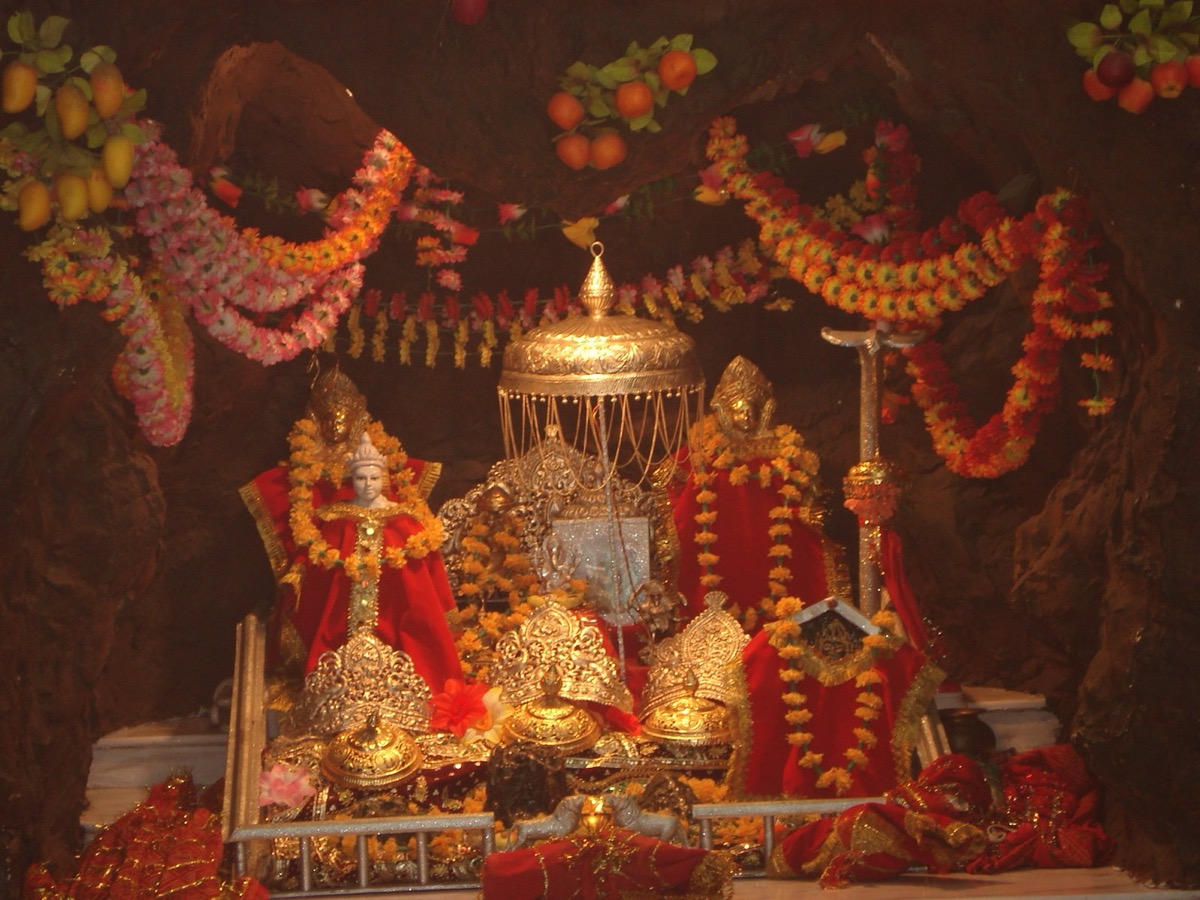
High in the Trikūṭa Hills of the Śivālika mountain range, at an elevation of 5,200 feet above sea level, lies one of the most revered and most visited pilgrimage destinations in the Indian subcontinent: the cave shrine of Śrī Mātā Vaishno Devī. Located approximately 12 kilometres from the town of Kaṭrā in the Reāsī district of Jammu and Kashmir, this sacred cave is the abode of the Goddess Vaishno Devī — a manifestation of the supreme feminine divine energy (Ādi Śakti) who appears in the unified form of three great Goddesses: Mahākālī, Mahālakṣmī, and Mahāsarasvatī.
What makes Vaishno Devī extraordinary among Hindu pilgrimage sites is that the deity is not an image carved by human hands but three natural rock formations — the piṇḍīs — that have emerged from the living rock of the cave itself. Devotees who undertake the arduous 13-kilometre mountain trek from Kaṭrā to the Bhawan (the shrine complex) believe they are answering the personal call of the Goddess, for it is said that Mātā Vaishno Devī summons each pilgrim individually: “No one comes to me unless I call them” (a widely held devotional belief). The Shri Mata Vaishno Devi Shrine Board reported over 9.52 million pilgrims visiting the shrine in 2023 alone, making it one of the most visited religious sites on earth.
The Legend of Vaishno Devī
The Birth and Vow of the Goddess
According to the traditional narrative preserved in the local Māhātmya texts and oral traditions of the region, Vaishno Devī was born as a human girl named Trikulā (or Vaiṣṇavī) in a Brahmin household in southern India. From her earliest childhood, she was a devoted worshipper of Lord Viṣṇu and resolved to remain a celibate devotee (brahmacāriṇī), dedicating her life entirely to the Supreme. She performed intense tapasyā (austerities) to attain union with Lord Viṣṇu, who blessed her and instructed her to establish her abode in the Trikūṭa Hills, promising that he would manifest before her in his Kalki avatāra at the end of the present age.
The Pursuit by Bhairavnāth
The most dramatic episode in the Vaishno Devī narrative involves the Tantric ascetic Bhairavnāth (also called Bhairon or Bhairō Bābā), a devotee of Lord Śiva. Learning of Vaiṣṇavī’s spiritual power and beauty, Bhairavnāth became obsessed with her and pursued her through the mountains. The Goddess fled from her meditation cave, not out of fear but to avoid violence, taking refuge in a succession of sacred spots along the mountain path.
At Bān Gaṅgā, the Goddess shot an arrow into the earth to create a stream so that her followers could drink. At Caraṇ Pādukā, she rested and left the imprint of her sacred feet. At Ādhkuṃvārī, she hid in a cave for nine months, meditating in the womb-like darkness (the name literally means “half-girl,” suggesting the cave where she completed her transformation). Finally, she entered the holy cave at the summit, and when Bhairavnāth followed her inside, she assumed the fierce form of Mahākālī and severed his head.
The Redemption of Bhairavnāth
In a profound act of divine mercy that is central to the theology of this pilgrimage, the Goddess granted Bhairavnāth mokṣa at the moment of his death. His severed head flew to a hilltop nearby, where the Bhairavnāth Temple now stands. Bhairavnāth is thus honoured not as a villain but as a devotee who received the ultimate blessing of the Goddess. Pilgrimage to Vaishno Devī is traditionally considered incomplete without a visit to the Bhairavnāth Temple, located about 2.5 kilometres beyond the main shrine.
The Three Piṇḍīs: The Heart of the Shrine
The sanctum sanctorum of Vaishno Devī is a narrow cave passage through which pilgrims wade through ankle-deep water. At the terminus of this passage, devotees behold the three piṇḍīs — natural rock formations that are worshipped as the three aspects of the Goddess:
-
Mahākālī Piṇḍī (right): The fierce, destructive aspect of the Goddess, associated with the annihilation of evil and the power of time (kāla). This piṇḍī is reddish in colour.
-
Mahālakṣmī Piṇḍī (centre): The sustaining, nourishing aspect, associated with prosperity, abundance, and the preservation of the cosmos. This piṇḍī is yellowish-white.
-
Mahāsarasvatī Piṇḍī (left): The creative, illuminating aspect, associated with knowledge, arts, and wisdom. This piṇḍī is whitish in colour.
This triad corresponds to the theology of the Devī Māhātmya (also known as the Durgā Saptaśatī or Caṇḍī Pāṭha), the foundational Śākta scripture contained in the Mārkaṇḍeya Purāṇa (chapters 81-93), which describes the Goddess as manifesting in three primary forms to destroy the demons Madhu-Kaiṭabha (Mahākālī, chapters 1), Mahiṣāsura (Mahālakṣmī, chapters 2-4), and Śumbha-Niśumbha (Mahāsarasvatī, chapters 5-13).
The Pilgrimage: The Sacred Trek
Kaṭrā: The Base Camp
The pilgrimage begins at the town of Kaṭrā (also spelled Katra), situated at the foot of the Trikūṭa Hills. Kaṭrā serves as the base camp for pilgrims and is well connected by road and rail (the nearest railway station is Shri Mata Vaishno Devi Katra). Before beginning the trek, many pilgrims visit the Kaṭrā temple complex and register with the Shri Mata Vaishno Devi Shrine Board, which manages the pilgrimage infrastructure.
The 13-Kilometre Trek
The yātrā (pilgrimage journey) from Kaṭrā to the Bhawan covers approximately 13 kilometres of mountain path. The trail has been significantly improved over the decades with paved pathways, railings, shelters, and illumination, but it remains a demanding physical endeavour, climbing from about 2,500 feet to 5,200 feet. Key stations along the trek include:
- Bān Gaṅgā (1.5 km): Where the Goddess created a stream with her arrow. Pilgrims bathe here before proceeding.
- Caraṇ Pādukā (3 km): The site of the Goddess’s sacred footprints, where pilgrims offer prayers.
- Ādhkuṃvārī (6 km): The cave where the Goddess meditated for nine months. This narrow cave passage is itself a pilgrimage site, and pilgrims crawl through it as a devotional act.
- Sāñjhī Chhaṭ (7.5 km): A plateau offering rest and panoramic mountain views.
- Bhawan (13 km): The shrine complex housing the sacred cave.
The Shrine Board has also constructed a newer route called the Himkoṭi track, offering an alternative path with different scenery. Helicopter services are available from Kaṭrā to Sāñjhī Chhaṭ for those unable to trek.
Darśana in the Sacred Cave
Upon reaching the Bhawan complex, pilgrims queue for entry into the cave. The passage is narrow — at some points barely wide enough for one person — and water from a natural spring flows through it. The moment of darśana (sacred seeing) of the three piṇḍīs is considered the spiritual culmination of the pilgrimage. Devotees offer flowers, coconuts, and chunrī (red cloth) to the Goddess. The experience of emerging from the cave is described by many pilgrims as a spiritual rebirth.
The Bhairavnāth Temple
Located approximately 2.5 kilometres beyond and above the main Bhawan complex, the Bhairavnāth Temple marks the spot where the head of Bhairavnāth fell after being severed by the Goddess. The temple, perched at an elevation of about 6,600 feet, offers commanding views of the surrounding mountains. Traditional pilgrimage protocol holds that the yātrā is complete only after visiting Bhairavnāth, as the Goddess herself granted him the boon that all pilgrims who come to her would also honour him.
The Aṣṭabhujā Temple Connection
Below the main cave shrine, at a slightly lower elevation, lies the ancient Aṣṭabhujā Temple (Temple of the Eight-Armed Goddess). According to tradition, after slaying Bhairavnāth, the Goddess manifested her eight-armed form (aṣṭabhujā) at this location before assuming the form of the three piṇḍīs in the cave above. The Aṣṭabhujā Temple thus represents a crucial stage in the theological narrative of the shrine and is visited by devout pilgrims as part of the complete darśana circuit.
Scriptural and Theological Foundations
The Devī Māhātmya Connection
The theology of Vaishno Devī is deeply rooted in the Devī Māhātmya (c. 5th-6th century CE), the most important scripture of the Śākta tradition. The three piṇḍīs correspond precisely to the three great Goddess forms described in the Devī Māhātmya: Mahākālī (the tāmasic form, associated with Śiva’s creative sleep), Mahālakṣmī (the rājasic form, the supreme sovereign Goddess), and Mahāsarasvatī (the sāttvic form, the Goddess of knowledge and liberation). The Devī Māhātmya declares: “By you this universe is borne, by you this world is created. By you it is protected, O Devī, and you always consume it at the end” (Devī Māhātmya 11.6).
Vaiṣṇava-Śākta Synthesis
The name “Vaishno Devī” itself signals a profound theological synthesis: the Goddess is simultaneously Vaiṣṇavī (a devotee and power of Viṣṇu) and the independent supreme Śakti. This synthesis reflects the broader Hindu theological understanding that the Goddess is both the consort of the male deities and the supreme reality in her own right. The Devī Bhāgavata Purāṇa (VII.33) describes her as: “She who is Lakṣmī in the abode of Viṣṇu, Sarasvatī in the abode of Brahmā, and Pārvatī in the abode of Śiva — she is the one Devī who pervades the entire universe.”
Śakti Pīṭha Tradition
While Vaishno Devī is not always listed among the canonical 51 Śakti Pīṭhas (sites where parts of Satī’s body fell), many devotional traditions consider it one of the most important seats of Śakti in northern India. Some local traditions identify the cave as the site where the Goddess’s right arm fell, though this attribution varies across textual sources.
Festivals and Sacred Calendar
Navarātri
The two Navarātri festivals (Caitra Navarātri in March-April and Śāradīya Navarātri in September-October) are the most important celebrations at Vaishno Devī. During these nine-night festivals dedicated to the Goddess, pilgrim numbers surge dramatically, with hundreds of thousands making the trek. Special abhiṣeka ceremonies are performed on the piṇḍīs, and the Devī Māhātmya is recited in its entirety.
Vaiśākhī
The harvest festival of Vaiśākhī (April) draws large numbers of pilgrims from Punjab and Jammu, many of whom combine agricultural thanksgiving with devotion to the Goddess.
Year-Round Pilgrimage
Unlike many mountain shrines that close during winter, Vaishno Devī remains open throughout the year, though snowfall between December and March adds significantly to the difficulty and spiritual intensity of the trek. Many devotees specifically choose the winter months for their yātrā, viewing the hardship as a deeper form of devotional offering.
The Shrine Board and Modern Infrastructure
The Shri Mata Vaishno Devi Shrine Board (SMVDSB), established in 1986 under an Act of the Jammu and Kashmir State Legislature, manages the entire pilgrimage infrastructure. The Board has transformed the pilgrimage experience through the construction of paved paths, shelters, medical facilities, langar (free communal kitchens), battery-operated vehicle services on certain stretches, helicopter services, and a comprehensive registration system that manages pilgrim flow to prevent overcrowding in the cave.
The Board also maintains the Trikūṭa Hills ecosystem, undertaking extensive afforestation and environmental conservation programmes. The integration of modern infrastructure with the ancient pilgrimage tradition has made Vaishno Devī accessible to pilgrims of all ages and physical abilities while preserving the essential character of the mountain trek as a devotional journey.
The Pilgrim Experience: A Spiritual Ascent
The pilgrimage to Vaishno Devī is understood not merely as a physical journey but as a spiritual ascent — a metaphor for the soul’s journey towards the divine. The trek from Kaṭrā to the Bhawan, with its progressively higher altitude, its sacred stations marking episodes from the Goddess’s legend, and its culmination in the dark, water-filled cave where the piṇḍīs await, is experienced by millions as a transformative encounter with the divine feminine.
The chant of “Jai Mātā Dī” (Victory to the Divine Mother) echoes ceaselessly along the mountain path, uniting pilgrims of all backgrounds in a single devotional purpose. Whether the pilgrim is a wealthy businessman from Delhi, a farmer from Punjab, a student from Bengal, or a grandmother from Tamil Nadu, the trek equalises all before the Goddess. The shared hardship of the climb, the collective singing of bhajans through the night, and the ecstatic moment of darśana in the cave create a communal devotional experience that is among the most powerful in the Hindu world.
Conclusion: The Living Goddess of the Mountain
Vaishno Devī stands as a living testament to the enduring power of the Goddess tradition in Hinduism. In an age of rapid modernisation, millions continue to undertake the demanding mountain pilgrimage, driven not by obligation but by a deeply personal sense of being called by the Goddess. The three piṇḍīs — uncarved, natural, emerging from the mountain itself — embody the Hindu conviction that the divine is not confined to human-made images but pervades the natural world. As the Devī Māhātmya proclaims: “Wherever there is suffering, wherever there is affliction, wherever there is danger — there the Goddess manifests to protect” (Devī Māhātmya 12.24-25). In the heart of the Trikūṭa Hills, in the darkness of the sacred cave, through the cold mountain water, millions of devotees each year find that this promise is kept.