Introduction: The City That Never Dies
Vārāṇasī — known also as Kāshī (“the Luminous”), Benares, and Avimukta (“never forsaken by Śiva”) — stands as the most sacred city in Hinduism. Located on the western bank of the holy river Gaṅgā in present-day Uttar Pradesh, this ancient city derives its modern name from its geographical position between two tributary streams: the Varaṇā (Varuna) to the north and the Asī to the south. Between these waters lies a crescent of land that Hindu tradition considers the most spiritually charged place on earth.
Mark Twain famously observed that “Benares is older than history, older than tradition, older even than legend, and looks twice as old as all of them put together.” Archaeological evidence confirms continuous habitation dating to at least the 11th century BCE, making Vārāṇasī one of the oldest continuously inhabited cities in the world. But for the devout Hindu, the city’s antiquity is not merely historical — it is cosmic. The Kāshī Khaṇḍa of the Skanda Purāṇa declares that Kāshī existed before creation itself and will endure even after the dissolution of the universe, for it rests upon Lord Śiva’s trident, beyond the reach of cosmic destruction (Skanda Purāṇa, Kāshī Khaṇḍa 26.30-32).
Mythological Origins: Śiva’s Eternal Abode
The City on the Trident
According to the Kāshī Khaṇḍa, when Lord Brahmā created the universe, Śiva established Kāshī as his permanent dwelling place. Unlike every other location in the cosmos, Kāshī is not destroyed during the pralaya (cosmic dissolution). Śiva lifts the city upon his trident (triśūla), holding it above the floodwaters of annihilation, and sets it down again when creation resumes. This is why the city bears the name Avimukta — the place Śiva never abandons (Skanda Purāṇa, Kāshī Khaṇḍa 7.56-60).
The Liṅga Purāṇa (1.92.122-125) further elaborates that Śiva declared to Pārvatī: “This Kāshī is my supreme abode. I shall never forsake it. Here I dwell forever as Viśvanātha, the Lord of All.” This divine promise is the theological foundation for the city’s extraordinary sanctity.
Śiva and Pārvatī’s Celestial Court
Hindu mythology portrays Kāshī as the earthly replica of Śiva’s heavenly abode on Mount Kailāsa. The Śiva Purāṇa describes how Śiva, accompanied by Pārvatī and his entire retinue of gaṇas (celestial attendants), chose to reside in Kāshī to be accessible to his devotees. Every temple in the city is understood to be a station in Śiva’s cosmic court, with Viśvanātha (the Kāshī Viśvanātha Liṅga) at the centre and 56 forms of Vināyaka (Gaṇeśa) and 8 forms of Bhairava guarding the sacred boundary.
The Legend of Divodāsa
One of the most elaborate myths in the Kāshī Khaṇḍa concerns King Divodāsa, a righteous monarch who obtained sovereignty over Kāshī after Śiva temporarily vacated the city. To reclaim his beloved abode, Śiva sent various gods and celestial beings — the Sun, the ten directional guardians, even Viṣṇu himself — to find faults in Divodāsa’s rule, but the king’s dharma was flawless. Finally, Śiva’s emissary convinced Divodāsa that the highest spiritual attainment lay in renunciation. When Divodāsa willingly departed for liberation, Śiva joyfully returned to Kāshī, vowing never to leave again (Skanda Purāṇa, Kāshī Khaṇḍa 52-72).
The Ghats: Steps to the Sacred
The ghats of Vārāṇasī — the broad stone staircases descending to the Gaṅgā — are the city’s most iconic feature. Stretching along approximately 6.8 kilometres of the riverfront, there are 84 ghats in total, each with its own history, patron deity, and ritual function. The ghats serve simultaneously as bathing places, cremation grounds, sites of religious ceremony, and gathering places for philosophical discourse.
Dashashwamedh Ghat
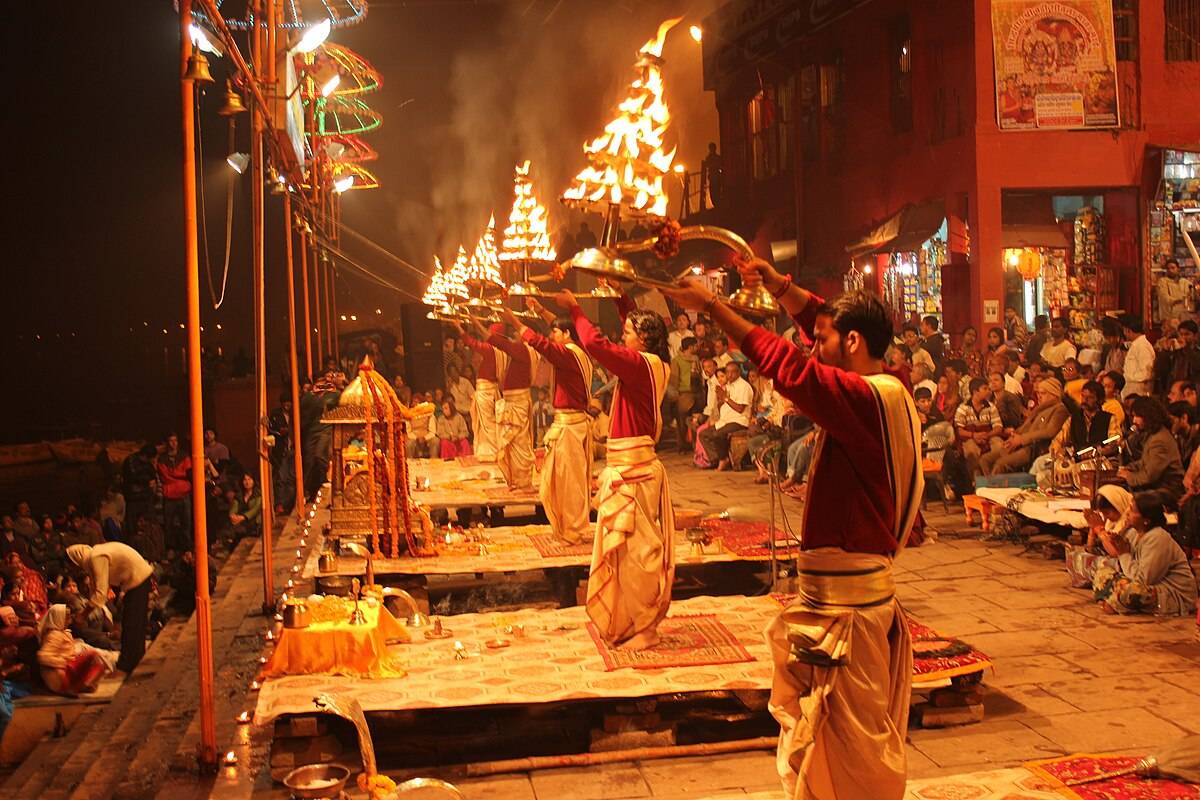
The most celebrated of all Vārāṇasī’s ghats, Dashāshvamedha Ghāṭ (“the ghat of ten horse sacrifices”), is where Lord Brahmā is said to have performed ten Aśvamedha Yajñas (horse sacrifices) to welcome Śiva back to Kāshī (Kāshī Khaṇḍa 62.1-15). Today, it is the site of the grand Gaṅgā Āratī, a nightly fire ceremony in which priests offer elaborate worship to the river goddess using multi-tiered brass lamps, conch shells, and camphor flames. This ceremony, performed every evening without interruption, draws thousands of pilgrims and has become one of the most recognizable images of Hindu devotion worldwide.
Maṇikarṇikā Ghat
Maṇikarṇikā Ghāṭ is the most sacred cremation ground in Hinduism. The name derives from the legend that Goddess Pārvatī’s earring (maṇikarṇikā) fell into the well here during the cosmic play of Śiva and Pārvatī. The Kāshī Khaṇḍa (35.8-12) declares that whoever is cremated at Maṇikarṇikā Ghāṭ receives mokṣa directly, bypassing all intermediate states. Funeral pyres have burned here ceaselessly for thousands of years, and the ghat is tended by the Ḍom Rājā, the hereditary keeper of the sacred flame.
Assi Ghat
Situated at the southern confluence of the Asī river and the Gaṅgā, Assi Ghāṭ marks the traditional southern boundary of the sacred Kāshī kṣetra (sacred zone). Pilgrims performing the Pañcakroshī Yātrā — the circumambulation of the entire sacred city covering roughly 80 kilometres — begin and end their journey here. The ghat also hosts a large Śiva Liṅga under a pīpal tree, where devotees offer worship before dawn.
Kāshī Viśvanātha Temple: The Heart of the City
The Kāshī Viśvanātha Temple (the “Golden Temple”) is the most revered Śiva temple in the world and one of the twelve Jyotirliṅgas — self-manifested liṅgas of light representing Śiva’s infinite, formless nature. The Śiva Purāṇa (Koṭirudra Saṃhitā 1.21-22) lists the Viśvanātha Liṅga as the supreme Jyotirliṅga, established by Śiva himself.
The original temple was destroyed and rebuilt multiple times over the centuries. The present structure, built in 1780 by Ahilyābāī Holkar of Indore, stands adjacent to the Jñānavāpī Mosque. In 1835, Mahārāja Raṇajīta Siṃha of Punjab donated gold plating for the temple’s spires, giving it the name “Golden Temple.” The Kāshī Viśvanātha Corridor, inaugurated in 2021, has dramatically expanded the temple complex, creating a grand processional pathway from the temple to the Gaṅgā ghats.
Pilgrims visiting Viśvanātha also traditionally worship at the Jñānavāpī (“Wisdom Well”), believed to have been dug by Śiva himself, and at the Annapūrṇā Temple, dedicated to the Goddess of Nourishment, who feeds the city’s mendicants and ensures that no one in Kāshī goes hungry.
Scriptural Authority: The Kāshī Khaṇḍa
The most comprehensive scriptural treatment of Vārāṇasī’s holiness is the Kāshī Khaṇḍa, a section within the Skanda Purāṇa comprising over 100 chapters. This text systematically establishes the city’s supremacy among all tīrthas (sacred sites) through philosophical discourse, mythological narrative, and ritual instruction.
Key teachings from the Kāshī Khaṇḍa include:
- Mokṣa in Kāshī: “There is no tīrtha equal to Kāshī, no deity equal to Viśvanātha. Dying in Kāshī, one attains liberation without doubt” (Kāshī Khaṇḍa 35.6).
- Śiva’s whisper: At the moment of death in Kāshī, Lord Śiva himself whispers the Tāraka Mantra (the liberating name of Rāma) into the ear of the dying person, granting immediate mokṣa (Kāshī Khaṇḍa 28.15-17).
- Kāshī as the entire cosmos: The text declares that all other tīrthas exist within Kāshī in subtle form; pilgrimage to Kāshī alone is equivalent to pilgrimage to every sacred site in the universe (Kāshī Khaṇḍa 26.48-50).
Beyond the Skanda Purāṇa, Vārāṇasī is praised in the Matsya Purāṇa (180-185), the Kūrma Purāṇa (1.30-31), the Padma Purāṇa, and extensively in the Mahābhārata (Anuśāsana Parva). The Ṛg Veda (Mandala VII, Hymn 103) contains what some scholars consider the earliest reference to Kāshī.
The Concept of Mokṣa in Kāshī
The doctrine that death in Kāshī guarantees liberation (mokṣa) is perhaps the single most important theological claim associated with the city. This belief rests on several interlinked ideas:
-
Kāshī as Śiva’s body: The entire city is conceived as the embodiment of Śiva. To die within the sacred zone (the Pañcakroshī boundary) is to die in Śiva’s embrace.
-
The Tāraka Mantra: Śiva, in his form as Tārakeshvara (“Lord of the Crossing”), whispers the liberating mantra into the ear of every dying soul in Kāshī. This is described in the Kāshī Khaṇḍa as Śiva’s personal promise and the reason the city is called Mahāśmaśāna — the “Great Cremation Ground” where the fire of spiritual knowledge burns away all accumulated karma.
-
Kāla Bhairava’s judgment: Before granting liberation, the fearsome form of Śiva known as Kāla Bhairava (“the Black Terror of Time”) subjects the dying soul to punishment proportional to its sins, compressing the karmic consequences of many lifetimes into the final moments of death. After this purification, the soul is released. The Kāla Bhairava temple in Vārāṇasī remains one of the city’s most important shrines.
This belief has drawn millions of elderly and ailing Hindus to Vārāṇasī throughout the centuries, many residing in hospices (mukti bhavanas) specifically dedicated to those awaiting death in the sacred city.
Major Festivals in Vārāṇasī
Dev Dīpāvalī
Dev Dīpāvalī (“the Dīpāvalī of the Gods”) falls on Kārtika Pūrṇimā, fifteen days after the main Dīvālī festival. According to tradition, on this night the gods descend to the ghats of Vārāṇasī to celebrate Śiva’s victory over the demon Tripurāsura. The entire riverfront is illuminated with over a million earthen lamps (dīyas) placed on every step of every ghat, creating a breathtaking spectacle of light reflected in the Gaṅgā’s waters. This festival has been celebrated in its modern form since 1985 and has become one of India’s most magnificent visual events.
Mahāśivarātri
The Great Night of Śiva is observed with particular intensity in Vārāṇasī, Śiva’s own city. Hundreds of thousands of devotees throng the Kāshī Viśvanātha Temple for the four-prahar night vigil, chanting “Om Namaḥ Śivāya” through the darkest hours. The Śiva Liṅga is bathed in milk, honey, and Gaṅgā water, and the city remains awake until dawn.
Gaṅgā Daśaharā and Other Observances
Gaṅgā Daśaharā (the ten-day celebration of the Gaṅgā’s descent to earth) is another major occasion in Vārāṇasī. Other significant festivals include Annakūṭa (the mountain of food offering at Annapūrṇā Temple), the month-long Śrāvaṇa celebrations, and the daily spectacle of the Gaṅgā Āratī at Dashāshvamedha Ghāṭ, which, while not a festival per se, constitutes the single most iconic ritual of the city.
Cultural and Intellectual Heritage
Vārāṇasī has been a centre of learning, philosophical debate, and artistic creation for over three millennia. The city nurtured the development of major schools of Hindu philosophy, Sanskrit grammar (Pāṇini is traditionally associated with Kāshī’s scholarly circles), classical music (the Benares gharānā of Hindustani classical music), and handloom weaving (the famous Banārasī silk sāṛī).
The Tulasī Mānasa Temple commemorates the site where Gosvāmī Tulasīdāsa composed the Rāmacaritamānasa, the beloved Hindi retelling of the Rāmāyaṇa, in the 16th century. Kabīr, the great saint-poet of the Bhakti movement, was born and taught in Vārāṇasī, challenging religious orthodoxy from within the city’s own tradition.
The Buddha chose nearby Sārnāth (just 13 km from Vārāṇasī) to deliver his first sermon, the Dharmacakrapravartana Sūtra, recognizing the region’s immense spiritual significance. Jainism’s 23rd Tīrthaṅkara, Pārśvanātha, was born in Vārāṇasī, further underscoring the city’s pan-Indian sacred character.
The Pañcakroshī Yātrā: Circumambulating the Cosmos
The Pañcakroshī Yātrā is the traditional circumambulation of the entire sacred zone of Kāshī, covering a distance of approximately 80 kilometres over five days. The route passes through 108 shrines and encircles the city in a clockwise direction, beginning and ending at Maṇikarṇikā Ghāṭ. The Kāshī Khaṇḍa (73.1-30) prescribes this pilgrimage as equivalent to circumambulating the entire universe, for Kāshī contains all tīrthas within itself.
Conclusion: The Eternal Light
Vārāṇasī endures not merely as a city but as a living theological statement — the assertion that the divine is accessible here and now, at the meeting place of flowing water and ascending flame. For millennia, Hindus have journeyed to this crescent of land between the Varaṇā and the Asī to bathe in the Gaṅgā, worship at Viśvanātha, and, if fate permits, to close their eyes in the one city where Lord Śiva himself promises liberation. As the Kāshī Khaṇḍa declares: “Kāshī is the whole world. Everything is established in Kāshī. He who knows Kāshī, knows the truth” (Kāshī Khaṇḍa 35.10).