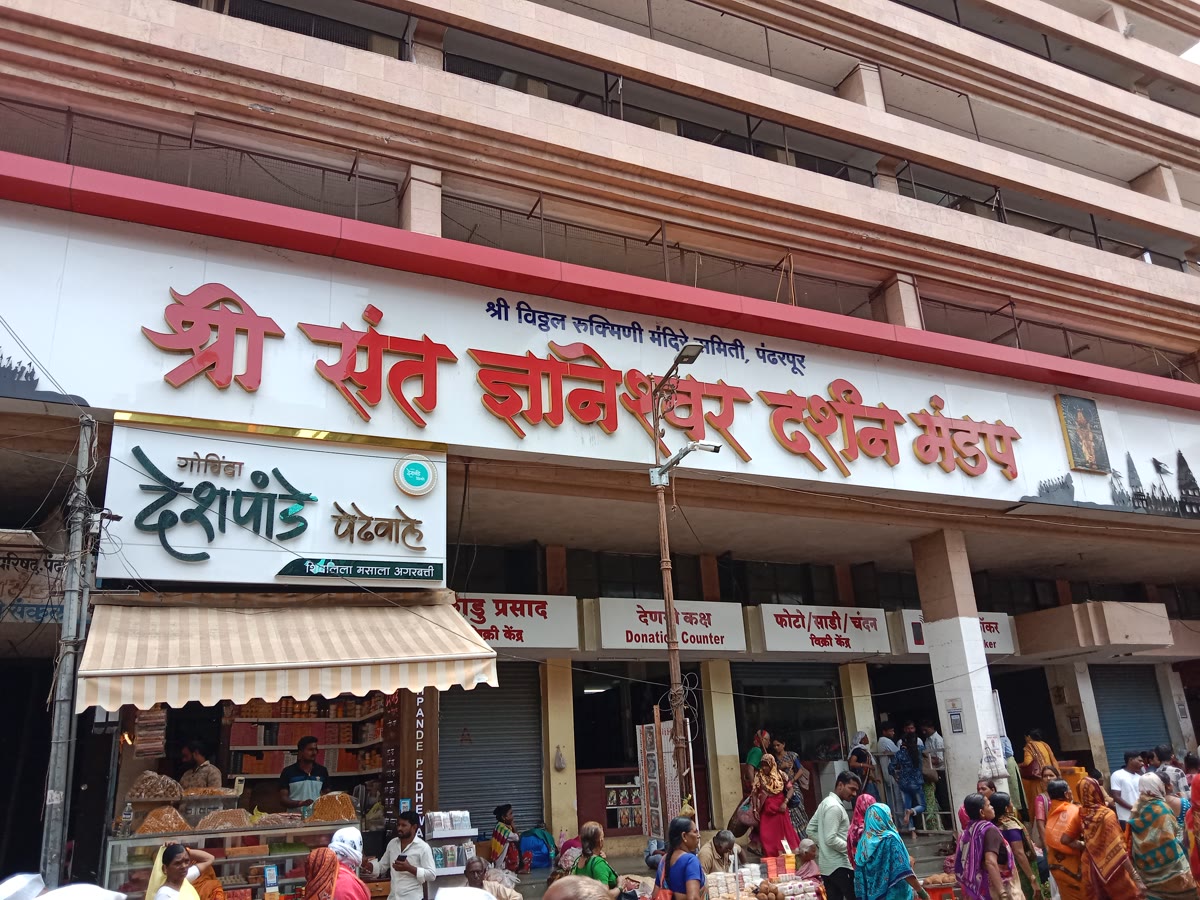
Pandharpur (Marathi: पंढरपूर), a small temple town on the banks of the crescent-shaped Chandrabhāgā river in the Solapur district of Maharashtra, is home to one of the most profoundly revered pilgrimage centres in all of Hinduism. At its heart stands the Vitthal-Rukmini Mandir, the sacred abode of Lord Vitthal — also known as Viṭhobā, Viṭhṭhala, and Pāṇḍuraṅga — a form of Lord Viṣṇu or Kṛṣṇa who, according to legend, has stood upon a brick (viṭ) here for millennia, arms placed on His waist, patiently waiting for His devotee Puṇḍalīk to finish serving his parents.
For over eight hundred years, this temple has been the spiritual nucleus of the Warkari (Vārkari) movement, one of India’s most remarkable Bhakti traditions, which wove together theological depth, poetic genius, and radical social reform into a living tapestry of devotion that continues to pulse with life today.
The Legend of Puṇḍalīk: A Deity Who Waits
The founding myth of Pandharpur is the story of Puṇḍalīk, a Brahmin youth whose transformation from a neglectful son to an exemplar of filial piety drew the Lord Himself from Dvārakā. In the most widely told version of the legend, the young Puṇḍalīk initially mistreated his aging parents while showering attention on his wife. One night, while travelling to Kāśī with his parents, he chanced upon the hermitage of the sage Kukkuṭsvāmī. There, through a crack in the wall, he witnessed three celestial women — the personified rivers Gaṅgā, Yamunā, and Sarasvatī — sweeping the sage’s floor and washing his clothes. When Puṇḍalīk asked why such exalted beings performed menial tasks, they revealed that the sage’s devotion to his parents had purified even them, while Puṇḍalīk’s neglect of his own parents had defiled the very waters of their rivers.
Shattered by this revelation, Puṇḍalīk returned home and devoted himself entirely to the care of his elderly parents. His transformation was so complete, his devotion so selfless, that Lord Kṛṣṇa Himself — accompanied by His consort Rukmiṇī — left Dvārakā to visit this extraordinary devotee at Pandharpur. But when the Lord arrived, Puṇḍalīk was massaging his father’s feet and could not rise to greet Him. Without interrupting his service, he tossed a brick (viṭ) toward the Lord and asked Him to stand upon it and wait. The Lord, far from taking offence, was so moved by this supreme expression of dharma that He stood upon the brick, placed His hands on His waist, and resolved to remain in that posture for eternity.
This is why the mūrti of Vitthal at Pandharpur is uniquely depicted as a youthful, dark-complexioned figure standing with arms akimbo upon a raised platform resembling a brick — an iconography found nowhere else in Hindu temple tradition. The name Viṭhobā itself derives from viṭ (brick) and bā (father/lord), literally “the Lord who stands on the brick.”
Temple Architecture and Sacred Geography
The Vitthal-Rukmini Temple stands on a small hillock at the centre of Pandharpur, enclosed by massive stone walls that form a rectangular compound. The temple complex is oriented eastward, and its primary entrance — the grand Mahādvāra (Great Gate) — faces the Chandrabhāgā river and the ghāṭs. In total, the temple possesses ten entrances, each associated with different communities and historical patrons.
The architectural style belongs to the medieval Hemāḍpanthī tradition — a distinctive Deccan construction technique using locally quarried black stone without mortar, attributed to the 13th-century minister Hemādri (Hemāḍpaṇṭ) of the Yādava court. The temple was most likely constructed during the reign of the Yādava dynasty in the 12th–13th centuries, though the site’s sanctity predates the current structure by centuries; the earliest documented reference to Pandharpur appears in a 516 CE Rāṣṭrakūṭa inscription.
Within the main compound lies a large paved quadrangle containing dīpmālās (lamp towers), a vṛndāvan (sacred tulasī platform), and a venerable neem tree. The sanctum sanctorum houses the standing black stone image of Vitthal, approximately two feet tall, adorned with gold ornaments and fresh tulasī garlands. Adjacent to the main shrine is the Rukmiṇī Temple, dedicated to the Lord’s consort, known locally as Rakhūmāī. The Puṇḍalīk Temple, marking the spot where the devoted son is believed to have served his parents, stands on the banks of the Chandrabhāgā below the main temple.
The Chandrabhāgā River
The Bhīmā River curves through Pandharpur in a crescent arc, earning the local name Chandrabhāgā (“moon-shaped” — candra meaning moon and bhāgā meaning curve). Pilgrims regard the Chandrabhāgā as equal in sanctity to the Gaṅgā herself. Fifteen ghāṭs line the riverbank, facilitating the ritual bathing that is an essential part of the Pandharpur pilgrimage. The oldest structures — the Kumbhār Ghāṭ and the Mahādvāra Ghāṭ — date to approximately 1770. Every pilgrim’s journey to Vitthal begins with a bath in the Chandrabhāgā and a visit to the Puṇḍalīk shrine before ascending to the main temple for darśana.
The Warkari Movement: Saints, Songs, and Social Revolution
The Warkari (Vārkari) tradition — literally “those who perform the vārī” (pilgrimage) — is a Maharashtrian Vaiṣṇava Bhakti movement that has shaped the spiritual, literary, and social landscape of western India for over seven centuries. Unlike many Hindu devotional streams that remained confined to temples and texts, the Warkari movement was born in the fields, nurtured in the homes of ordinary people, and expressed through a literary form of extraordinary power: the abhanga (अभंग), a devotional poem-song in Marathi whose very name means “unbreakable.”
Sant Dnyaneshwar (Jñāndev, 1275–1296)
The fountainhead of the Warkari tradition is Sant Dnyaneshwar (Jñāneśvara), a prodigy who, at the age of sixteen, composed the Jñāneśvarī — a verse-by-verse Marathi commentary on the Bhagavad Gītā that remains one of the supreme masterpieces of Indian literature. Born into a Brahmin family that was excommunicated because his father Viṭṭhalpant had returned from sannyāsa to married life, Dnyaneshwar and his siblings — Nivṛttināth, Sopāndev, and Muktābāī — faced brutal social ostracism. Yet it was precisely this suffering that fuelled Dnyaneshwar’s revolutionary insistence that spiritual knowledge belongs to all, not merely to those born into privilege.
In the Jñāneśvarī (Chapter 9, verses 22–23), he writes that the Lord accepts the offering of even a leaf, a flower, or water when given with love — and that caste, gender, and social status are irrelevant before the divine. His other great work, the Amṛtānubhava (“Nectar of Experience”), explores non-dual philosophy with a lyrical intensity that scholars have compared to the poetry of Rūmī and Meister Eckhart. Dnyaneshwar is believed to have taken living samādhi at Ālandi near Pune in 1296, at the age of just twenty-one.
Sant Nāmdev (1270–1350)
Nāmdev, a tailor by caste, was Dnyaneshwar’s contemporary and close companion. His abhaṅgas are remarkable for their directness and emotional immediacy — he addresses Vitthal not as a distant cosmic principle but as a personal friend, a mother, a beloved. Nāmdev’s influence transcended regional boundaries; he is one of the very few non-Sikh saints whose compositions are included in the Gurū Granth Sāhib, the sacred scripture of Sikhism. His verses, infused with devotion and social commentary, resonated with both Hindus and Muslims, making him a bridge between communities.
Sant Eknāth (1533–1599)
Eknāth, a householder Brahmin from Paiṭhaṇ, is remembered as the great editor and preserver of the Warkari literary heritage — he produced a critical edition of the Jñāneśvarī that rescued Dnyaneshwar’s text from centuries of scribal corruption. But Eknāth was far more than a scholar. He was a fearless social reformer who publicly dined with untouchables, composed devotional songs in the voices of women and outcasts, and wrote the Eknāthī Bhāgavata, a Marathi rendering of the Eleventh Book of the Bhāgavata Purāṇa that made Vaiṣṇava philosophy accessible to the common people.
Sant Tukārām (1608–1649)
Tukārām, a Śūdra grocer from Dehu near Pune, is the most beloved of all Warkari saints. His approximately 4,500 abhaṅgas — composed in a Marathi so colloquial, so vivid, so emotionally raw that they feel as though they were written yesterday — constitute one of the greatest bodies of devotional poetry in any language. Tukārām used his songs to expose the hypocrisy of caste-proud Brahmins, the corruption of religious authorities, and the spiritual emptiness of mere ritual. His famous abhanga beginning “Viṭhṭhalā, You are my mother and father” (Viṭhṭhalā, tū māzā mātā-pitā) captures the essence of the Warkari relationship with the divine: intimate, familial, unmediated.
Tukārām is credited with institutionalising the Pālkhī tradition — the practice of carrying the saints’ pādukā (sandals) in decorated palanquins from their samādhi shrines to Pandharpur — which remains the defining ritual of the Warkari movement today.
Other Luminaries
The Warkari galaxy includes many other remarkable figures: Chokhāmelā, a Mahār (untouchable) saint whose abhaṅgas are searing indictments of caste oppression; Janābāī, a maidservant-poet who sang of Vitthal while grinding grain; Bahiṇābāī (1628–1700), who composed profound philosophical verses despite facing domestic violence; and Kānhopātrā, a courtesan who renounced her life for Vitthal. Together, these saints created a tradition in which spiritual authority derived not from birth, gender, or social standing, but from the intensity of one’s devotion.
The Pandharpur Wari: India’s Greatest Walking Pilgrimage
The Wārī (Marathi: वारी) — the mass pilgrimage to Pandharpur — is one of the most extraordinary religious phenomena in the world. Occurring four times a year on the Ekādaśī (eleventh day) of each major season, the two principal Wārīs are the Āṣāḍhī Wārī (June–July, during the monsoon) and the Kārtikī Wārī (October–November, after the harvest). The Āṣāḍhī Wārī is by far the largest, drawing anywhere from 700,000 to over a million pilgrims who walk together for approximately 21 days, covering roughly 250 kilometres on foot.
The Pālkhī Processions
The Wārī is organised around the Pālkhī (palanquin) processions, each carrying the pādukā (sacred sandals) of a Warkari saint from their samādhi shrine to Pandharpur. The two most prominent Pālkhīs are those of Sant Dnyaneshwar (departing from Ālandi near Pune) and Sant Tukārām (departing from Dehu near Pune). Additional Pālkhīs carry the sandals of Nāmdev, Eknāth, Sopāndev, Nivṛttināth, Muktābāī, and other saints. The modern Pālkhī system was formalised in the 1820s by Haibatrao Bābā Arphālkar, who introduced fixed timetables, designated rest stops, and the ceremonial accoutrements that characterise the processions today.
Each Pālkhī is a moving city of devotion. The palanquin, richly decorated with flowers and silk, is carried at the head of the procession, preceded by a horse (the saint’s symbolic mount) and accompanied by musicians, flag-bearers, and dindī groups — small congregations of pilgrims who sing abhaṅgas in unison as they walk. The atmosphere blends solemnity with celebration; the Marathi term soholā (festival) captures the joyous character of what is, at its core, a deeply spiritual journey.
Life on the Road
The Wārī is a radical experiment in egalitarian community. During the three-week walk, all distinctions of caste, class, and social hierarchy are suspended. Pilgrims — predominantly farming families — sleep under the open sky or in temporary shelters, share communal meals prepared by volunteer cooks, and spend their days singing abhaṅgas, performing kīrtana (devotional narration with song), and reciting the names of Vitthal. The Riṅgaṇ ceremony, in which the Pālkhī horse gallops through the crowd while pilgrims prostrate themselves in its path, is one of the most electrifying moments of the procession.
The Abhanga: Literature as Devotion
The abhanga (अभंग, literally “that which is not broken”) is the distinctive literary form of the Warkari tradition — a short, metrically flexible Marathi poem set to music and intended for congregational singing during kīrtana and on the road during the Wārī. Composed in the vernacular rather than Sanskrit, abhangas democratised spiritual expression and placed the most profound theological insights into the mouths of farmers, tailors, potters, and maidservants.
The genius of the abhanga lies in its capacity to compress vast philosophical meaning into a handful of vivid, conversational lines. Tukārām’s famous verse — “When I am dead, let the name of Viṭhṭhala be my shroud” — captures in a single image the Warkari ideal of a life so saturated with devotion that even death becomes an act of worship. The collective corpus of Warkari abhangas — numbering in the tens of thousands — constitutes one of the richest bodies of devotional literature in any language or tradition.
Social Reform and Caste Equality
Perhaps the most revolutionary dimension of the Warkari movement was its sustained challenge to the caste system. At a time when the rigid hierarchy of varṇa and jāti was considered divinely ordained and immutable, the Warkari saints declared — in verse after verse, in practice after practice — that devotion to Vitthal was the only qualification for spiritual merit.
Dnyaneshwar, himself an outcast Brahmin, insisted that spiritual knowledge was the birthright of all. Nāmdev, a tailor, sang alongside Brahmins as an equal. Eknāth publicly ate with Dalits, scandalising the orthodox establishment. Tukārām, a Śūdra, was persecuted by Brahmin authorities who could not accept that a man of low birth could produce scripture-worthy poetry. Chokhāmelā, an Untouchable, composed abhaṅgas that remain among the most powerful anti-caste literature ever written in any Indian language.
The Wārī pilgrimage itself was — and remains — a living enactment of this egalitarian vision. On the road to Pandharpur, the cobbler walks beside the Brahmin, the woman beside the man, the rich beside the poor. All eat together, all sleep together, all sing together. It is a temporary but recurring dissolution of social hierarchy that has served, for centuries, as a quiet but persistent challenge to the structures of inequality.
Festivals and Worship at Pandharpur
The temple observes a full calendar of festivals, but the four Ekādaśī celebrations hold supreme importance:
- Āṣāḍhī Ekādaśī (June–July): The culmination of the great monsoon Wārī, when the largest number of pilgrims arrives. This is also called Devśayanī Ekādaśī, marking the beginning of Lord Viṣṇu’s cosmic sleep.
- Kārtikī Ekādaśī (October–November): The second-largest pilgrimage, coinciding with the post-harvest season and Viṣṇu’s awakening (Prabodhinī Ekādaśī).
- Māghī Ekādaśī (January–February) and Chaitra Ekādaśī (March–April): Smaller but deeply significant gatherings.
Daily worship at the temple follows an elaborate schedule beginning with the pre-dawn Kākaḍ Āratī (lamp ceremony) and concluding with the night Śejāratī (bedtime ceremony for the deity). The most coveted moment of darśana is the early morning abhiṣeka (ritual bathing of the mūrti), when the black stone image of Vitthal is revealed in its unadorned majesty before being dressed and decorated for the day.
Pandharpur in the Modern Era
The Vitthal-Rukmini Temple continues to occupy a central place in Maharashtra’s spiritual and cultural life. The Shri Vitthal Rukmini Mandir Samiti, a trust established by the Government of Maharashtra, administers the temple and manages the massive logistical challenge of the annual Wārī. In recent decades, the Wārī has drawn international scholarly attention as one of the world’s largest and oldest continuous pilgrimage traditions — a living demonstration that the medieval Bhakti movement is not a relic of the past but a vibrant, evolving tradition that continues to shape the lives of millions.
For the Warkari, Pandharpur is not merely a place on the map. It is Bhūvaikuṇṭha — “Vaikuṇṭha on earth” — the point where heaven touches the ground, where the Lord Himself chose to stand and wait, and where every pilgrim, regardless of birth or station, can look into the eyes of Vitthal and know themselves to be seen, known, and loved.