Introduction: The Forest Where God Was a Child
Vṛndāvana — literally “the forest (vana) of tulasī (vṛndā)” — is a small town in the Mathurā district of Uttar Pradesh that occupies an extraordinary position in Hindu devotion. For the hundreds of millions who worship Lord Kṛṣṇa, Vṛndāvana is not simply a geographical location but the eternal playground of God himself, the place where the Supreme Being chose to appear as a mischievous cowherd boy, steal butter, play his flute by the Yamunā, and dance in moonlit groves with the gopīs (cowherd maidens) in an expression of unconditional divine love.
The Bhāgavata Purāṇa (Skandha X), the primary scriptural source for Kṛṣṇa’s life, devotes hundreds of verses to the events that took place in and around Vṛndāvana. These narratives — collectively known as the Vṛndāvana Līlā — have inspired some of the most exquisite devotional poetry, painting, music, and theology in Indian civilization. The town lies at the heart of the broader Braj region, a sacred landscape encompassing Mathurā (Kṛṣṇa’s birthplace), Gokula, Govardhana, Barsānā (Rādhā’s village), and the twelve forests (Dvādaśa Vana) through which Kṛṣṇa wandered with his cows and companions.
Mythological and Scriptural Significance
Kṛṣṇa’s Childhood in Vṛndāvana
According to the Bhāgavata Purāṇa (10.1-45), Kṛṣṇa was born in the prison of the tyrant Kaṃsa in Mathurā but was immediately carried across the flooding Yamunā by his father Vasudeva to the cowherd settlement of Gokula, and later grew up in the pastoral landscape of Vṛndāvana. Here, in the company of his elder brother Balarāma and their cowherd friends, the young Kṛṣṇa performed extraordinary feats: he slew the demoness Pūtanā who came disguised as a wet-nurse (Bhāgavata Purāṇa 10.6), subdued the serpent Kāliya who had poisoned the Yamunā (10.16), and swallowed a forest fire to protect the cowherds (10.19).
But it is the gentler pastimes — the butter-stealing (mākhana-corī), the flute-playing that drew all creatures of the forest to him, the games of hide-and-seek in the groves — that have most deeply captured the Hindu devotional imagination. These līlās are understood not as mere mythology but as eternal divine events continually unfolding in the spiritual Vṛndāvana, of which the earthly town is a reflection.
The Rāsa Līlā: The Divine Dance of Love
The most celebrated episode of Kṛṣṇa’s Vṛndāvana pastimes is the Rāsa Līlā, described in Chapters 29-33 of Skandha X of the Bhāgavata Purāṇa. On an autumn full-moon night, Kṛṣṇa played his flute, and its irresistible melody drew the gopīs of Vṛndāvana away from their homes and families to the banks of the Yamunā. There, in the moonlit forest, Kṛṣṇa multiplied himself so that each gopī believed she was dancing with him alone, creating a circle of divine partners in the cosmic dance.
The Rāsa Līlā is interpreted by Vaiṣṇava theologians — particularly those of the Gauḍīya and Puṣṭimārga traditions — not as a romantic episode but as the supreme expression of prema (selfless divine love). The gopīs represent the individual soul (jīva) drawn irresistibly toward God, abandoning all worldly attachment. Śrī Caitanya Mahāprabhu (1486-1534 CE) taught that the Rāsa Līlā reveals the highest rasa (aesthetic-spiritual flavour) of the divine-human relationship: mādhurya-rasa, the sweetness of conjugal love between the soul and God.
Govardhana Līlā: The Mountain of Grace
The lifting of Govardhana Hill is one of Kṛṣṇa’s most iconic acts. When the young Kṛṣṇa persuaded the residents of Vṛndāvana to worship Govardhana Hill instead of performing the traditional Indra Yajña, the enraged Indra unleashed a devastating storm of rain and hail upon Braj. Kṛṣṇa then lifted the entire Govardhana Hill on the little finger of his left hand, holding it aloft as an umbrella for seven days and seven nights while the cowherds and their cattle sheltered beneath (Bhāgavata Purāṇa 10.25).
Govardhana Hill (Girirāja), located about 22 kilometres from Vṛndāvana, is worshipped as a form of Kṛṣṇa himself. The Govardhana Parikramā — a 21-kilometre circumambulation of the hill — is one of the most popular pilgrimages in the Braj region, performed by millions annually, often barefoot and accompanied by continuous chanting of Kṛṣṇa’s names.
Rādhā Kuṇḍa and Śyāma Kuṇḍa
At the foot of Govardhana Hill lie two sacred ponds: Rādhā Kuṇḍa and Śyāma Kuṇḍa, considered the holiest bathing places in all of Braj. According to tradition, these twin ponds appeared miraculously during a divine exchange between Rādhā and Kṛṣṇa. The Padma Purāṇa declares that of all the holy places in the universe, Rādhā Kuṇḍa is the most dear to Lord Kṛṣṇa, for it embodies the love of Śrīmatī Rādhārāṇī. Caitanya Mahāprabhu, upon discovering the location of these lost ponds during his Braj pilgrimage in 1514 CE, bathed in Rādhā Kuṇḍa with great ecstasy and declared it the supreme tīrtha.
Sacred Geography: The Twelve Forests of Braj
Vṛndāvana is the heart of the Braj Maṇḍala, a sacred landscape comprising twelve principal forests (Dvādaśa Vana) on the western bank of the Yamunā and twelve secondary groves (Upa-Vana) on the eastern bank. Each forest is associated with specific pastimes of Kṛṣṇa. The Braj Parikramā — the circumambulation of the entire Braj region covering approximately 300 kilometres — passes through all these forests and is documented extensively in David L. Haberman’s ethnographic study Journey through the Twelve Forests (1994).
The twelve principal forests are: Madhuvana, Tālavana, Kumudavana, Bahulāvana, Kāmyavana, Khadīravana, Vṛndāvana, Bhadravana, Bhaṇḍīravana, Belavana, Lohavana, and Mahāvana. Each has its own presiding deity, associated season, and devotional significance.
Major Temples and Sacred Sites
Banke Bihārī Temple
The Banke Bihārī Temple, established in 1864 by Svāmī Haridāsa (a renowned saint-musician of the 16th century), houses one of the most beloved images of Kṛṣṇa in all of India. The deity, depicted in the tribhaṅga (triple-bend) posture, is believed to have manifested from the Nidhuvana grove during Haridāsa’s deep meditation. A distinctive feature of the temple is that the curtain (jhāṅkī) before the deity is opened and closed repeatedly during darśana, as it is believed that the deity’s gaze is so powerful that prolonged eye contact would draw the devotee’s soul out of the body.
ISKCON Kṛṣṇa-Balarāma Mandir
The ISKCON temple, inaugurated in 1975 by A.C. Bhaktivedānta Svāmī Prabhupāda, the founder of the International Society for Krishna Consciousness, is one of Vṛndāvana’s most visited modern temples. The complex includes the samādhi (memorial shrine) of Prabhupāda and serves as a major centre for international Vaiṣṇava pilgrimage and study.
Prem Mandir
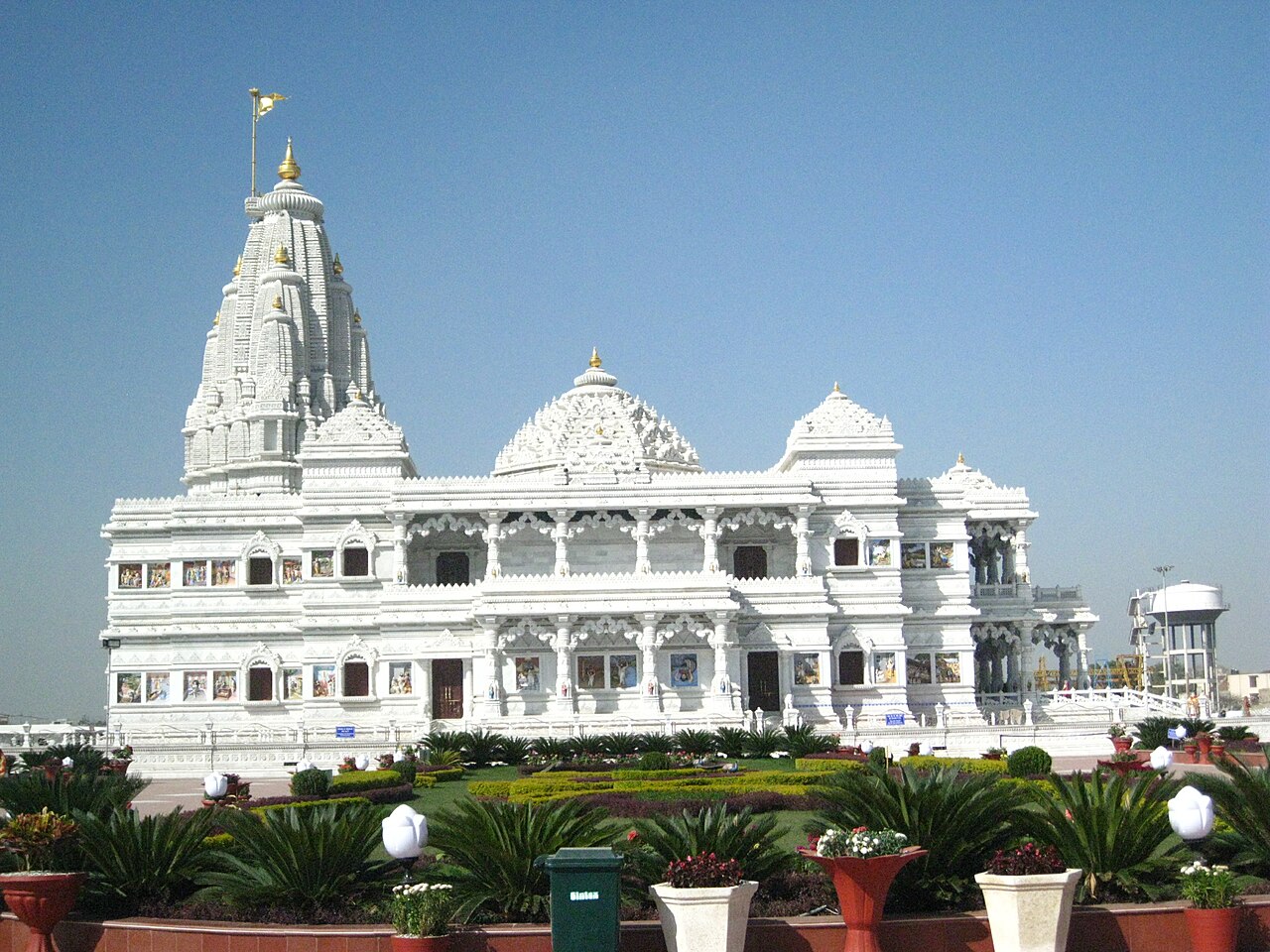
The Prem Mandir (“Temple of Love”), inaugurated in 2012, is an architecturally magnificent white marble temple built by Jagadguru Kripalu Parishat. Its walls are carved with scenes from Kṛṣṇa’s pastimes, and the temple is spectacularly illuminated at night. The structure draws on the traditions of Braj temple architecture while incorporating elements of classical Nāgara style.
Nidhuvana
Nidhuvana (“the forest of treasure”) is a dense grove of tulasī bushes where, according to local tradition, Kṛṣṇa and Rādhā still perform the Rāsa Līlā every night. The grove is locked at sunset; no human is permitted to remain inside after dark. Legend holds that anyone who witnesses the divine dance is struck blind, mad, or dead. The twisted, interlocked trunks of the tulasī bushes are said to be the gopīs, frozen in their dancing posture at dawn.
Theological Significance in Vaiṣṇava Traditions
The Concept of Dhāma: The Eternal Abode
In Gauḍīya Vaiṣṇava theology, Vṛndāvana on earth is understood as a direct manifestation of the eternal spiritual realm (Goloka Vṛndāvana), the highest planet in the Vaiṣṇava cosmological system. Rūpa Gosvāmī (1489-1564 CE), one of the Six Gosvāmīs of Vṛndāvana who were direct disciples of Caitanya Mahāprabhu, taught that the earthly Vṛndāvana and the transcendental Vṛndāvana are non-different: “For one whose eyes are anointed with the salve of love, Vṛndāvana is directly visible as the supreme abode” (Laghu-bhāgavatāmṛta 1.5.461).
The Six Gosvāmīs — Rūpa, Sanātana, Raghunātha Bhaṭṭa, Raghunātha Dāsa, Gopāla Bhaṭṭa, and Jīva — relocated to Vṛndāvana in the 16th century at Caitanya’s instruction and rediscovered the lost sacred sites, wrote foundational theological treatises, and established temples that define the town’s religious landscape to this day.
Puṣṭimārga and Vallabhācārya
The Puṣṭimārga tradition founded by Vallabhācārya (1479-1531 CE) also holds Vṛndāvana in supreme reverence. Vallabhācārya performed his famous Bhāgavata discourses at the Govinda Ghāṭ in Vṛndāvana, and his son Viṭṭhalanātha established the iconic Śrī Nāthajī temple at Govardhan (later moved to Nāthdwārā in Rajasthan during the Mughal period).
The Yamunā: Kṛṣṇa’s River
The Yamunā river, flowing through Vṛndāvana, is worshipped as a goddess and an intimate companion of Kṛṣṇa. The Bhāgavata Purāṇa describes the Yamunā’s banks as the setting for Kṛṣṇa’s most tender pastimes — the flute-playing at Vaṃśīvaṭa (the banyan tree of the flute), the water-sports with the gopīs, and the subduing of the serpent Kāliya. The Keśī Ghāṭ, where Kṛṣṇa slew the horse-demon Keśī, is one of the holiest bathing spots along the river.
Festivals and Living Traditions
Vṛndāvana celebrates the Kṛṣṇa calendar with extraordinary fervour. The major festivals include:
- Janmāṣṭamī (Kṛṣṇa’s birth anniversary): The entire town erupts in celebration at midnight, with elaborate temple ceremonies and theatrical re-enactments of the birth.
- Holī (the Festival of Colours): Braj Holī is famous across India. The celebrations extend over weeks, with the Lathmar Holī of Barsānā (where women playfully strike men with sticks, recalling Rādhā’s village) being the most distinctive.
- Rādhāṣṭamī (Rādhā’s birth anniversary): Celebrated with as much fervour as Janmāṣṭamī, reflecting the centrality of Rādhā in Vṛndāvana’s devotional culture.
- Govardhana Pūjā (the day after Dīvālī): Commemorates Kṛṣṇa’s lifting of Govardhana Hill. Mountains of food (annakūṭa) are offered to the deity.
- Rāsa Līlā performances: Traditional Rāsa Līlā theatrical performances, featuring young boys portraying Kṛṣṇa and the gopīs, are staged throughout the year and are a living art form unique to Braj.
Conclusion: The Land Where Love Is Supreme
Vṛndāvana remains, after five millennia, the beating heart of Kṛṣṇa devotion. Whether one approaches it as a pilgrim seeking the dust of the land where God walked, as a theologian contemplating the mysteries of divine love, or simply as a traveller drawn by the town’s extraordinary atmosphere of devotion, Vṛndāvana offers an encounter with a dimension of Hinduism where the Absolute is not fearsome or remote but tender, playful, and infinitely accessible. As the Bhāgavata Purāṇa declares: “Vṛndāvana is the supreme abode, higher even than Vaikuṇṭha, for here the Lord appears not as the majestic sovereign of the cosmos but as the beloved friend, the mischievous child, the irresistible lover — drawn by the pure love of his devotees” (Bhāgavata Purāṇa 10.9.21, commentary tradition).